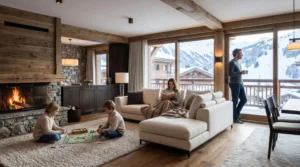
Browse through Courchevel 1850 rental listings for ten minutes, and virtually every property claims to offer “exceptional luxury,” “unparalleled comfort,” or “premium standing.” The sheer abundance of identical superlatives creates a curious paradox: when everything positions itself as luxury, how do you distinguish genuine quality from marketing gloss? For families planning a substantial investment — typically between £15,000 and £25,000 for a week’s ski holiday — this opacity transforms what should be an exciting booking process into an exercise in scepticism.
The reality is that authentic luxury in Courchevel 1850 emerges not from labels but from precise alignment between apartment configuration, location, included services and your group’s actual needs. A meticulously chosen two-bedroom apartment in a ski-in/ski-out position may deliver a vastly superior experience to a sprawling four-bedroom penthouse requiring daily shuttle logistics — despite the latter commanding twice the price. The challenge lies in establishing objective evaluation criteria that cut through promotional rhetoric and reveal what genuinely matters for your specific circumstances.
This analysis provides a structured framework for comparing luxury rental options across Courchevel 1850’s diverse offering, which currently encompasses approximately 107 properties ranging from compact one-bedroom flats to expansive multi-bedroom penthouses accommodating 4 to 16 guests. Rather than accepting marketing claims at face value, you’ll gain verifiable criteria for assessing spatial configuration, location trade-offs, amenity value and service transparency — transforming an overwhelming market into a clear set of choices.
In this article
- What defines a luxury apartment in Courchevel 1850?
- How to choose between one-bedroom flats and family penthouses
- Location matters: ski-in/ski-out vs village centre properties
- Premium amenities that justify the investment
- What to expect from concierge services in high-end rentals
- Creating a meaningful luxury experience in Courchevel 1850
- Applying the evaluation framework to your apartment search
What defines a luxury apartment in Courchevel 1850?
Courchevel 1850 occupies a distinctive position within the Three Valleys ski area — the world’s largest interconnected ski domain. While the broader Courchevel resort welcomes approximately 1.6 million skier days annually across its various altitude stations, the 1850 sector concentrates the most premium accommodation offerings, where properties consistently command significant price differentials compared to neighbouring altitudes.
Yet “luxury” remains a classification exercised with considerable liberality across rental platforms. Establishing what separates genuinely premium apartments from standard properties wrapped in aspirational language requires examining objective, verifiable standards rather than promotional assertions. In France, tourist accommodation follows an official classification system administered by Atout France, the national tourism development agency, which categorises furnished rentals from one to five stars based on quantifiable criteria including surface area per person, equipment standards and service provision.
The current Courchevel 1850 luxury rental market spans a remarkable price spectrum, with weekly rates ranging from approximately €2,400 to €150,000 depending on property size, location and standing. This tenfold variation underscores a fundamental reality: the luxury segment itself contains distinct tiers, from entry-level premium properties to exceptional statement residences. Understanding where a specific apartment sits within this continuum proves essential for calibrating whether its tariff reflects genuine differentiation or opportunistic positioning.
Several baseline standards characterise authentic luxury offerings in this market. Surface allocation provides an immediate indicator — premium apartments typically provide between 30 and 40 square metres per guest, ensuring genuine spatial comfort rather than maximum capacity packing. Architectural finishes extend beyond cosmetic decoration to encompass natural materials: aged oak or larch timber, natural stone applications, quality fabrics with visible weave texture. Technology integration includes robust WiFi infrastructure capable of supporting simultaneous professional videoconferencing and streaming entertainment, and often encompasses integrated audio systems and automated lighting or climate control.
Wellness facilities represent another differentiating dimension. While standard apartments may offer access to a shared residence spa, luxury properties increasingly incorporate private wellness spaces — typically a sauna, hammam or jacuzzi accessible exclusively to apartment occupants. This distinction transforms après-ski recovery from a scheduled, semi-public activity into an intimate, available-on-demand experience that families with young children or professionals seeking genuine privacy particularly value.
Five-point evaluation framework for verifying luxury claims: When assessing any property, examine (1) specified surface area per maximum occupancy to calculate personal space allocation; (2) named brands or specific references for key equipment rather than vague “high-end” descriptions; (3) private versus shared wellness facilities; (4) documented location with verifiable proximity to slopes or village amenities; and (5) itemised service inclusions with explicit boundaries between standard provision and chargeable extras. Properties unable to provide this specificity often substitute promotional language for substance.
The distinction between luxury tiers matters particularly when comparing similarly priced options. An entry-level luxury apartment might offer quality finishes and excellent location whilst maintaining shared building amenities, whilst a confirmed luxury property adds private spa facilities and superior spatial generosity, and exceptional ultra-luxury residences layer on architectural distinction, bespoke concierge capabilities and exclusive positioning. None of these categories inherently delivers superior value — the question centres on which configuration aligns with your priorities and whether the price differential justifies the additional features for your specific usage pattern.
How to choose between one-bedroom flats and family penthouses
Property listings describe capacity through maximum occupancy figures — “sleeps 8” or “accommodates 12” — but this numerical ceiling rarely reflects the configuration that optimises comfort, particularly for stays extending beyond a weekend. The gap between fitting a group into available beds and providing each member with adequate personal space and privacy generates one of the most common sources of rental dissatisfaction. Selecting the right apartment size requires understanding your group’s composition and dynamics, not simply counting heads and matching the number to a capacity figure.
Consider three archetypal scenarios that illustrate how different groups navigate this decision landscape.
Compact luxury for couples and small groups
One-bedroom luxury apartments in Courchevel 1850 typically accommodate two to four people, with the higher capacity assuming either young children sharing the bedroom with parents or use of a sofa bed in the living area. This configuration suits couples seeking a romantic alpine escape, close friends comfortable sharing intimate space, or families with one young child for whom a separate bedroom provides limited additional value.
The economic logic proves compelling for smaller groups. A meticulously specified one-bedroom apartment with excellent location and premium amenities often delivers superior overall experience compared to a larger but less well-positioned or equipped property at similar total cost. The spatial limitation becomes less relevant when occupants spend substantial daytime hours skiing and exploring the resort, returning to the apartment primarily for sleeping and morning preparation.
The family sweet spot: two to three bedrooms
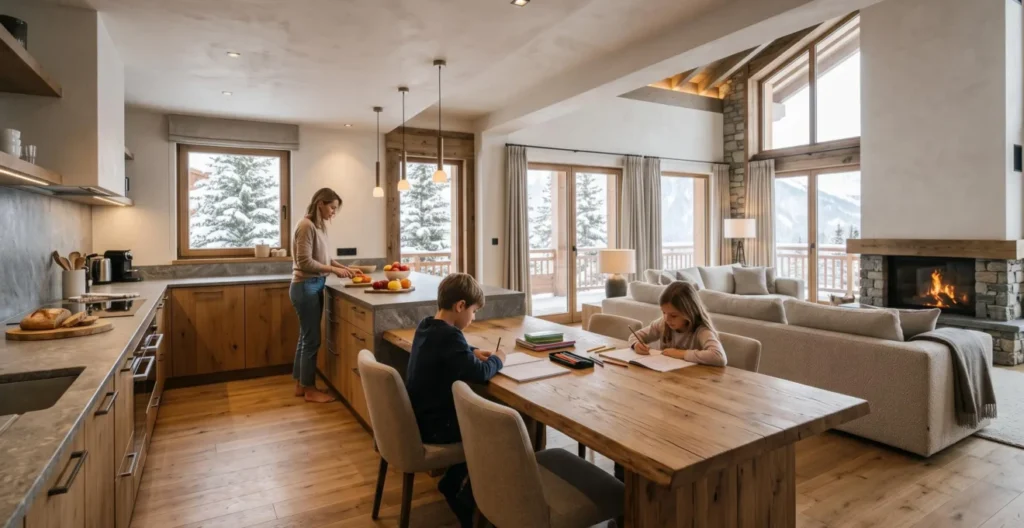
Families of four to six people encounter the most complex calibration decision. A family with two children aged around 12 and 15 — similar to many readers’ circumstances — faces a genuine choice between a spacious two-bedroom configuration where siblings share, or a three-bedroom arrangement providing each child with independent space.
The two-bedroom option concentrates budget on other value drivers: superior location, private wellness facilities, or extended stay duration. Children sharing a room strengthens sibling bonds during the holiday and concentrates the family’s waking hours in generous communal living spaces designed for togetherness. This configuration works particularly well when both children fall within similar age brackets and parents prioritise maximising time on the slopes over expansive apartment footprint.
Conversely, the three-bedroom layout addresses the reality that adolescents increasingly value privacy and personal space for decompression, particularly after intensive physical activity and group ski lessons. The additional bedroom transforms from luxury to practical necessity when children’s age gap creates divergent bedtimes, activity preferences or simply reduced tolerance for constant proximity. Parents also gain more flexible use of communal spaces — one adult might prepare dinner whilst the other helps a child with homework, without the spatial constraints that force all activities into the same visual and acoustic field.
The budget impact typically represents a 25 to 40 per cent increment when moving from two to three bedrooms at comparable quality and location, though this varies considerably based on specific properties and booking timing. This differential merits careful evaluation against the enhanced comfort it delivers across a week-long stay — effectively the cost per day of reduced household friction and improved personal space.
Statement penthouses for extended groups
Four-bedroom and larger penthouses accommodating eight to sixteen guests serve fundamentally different purposes beyond simple scaled-up family holidays. These properties address multi-generational gatherings — three couples with their children, for instance — or groups of friends seeking a shared alpine experience whilst maintaining individual couple or family privacy.
The configuration value extends beyond bedroom count to encompass multiple communal zones that allow the group to fragment and recombine organically. A well-designed penthouse might offer a principal living area with fireplace and mountain views, a separate media room for children’s entertainment, a formal dining space accommodating the full group, and perhaps a games room or library providing quieter retreat options. This spatial diversity prevents the forced togetherness that often generates tension in extended group holidays.
For professionals who entertain clients or business contacts, a statement penthouse also functions as a hospitality venue that projects success and provides a memorable backdrop for relationship development — a legitimate business consideration that extends the property’s value beyond pure accommodation function. The question becomes whether this reputational and experiential dimension justifies the substantial tariff, which for exceptional properties can reach five figures per night during peak periods.
| Configuration | Typical capacity | Ideal group profile | Key advantages | Primary limitations |
|---|---|---|---|---|
| 1 bedroom | 2-4 people | Couples, close friends, family with one young child | Budget concentration on location and amenities; intimate atmosphere; simplified logistics | Limited privacy for groups over two; constrained hosting capacity |
| 2-3 bedrooms | 4-6 people | Standard families; small friendship groups; couples with teenagers | Balance of privacy and communal space; optimised cost-per-person; manageable for single-family coordination | Potential bedroom-sharing compromises; limited capacity for hosting additional guests |
| 4+ bedrooms | 8-16 people | Multi-generational families; friendship groups; professional entertainment | Multiple communal zones; individual couple/family privacy; hosting and entertainment capability; shared cost per person | Coordination complexity; significant absolute cost; may exceed needs for smaller actual groups |
The fundamental insight remains that apartment selection should optimise daily lived experience rather than simply accommodate maximum capacity. A family of four might fit into a two-bedroom apartment, but would they thrive there across seven days with two teenage children? Conversely, does a group of eight adults genuinely require a six-bedroom penthouse, or would two adjacent three-bedroom apartments provide better functionality at lower total cost? These questions demand honest assessment of your group’s interaction patterns, privacy requirements and tolerance for shared space.
Location matters: ski-in/ski-out vs village center properties
Location terminology in alpine property marketing can obscure as much as it reveals. “Ski-in/ski-out” — perhaps the most heavily marketed feature in premium rentals — describes properties offering direct piste access from the building, allowing occupants to depart for skiing and return from the slopes without removing equipment or utilising vehicular transport. The designation sounds straightforward, yet its practical implications vary substantially depending on your group composition and holiday priorities.
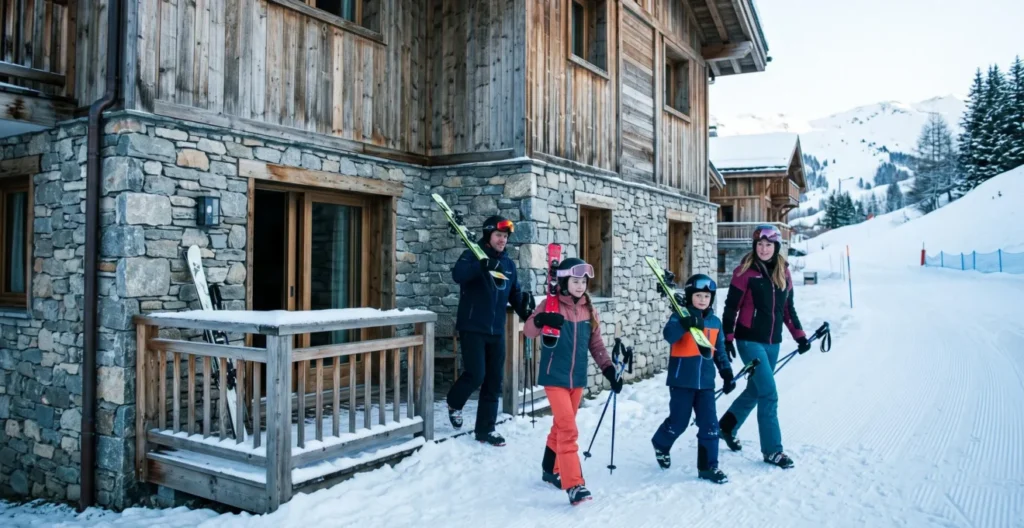
For families with children enrolled in daily ski school sessions, authentic ski-in/ski-out configuration delivers quantifiable time savings. Consider the alternative logistics: gathering children and equipment each morning, transporting to the meeting point, returning to the apartment, then reversing the process for midday collection if children take lunch breaks, and again at end-of-day pickup. This cycle easily consumes 60 to 90 minutes daily in pure transit and waiting time. Piste-side properties collapse this overhead to near-zero — children ski directly from the door to their instructor meeting point metres away.
The time dividend compounds across a week. Seven days of recovered 90-minute blocks equals more than ten hours — effectively two additional full ski days in usable time. For families where both parents ski and must coordinate around children’s schedules, this liberation from logistical choreography substantially elevates the holiday’s quality. The convenience extends to equipment management: ski-in/ski-out buildings typically feature heated ski storage rooms accessible directly from the slopes, eliminating the awkward carries and moisture control challenges that plague properties requiring transport between skiing and accommodation.
This convenience commands a measurable premium. Comparable apartments diverge in weekly rental rates by approximately 20 to 40 per cent based primarily on ski-in/ski-out versus village centre positioning, with the exact differential influenced by the property’s other characteristics and the village centre location’s specific amenities. Whether this represents value depends fundamentally on how you intend to use Courchevel.
Village centre properties offer their own distinctive advantages that ski-in/ski-out locations often cannot match. Proximity to Courchevel 1850’s concentration of restaurants, boutiques and evening entertainment creates a different kind of convenience — the ability to stroll to a Michelin-starred dinner without arranging transport, browse shops during a rest afternoon, or access the resort’s social heart without ski equipment. For groups that view the ski holiday as balanced between mountain sport and alpine lifestyle immersion, village centrality may deliver superior overall value.
Couples without children, or groups of adult friends, often find village centre positioning more aligned with their usage patterns. Their skiing commences later without school drop-off constraints, they may prioritise long lunches at mountain restaurants over returning to the apartment, and their evenings emphasise dining and socialising rather than family routines. The morning shuttle or short walk to lift access represents minimal inconvenience against the evening benefit of simply walking home from dinner rather than arranging pickup or navigating unfamiliar roads.
Evaluating ski-in/ski-out value for your specific circumstances
- If you have children under 14 in daily ski school:
Ski-in/ski-out likely justifies its premium through substantial daily time savings and logistical simplification, particularly if both parents ski independently. - If your group consists primarily of adult skiers:
Village centre may optimise overall convenience, especially if you value dining flexibility and evening social activity without transport dependency. - If you plan intensive skiing maximising slope time:
Direct piste access eliminates friction between accommodation and skiing, supporting earlier starts and spontaneous additional runs. - If you view the stay as balanced ski and cultural experience:
Central location provides easier access to restaurants, shops and resort atmosphere, compensating for modest additional ski commute effort.
Neither location category universally surpasses the other — they optimise for different holiday archetypes. The error lies in accepting ski-in/ski-out as inherently superior and worth any premium, rather than evaluating whether its specific benefits align with your group’s actual priorities and usage patterns. A family paying 35 per cent more for piste-side access they barely utilise has misallocated budget that might have funded superior amenities or extended stay duration. Conversely, a family choosing village centre to save money, then spending 90 minutes daily in logistics frustration, has achieved false economy.
Premium amenities that justify the investment
Luxury property descriptions typically enumerate extensive equipment lists: designer furnishings, state-of-the-art technology, premium appliances, spa facilities, entertainment systems. The challenge lies in distinguishing which amenities genuinely enhance your daily experience from those that constitute marketing decoration — features that sound impressive but deliver minimal practical value for the substantial costs they help justify.
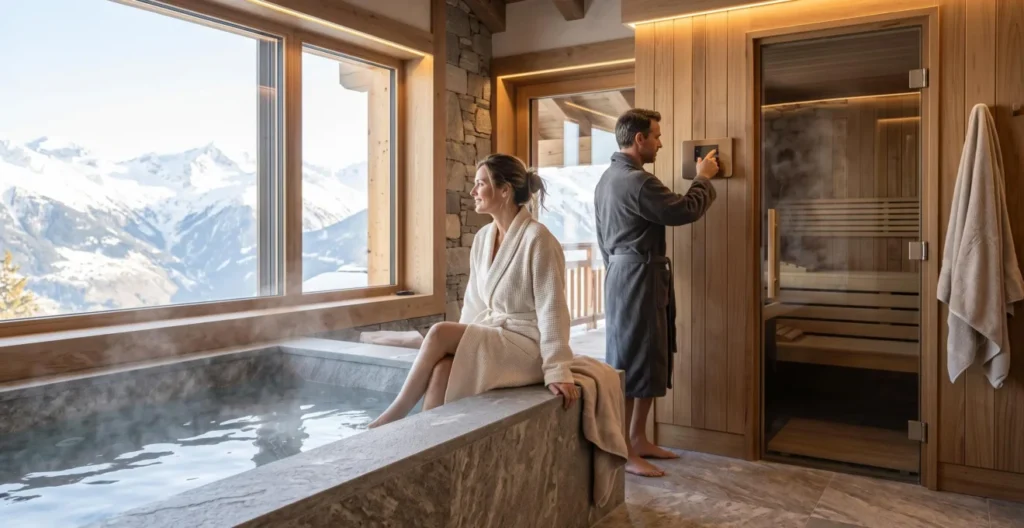
Certain equipment categories demonstrate clear, recurring impact on occupant satisfaction. Private wellness facilities — specifically a sauna, hammam or jacuzzi accessible exclusively to apartment occupants — transform the après-ski experience from aspiration to reliable daily routine. After six hours of alpine skiing, the ability to immediately access therapeutic heat and hydrotherapy without scheduling, without sharing space with strangers, and without leaving your accommodation delivers both physical recovery benefits and psychological restoration that families with children particularly value. Teenagers might use the facility later in the evening; parents might enjoy it before dinner; the availability matches your rhythm rather than imposing external schedules.
By contrast, access to a shared residence spa — whilst pleasant — introduces coordination friction: operating hours, potential crowding during peak times, the semi-public nature that requires appropriate attire and inhibits complete relaxation. The private facility commands a rental premium, typically adding 15 to 25 per cent to comparable apartments without this feature, but the differential translates to perhaps £50 to £80 per day across a week-long stay for a family — arguably reasonable for a amenity used daily.
Kitchen equipment quality represents another high-impact category, particularly for longer stays or groups managing costs by preparing some meals in-apartment. A genuinely well-equipped kitchen — professional-grade appliances, comprehensive cookware, sufficient crockery and glassware for the full occupancy — enables everything from simple breakfast preparation to ambitious dinner parties. This capability provides budget flexibility (one restaurant dinner saved covers substantial grocery expenditure) and dietary control valuable for families with specific requirements. Vague descriptions like “fully equipped kitchen” should prompt specific enquiries: named appliance brands, oven capacity, dishwasher presence, specialised equipment such as raclette grills or fondue sets.
Heated ski storage with boot drying facilities might appear mundane relative to marble bathrooms or designer furniture, yet its daily utility proves substantial. Skiing in dry, warm boots each morning rather than clammy equipment from the previous day meaningfully improves comfort across a week of intensive activity. For families, this amenity multiplies by four or more sets of equipment requiring overnight drying — the difference between manageable routine and persistent dampness affecting hygiene and comfort.
Other equipment deserves scrutiny regarding actual usage probability. A private cinema room sounds compelling, but do families on ski holidays genuinely spend sufficient evening time watching films to justify the premium this feature commands? Perhaps during poor weather days, though Courchevel’s infrastructure of restaurants and alternative activities often absorbs those periods. A wine cellar might appeal to oenophiles planning a special occasion, but adds minimal value for groups primarily drinking beers and spirits or those leveraging the apartment mainly for sleeping and breakfast.
Technology infrastructure — specifically robust, high-speed WiFi throughout the property — merits verification rather than assumption. Many professionals cannot entirely disconnect during holidays; teenagers expect reliable connectivity; families might stream entertainment. Properties advertising luxury standing should support simultaneous videoconferencing, streaming and general browsing without degradation, yet wide variability exists in actual delivery. Requesting specific bandwidth figures or recent guest feedback on connectivity proves more reliable than accepting promotional assurances.
Amenity hierarchy for decision prioritisation: Essential luxury — private wellness facilities (sauna/hammam/jacuzzi), heated ski storage, fully equipped kitchen with quality appliances, reliable high-speed WiFi, parking if arriving by car. High-value additions — fireplace for atmosphere, substantial balcony or terrace with mountain views, second bathroom for families, dishwasher, washing machine for longer stays. Nice enhancements — home cinema, wine cellar, high-end audio system, gaming equipment. Marketing elements — designer furniture claims without brand specifics, generic “luxury finishes” descriptions, technological features requiring training to operate, amenities duplicating readily available resort services.
The verification challenge persists: how do you confirm amenity quality before committing to a booking? Beyond requesting specific brand names and model numbers for key equipment, examining detailed property photographs that show actual amenities in context rather than lifestyle imagery proves revealing. Properties confident in their offering provide extensive, well-lit photography showing spaces from multiple angles. Video walkthroughs eliminate the selective framing that photographs permit. Guest reviews, whilst requiring critical reading for recency and relevance, often identify gaps between marketing promises and delivered reality.
Ultimately, amenity value emerges from the alignment between equipment provided and your actual usage patterns. A gourmet kitchen delivers nothing to groups planning to dine out nightly, whilst it represents extraordinary value for a family preparing daily breakfasts, packed lunches and occasional dinners. The decision framework centres not on which amenities sound most impressive, but which you will genuinely use repeatedly across your stay — and whether their presence justifies the rental differential they command.
What to expect from concierge services in high-end rentals
The term “concierge service” features prominently across luxury rental marketing, yet the phrase encompasses a remarkably broad spectrum of actual provision — from basic property management contact details to comprehensive lifestyle coordination that addresses every aspect of your stay. Understanding precisely which services are included within your quoted rental rate, which remain available but charged separately, and which simply don’t exist despite suggestive language prevents both budgetary surprises and unmet expectations.
Certain baseline services should be standard in any genuinely luxury rental, forming part of the advertised rate rather than optional extras. Personalised arrival reception — meeting you at the property, explaining systems and equipment, providing local orientation — represents basic hospitality rather than premium service. Similarly, provision of quality bed linen, bathroom towels and kitchen textiles, along with end-of-stay cleaning, constitute fundamental rental components. Properties attempting to charge these elements separately or describing them as concierge “benefits” reveal their positioning as aspirational rather than established luxury.
Mid-week housekeeping service for stays exceeding four or five nights typically transitions from standard inclusion to negotiable extra depending on property and rental duration. Some luxury apartments include a mid-stay refresh automatically; others offer it at additional cost; some provide it only upon explicit request. Clarifying this element during booking prevents the awkward situation of expecting service that never materialises, or discovering an unexpected charge upon checkout.
- Personalised arrival and departure coordinationMeeting you at the property with keys, providing comprehensive briefing on apartment systems and local amenities, arranging departure logistics including luggage assistance if required.
- 24/7 emergency contact and responseAccessible telephone line for urgent issues — heating failure, equipment malfunction, security concerns — with commitment to rapid resolution through direct intervention or specialist contractor deployment.
- Quality linen and regular housekeepingHotel-standard bed linen and towels for all occupants, with quantities sufficient for stay duration; end-of-stay deep cleaning; often mid-stay refresh for bookings exceeding one week.
- Information and recommendations provisionCurated guidance on restaurant options, activity possibilities, practical logistics and resort services, ideally personalised to your stated interests and group composition.
- Basic coordination assistanceHelp arranging restaurant reservations at establishments accepting bookings, providing contact details for local services, answering questions about resort operations and facilities.
Beyond these baseline elements, comprehensive concierge services available through specialist operators extend into genuine lifestyle coordination that addresses the complexity families often find overwhelming when organising alpine holidays. Pre-arrival grocery delivery, stocking the apartment with specified provisions before your arrival, eliminates the immediate post-travel supermarket expedition that consumes limited first-evening energy. Lift pass procurement and ski lesson booking, coordinated in advance with your preferences, means stepping directly onto the slopes rather than navigating resort offices and potential language barriers upon arrival.
Airport or railway transfer arrangement represents another area where professional coordination delivers disproportionate value. Rather than researching transport options, comparing providers and managing booking confirmation in French, a quality concierge handles the entire chain — monitoring your actual arrival time, adjusting for flight delays, ensuring the correct vehicle capacity for your group and luggage. For families arriving into Geneva airport, this service transforms a potentially stressful 90-minute transfer into a seamless, pre-arranged component.
Specialist operators such as Courchevel 1850 accommodation agencies distinguish themselves through ability to coordinate these multiple elements as an integrated package rather than piecemeal responses to individual requests. The value emerges not from any single service but from the systemic reduction in planning overhead and arrival-day logistics that allows you to begin your holiday immediately rather than spending the first day completing administrative tasks.
Certain premium services, whilst coordinated through concierge contacts, almost universally incur separate charges beyond the rental rate. Private chef services or in-apartment catering, whilst luxurious, represent significant additional expenditure — typically £400 to £800 for a dinner party depending on group size and menu complexity. In-apartment spa treatments and massage therapy, childcare or babysitting services, private ski instruction beyond group lessons, and specialised activity arrangement such as helicopter transfers or exclusive mountain dining experiences all constitute chargeable extras.
The transparency with which properties and their management communicate these distinctions signals their overall credibility. Reputable operators provide itemised clarity about included services and fee-based additions, allowing you to budget comprehensively rather than discovering costs incrementally. Properties that remain vague about service boundaries, describe everything as “available” without distinguishing included from chargeable, or present optional extras as standard benefits often extend this ambiguity to other aspects of their offering.
Essential pre-booking verification to prevent service misunderstandings: Explicitly confirm which housekeeping services are included beyond end-of-stay cleaning, particularly for bookings exceeding five nights. Request written specification of what “concierge service” encompasses for this property — ask whether it extends to pre-arrival coordination of transfers, passes and lessons or remains limited to on-demand recommendations. Clarify the response timeline and communication language for concierge requests. Determine whether any services described in marketing materials incur additional charges and request transparent fee schedules. Properties confident in their service delivery welcome these questions; those offering vague reassurances merit heightened scrutiny.
The qualitative dimension of concierge service — responsiveness, local knowledge depth, linguistic capability, proactive anticipation of needs — proves difficult to assess before experience. Recent guest reviews often illuminate these aspects more reliably than promotional descriptions, particularly when reviewers detail specific service interactions. Multiple mentions of slow response times, language barriers impeding communication, or difficulty reaching contacts outside office hours reveal operational limitations that undermine otherwise attractive properties.
Creating a meaningful luxury experience in Courchevel 1850
The luxury travel sector faces mounting scrutiny regarding its environmental and social footprint, particularly within alpine destinations confronting climate change impacts directly visible through shortened seasons, retreating glaciers and increased snowmaking dependency. For sophisticated travellers — the demographic typically booking premium Courchevel accommodation — the ethical dimension of tourism choices increasingly influences destination and property selection alongside traditional quality and service considerations.
This tension between luxury consumption and environmental responsibility need not remain irreconcilable. A growing segment of Courchevel’s premium accommodation market integrates sustainability practices that extend beyond superficial gestures into substantive operational commitments. The challenge lies in distinguishing genuine initiatives from cosmetic greenwashing deployed to capture environmentally conscious bookings without underlying behaviour change.
Verifiable environmental certifications provide the most reliable indicator of authentic commitment. The Clef Verte (Green Key) label, awarded by environmental organisation Teragir and recognised internationally, certifies tourist accommodations meeting rigorous criteria across water and energy consumption, waste management, responsible purchasing and environmental awareness. Properties displaying this certification — such as the Résidence premium Pierre & Vacances – Les Chalets du Forum in Courchevel 1850 — undergo regular independent audits verifying compliance rather than self-declaring sustainability credentials.
Building-level sustainability measures prove most impactful for reducing accommodation environmental footprint. Modern luxury residences increasingly incorporate enhanced thermal insulation minimising heating requirements, renewable energy integration through solar thermal or geothermal systems, LED lighting throughout, and water consumption reduction through efficient fixtures. Older properties retrofitted with these technologies demonstrate commitment extending beyond regulatory minimum compliance into proactive environmental stewardship.
Sourcing practices represent another dimension where luxury properties can demonstrate responsible operation whilst potentially enhancing guest experience. Partnerships with local Savoyard producers for concierge-coordinated grocery delivery or in-apartment dining — farmhouse Beaufort cheese, charcuterie from nearby valleys, organic vegetables from regional suppliers — simultaneously reduce transport footprint and connect guests with authentic alpine food culture. Properties articulating specific supplier relationships rather than generic “local produce” claims signal operational integration of these principles.
The broader question of whether ultra-luxury alpine tourism can ever qualify as truly responsible admits no comfortable answer. A week-long stay in a heated 300-square-metre penthouse, potentially reached via private aviation, undeniably consumes substantial resources regardless of the property’s efficiency measures. Honest reckoning requires acknowledging this reality rather than allowing marginal improvements to obscure the fundamental impact profile.
Yet relative harm reduction remains meaningful. Choosing properties with verified environmental certifications, favouring longer stays over frequent short trips (amortising travel impact across extended duration), selecting scheduled flights over private aviation, prioritising properties accessible via rail from major cities, and supporting accommodation providers demonstrating genuine local economic contribution all materially reduce impact compared to alternative choices within the luxury segment.
Beyond environmental considerations, the concept of meaningful luxury extends into experiential authenticity — engagement with destination culture and landscape that transcends consumption of premium amenities. Courchevel’s Savoyard heritage, whilst often overshadowed by its international luxury positioning, remains accessible through deliberate choices: visiting the weekly farmers’ market rather than exclusively patronising hotel boutiques, arranging visits to local artisan workshops (woodworkers, cheese producers, traditional textile crafts), exploring snowshoeing or ski touring for contemplative landscape immersion beyond resort infrastructure, and prioritising family-run mountain restaurants showcasing regional cuisine over exclusively Michelin-starred establishments.
These experiences need not require sacrificing comfort or quality. The most memorable holidays often balance premium accommodation providing genuine rest and restoration with authentic cultural encounters that create lasting family memories and deepen connection to place beyond superficial consumption. A teenager might recall the afternoon spent learning about Beaufort production from a third-generation cheesemaker more vividly than another restaurant meal, however excellent.
Verifying responsible luxury credentials beyond marketing claims: Request specific environmental certification details (Clef Verte, EU Ecolabel, or equivalent) with registration numbers you can independently verify through issuing organisation databases. Ask about building energy sources and whether renewable generation or purchasing is documented. Enquire which local suppliers the property or its concierge service partners with, expecting named businesses rather than generic references to “local produce”. Examine whether the operator demonstrates visible community engagement — employment of local staff, support for valley cultural initiatives, collaboration with environmental organisations. Properties genuinely committed to responsible operation welcome detailed questions and provide substantive answers; those deploying sustainability language cosmetically typically offer vague reassurances without verifiable specifics.
The evolution toward more responsible luxury tourism remains incomplete and inconsistent across Courchevel’s accommodation market. Properties genuinely integrating sustainability principles coexist with others for whom environmental language serves purely marketing functions. Your role as a discerning consumer includes applying the same analytical scrutiny to sustainability claims that this guide advocates for evaluating luxury credentials generally — demanding verification, questioning vague assertions, and rewarding authentic commitment through booking decisions that recognise and value substantive practice over superficial positioning.
Applying the evaluation framework to your apartment search
The luxury apartment rental market in Courchevel 1850 rewards analytical decision-making over passive acceptance of marketing hierarchies. Properties commanding premium rates sometimes deliver exceptional value through precise alignment with your specific needs; others justify their positioning primarily through branding rather than substantive differentiation. Your capacity to distinguish these categories depends on applying objective evaluation criteria consistently across the options you consider.
The framework established through this analysis centres on several core principles. First, match apartment configuration to your group’s actual dynamics rather than simple capacity numbers — a family of four might genuinely require three bedrooms for adolescent privacy, or might thrive in a premium two-bedroom focusing budget on superior location or amenities. Second, evaluate location through your specific usage pattern rather than universal hierarchy — ski-in/ski-out delivers transformative value for families managing daily ski school logistics, whilst couples prioritising dining and evening activities may derive superior benefit from village centrality despite modest additional ski commute.
Third, scrutinise amenities for tangible daily impact rather than impressive-sounding features — private wellness facilities and quality kitchen equipment enhance experience measurably, whilst designer furniture claims and generic luxury descriptors often substitute for substance. Fourth, demand transparency regarding concierge service scope, distinguishing clearly between included provision, available coordination and separately charged premium services to prevent budgetary surprises and unmet expectations.
Finally, consider the broader dimension of meaningful experience that balances premium comfort with authentic cultural engagement and acknowledges environmental impact through verifiable sustainability practices rather than marketing gestures. The most successful luxury alpine holidays typically emerge from this integration — exceptional accommodation providing genuine restoration combined with experiences connecting you to alpine culture and landscape beyond pure consumption.
The investment you contemplate remains substantial — mid-to-high five figures for a week accommodating a family in genuine luxury standing during peak season. This expenditure magnitude merits proportionate diligence in selection, moving beyond attractive photography and promotional language into verification of specific attributes that determine your daily lived experience. Properties and operators confident in their offering welcome detailed questions and provide substantive, verifiable answers. Those offering vague reassurances or resisting specification reveal their positioning as aspirational marketing rather than delivered reality.
Your next step involves applying these evaluation criteria to specific properties under consideration, requesting the detailed information this analysis identifies as decision-critical, and comparing options through the multidimensional framework of configuration, location, amenities, services and values alignment rather than simplistic price-per-night calculations. The luxury that matters emerges not from the highest rate or most superlatives, but from the closest match between what a property genuinely offers and what your group actually values across a week together in the Alps.