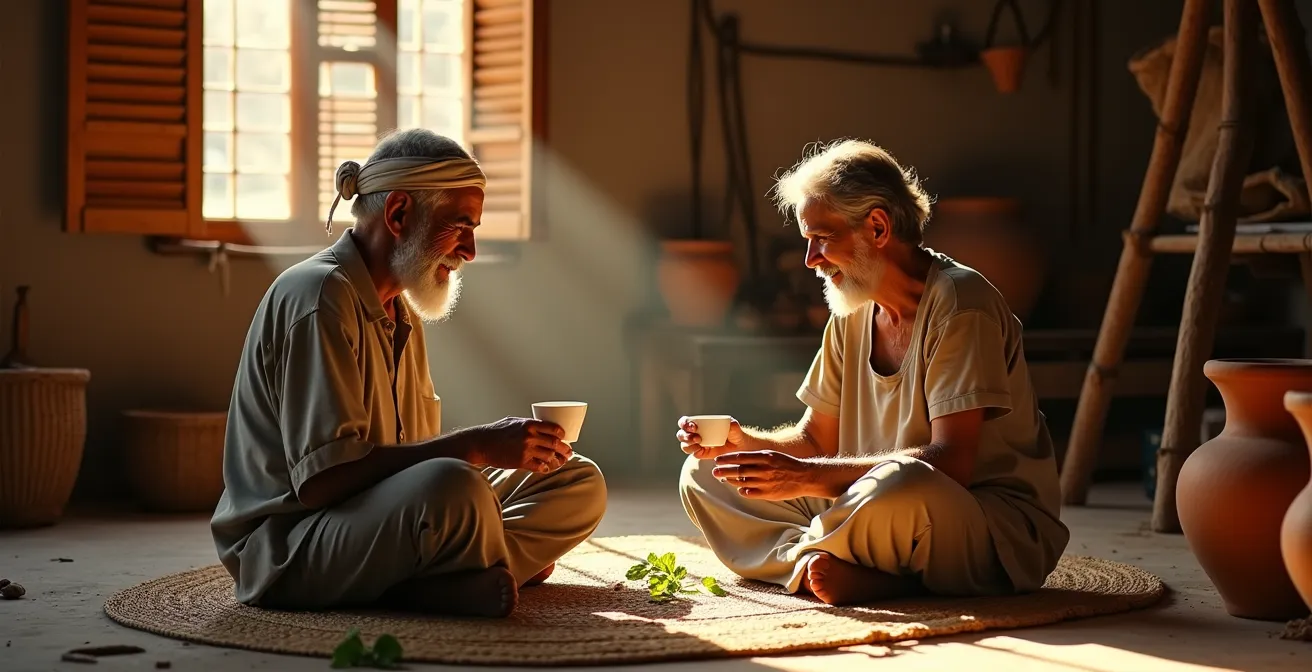
The shift from tourist to traveler isn’t about changing your itinerary, but about fundamentally changing your mindset from consumer to participant.
- True connection is built on a framework of reciprocity and what can be called “narrative humility”—the active dismantling of your own preconceived notions.
- Your economic choices, from where you sleep to what you buy, are your most powerful tools for ethical engagement and showing respect for the local culture.
Recommendation: Begin by auditing your own travel stereotypes and consciously choosing to support locally-owned ventures that offer economic dignity to the community.
There’s a quiet dissatisfaction that often accompanies the frequent traveler. You’ve seen the landmarks, ticked the boxes, and collected the photos, yet a feeling of emptiness lingers. You stand before a magnificent temple or a bustling market, separated by an invisible pane of glass, an observer of a life you can’t quite touch. This is the hallmark of the tourist experience: a journey of consumption, of sightseeing. The common advice—to eat local food or wander off the main street—scratches the surface but often fails to address the core of this unfulfillment. It mistakes a change in activity for a change in perspective.
The true journey from tourist to traveler is an internal one. It’s a transition from seeing the world as a spectacle arranged for your viewing pleasure to understanding it as a complex web of human relationships. This deeper path requires moving beyond simple observation and embracing a mindset of participation. It’s about engaging with a place not just with your eyes, but with your conscience and your humility. It asks a more profound question: how can I be a respectful guest in someone else’s home, rather than just a customer in a destination?
This article provides an anthropological framework for that transition. We will explore the practical ethics of communication, cultural exchange, and economic impact. We will dismantle the “single story” that flattens entire nations into stereotypes and analyze how our presence, even when well-intentioned, can cause harm. Ultimately, this is a guide to fostering connections that are authentic, reciprocal, and deeply human, transforming your travels from a series of sights into a collection of meaningful relationships.
To guide you on this transformative path, this article is structured to build from the foundations of respectful interaction to the broader impact of your presence. Here is a look at the key areas we will explore.
Summary: Tourist vs Traveler: A Guide to Deep Human Connection
- How to Communicate Respectfully When You Don’t Speak the Language?
- Appreciation vs Appropriation: How to Wear Local Clothing Respectfully?
- Homestay vs Hotel: Which Offers a Better Understanding of Daily Life?
- How to Get Invited to a Local’s Home for Dinner Safely?
- When to Visit to Experience Real Traditions vs Tourist Shows?
- The Danger of a Single Story: How It Stereotypes Entire Nations
- The Orphanage Trap: Why Short-Term Volunteering Can Harm Communities?
- How to Ensure Your Tourist Dollars Actually Reach the Local Community?
How to Communicate Respectfully When You Don’t Speak the Language?
The first barrier to connection is often language. A tourist sees this as an inconvenience to be solved with technology; a traveler sees it as the first opportunity to demonstrate respect. The goal is not to achieve perfect fluency overnight but to show you’re willing to share the burden of communication. This act of intentional friction—choosing a slightly harder path for the sake of connection—is a powerful non-verbal signal. It communicates: “I value this interaction enough to be vulnerable and put in the effort.”
Start with the basics: master greetings, “please,” and “thank you” in the local tongue. But true respect lies beyond rote memorization. It’s about your presence. Put the phone away after an initial lookup. Make eye contact. Smile. Use open, slow gestures. One of the most profound tools is the universal head tilt, a gesture that conveys curiosity and a listening ear without a single word. By mirroring the pace and energy of the person you’re speaking with, you build a subconscious rapport. It’s a silent acknowledgment that you are a guest, willing to adapt.
These repeated, low-stakes interactions—buying bread from the same baker each morning, greeting the same shopkeeper—build familiarity. They are small deposits into a bank of trust. The traveler understands that they must “take matters into their own hands and engage the world around them,” creating natural opportunities for these brief but meaningful exchanges. This isn’t about transactional efficiency; it’s about laying the groundwork for a genuine human relationship, one respectful gesture at a time.
Appreciation vs Appropriation: How to Wear Local Clothing Respectfully?
As travelers seek deeper connections, the desire to engage with local culture grows; in fact, an estimated 56% of all travel in 2024 focused on cultural heritage. This often leads to the question of wearing local attire. Is it a sign of respect or an act of appropriation? The difference lies not in the garment itself, but in the context, source, and intent behind wearing it. A tourist might buy a mass-produced “local” shirt at the airport, reducing a cultural symbol to a costume. A traveler seeks to understand the story behind the textile.
Appreciation involves a respectful exchange. It means purchasing a piece directly from the artisan who made it, listening to its story, and understanding its significance. Are you buying a general textile sold at a market, or are you taking a sacred ceremonial garment and wearing it to a bar? The former is appreciation; the latter veers into appropriation by trivializing its cultural meaning. The key is to see the garment not as an accessory for your travel photos, but as a piece of art and heritage you have been privileged to acquire.
Wearing it respectfully means you become an active storyteller. If someone asks about it, you should be prepared to share the maker’s name, the region it came from, and what you learned about its meaning. This transforms you from a passive consumer into an ambassador for the artisan, honoring their craft and contributing to its preservation. The following checklist can help you navigate this complex but rewarding aspect of cultural immersion.
Your Action Plan: A Framework for Respectful Cultural Clothing Choices
- Assess Context: Differentiate between general textiles available at public markets (appreciation) and culturally or religiously significant ceremonial garments worn in inappropriate settings (appropriation).
- Buy Directly: Purchase from the makers themselves. This ensures artisans benefit directly from their work and gives you the opportunity to learn the story behind the piece.
- Become a Storyteller: Be prepared to respectfully share the garment’s origin, its meaning, and the artisan’s name when asked. You are now a custodian of its story.
- Consider the Setting: Before wearing the item, ask yourself if the environment you’ll be in honors or trivializes its cultural significance.
- Understand the ‘Why’: Reflect on your motivation. Are you wearing it to honor the culture and the artist, or to create a certain image for yourself?
Homestay vs Hotel: Which Offers a Better Understanding of Daily Life?
Where you sleep is one of the most significant choices you’ll make, dictating the entire rhythm and texture of your journey. The hotel, with its standardized comfort and insulated environment, is designed for the tourist. It offers an escape from the destination. The homestay, by contrast, is an invitation into it. This preference for authentic experience is a growing movement; the global homestay market was valued at over USD 19.5 billion in 2024, driven by a desire for genuine immersion.
Choosing a homestay is choosing to be a participant, not a spectator, in the flow of daily life. It’s trading the anonymous buffet for a seat at the family dinner table. It’s hearing the sounds of the neighborhood waking up, not the hum of an air conditioner. Research confirms that motivations for choosing homestays are “cultural immersion, personalised experiences, and the desire for authentic local interactions.” Satisfaction comes from the host family’s attitude, sharing authentic cuisine, and being in a location that feels real and lived-in, not sanitized for tourism.
This isn’t to say a homestay is always easy. It requires flexibility, an open mind, and a willingness to step outside your comfort zone. But the rewards are immeasurable. You don’t just see a culture; you experience its daily rhythms, its challenges, and its joys from the inside.

As this image suggests, the most profound moments of travel are often not found in grand monuments, but in the quiet, shared activities of a family kitchen. This is where stories are exchanged, recipes are taught, and the invisible wall between “host” and “guest” begins to dissolve into a genuine human connection. It’s the difference between seeing a country and feeling its heartbeat.
How to Get Invited to a Local’s Home for Dinner Safely?
An invitation into a local’s home is perhaps the highest expression of trust and acceptance a traveler can receive. It is a sacred threshold to cross, and it cannot be forced or sought directly. It must be earned. A tourist might see such an invitation as a bucket-list item to be checked off, but a traveler understands it is the natural outcome of a relationship built on patience and reciprocity. This isn’t an algorithm; it’s the slow, unglamorous work of building human trust.
The process begins long before an invitation is ever considered. It starts with planting seeds of familiarity. Visit the same small café every morning. Buy your fruit from the same vendor. Engage in those repeated, low-stakes interactions we discussed earlier. Let people see you as a consistent, respectful presence in their community, not a fleeting visitor. Show genuine interest in their lives—ask about family photos on the wall or the history of their shop—without any expectation of an invitation. Your curiosity must be authentic, not transactional.
Practice reciprocity first. Don’t wait to receive; offer something of value. This is rarely monetary. It could be a story from your home country, help with a simple task, or sharing a skill if appropriate. Working with cultural brokers, such as your homestay host or a local guide you’ve built rapport with, can also help vouch for your character. They can bridge the gap of trust. An invitation is a gift, and it will only be offered when a host feels safe and genuinely wants to share their life with you, not when they feel pressured by a tourist’s agenda.
As a guiding principle, remember the words of a global authority on the matter. UN Tourism declared on World Tourism Day 2023:
Tourism Opens Minds
– UN Tourism, 2023 World Tourism Day
This opening of minds is a two-way street, built on the slow, deliberate construction of mutual respect and trust.
When to Visit to Experience Real Traditions vs Tourist Shows?
The desire for authenticity is a powerful driver in modern travel. In the Asia Pacific region alone, research reveals that 77% of Asia Pacific travelers seek destinations for cultural heritage understanding. This quest often leads to a critical question of timing: how do you witness a living tradition rather than a hollow performance staged for tourists? The difference is one of purpose. A living tradition serves the community; a tourist show serves the visitor’s wallet.
The key is to research beyond the main tourism calendar. Look for smaller, regional festivals that are not heavily marketed to international visitors. These are often tied to harvest cycles, local saints’ days, or seasonal rites that hold deep meaning for the community. Attending such an event requires a shift in mindset. You are not the audience for whom the event is performed; you are a privileged observer. This requires a high degree of respect and self-awareness. Dress modestly, be mindful of your camera, and follow the cues of the local participants. Your role is to be as inconspicuous as possible.
A “living tradition” is characterized by active participation from the community and a deep respect for context. It’s about understanding the historical and social significance of a practice, not reducing it to a colorful photo opportunity. A traveler seeks to learn the “why” behind the ceremony. This might mean visiting during the off-season when daily life is more visible, or arriving for a festival a week early to observe the preparations. This allows you to see the communal effort and anticipation, which is often more telling than the main event itself. It’s the difference between watching a play and being allowed backstage to see how the magic is made.
The Danger of a Single Story: How It Stereotypes Entire Nations
Perhaps the greatest obstacle to genuine connection is not a lack of language skills or a “bad” hotel choice, but the invisible luggage we all carry: our preconceptions. As the classic quote suggests:
A traveler sees what he sees; the tourist sees what he has come to see
– The Travel Club, Are you a Traveller or a Tourist
The tourist arrives with a “single story”—a simplistic, often stereotypical narrative fed by media, politics, or pop culture. This single story reduces a complex, multi-faceted nation of millions into a single, easily digestible cliché. The traveler’s most important work is to actively dismantle this. This requires a conscious practice of what can be called “narrative humility”—the acknowledgment that your perspective is incomplete and actively seeking out stories that contradict your own.
Before you even pack your bags, perform a pre-travel narrative audit. Write down every stereotype and image that comes to mind about your destination. Then, actively seek to complicate them. Follow local journalists, artists, bloggers, and activists on social media. Read novels by the country’s authors. Watch films by its directors. Your goal is to absorb a multiplicity of voices before you even arrive, so you land with questions instead of answers.
Once there, continue this work on the ground. Make a conscious effort to speak with people from diverse walks of life: a university student, an elderly shopkeeper, a tech worker, a farmer. Ask them what they love about their country and what they would change. Document these multiple, often conflicting, perspectives. The goal isn’t to find the “one true story,” but to appreciate the beautiful, complex, and sometimes contradictory chorus of many.

Like the different people converging in this square, every nation is a collection of countless individual narratives. The traveler’s task is to listen to as many as possible, allowing their simple, single story to fracture and reform into a rich, layered, and more truthful mosaic.
The Orphanage Trap: Why Short-Term Volunteering Can Harm Communities?
The desire to “give back” is a noble one, but it can lead travelers into one of the most ethically fraught areas of tourism: short-term voluntourism, particularly in orphanages. What feels like a helpful act to the visitor can often be a harmful, destabilizing force for the community. The “orphanage trap” is built on a business model that profits from the good intentions of tourists. Many children in these institutions are not orphans but have been separated from their families who are unable to afford their care—a situation exacerbated by the demand from foreign volunteers.
The core problem is one of attachment and abandonment. For children, forming bonds with a constant stream of short-term volunteers who inevitably leave can lead to severe attachment disorders and long-term psychological harm. Furthermore, it perpetuates a “savior complex” in the traveler, positioning them as a hero and the local community as helpless victims. This undermines local expertise and agency. A traveler, practicing ethical engagement, must first ask: “Am I offering a skill that is genuinely needed and unavailable locally, or am I just seeking a fulfilling personal experience?”
The ethical alternative is to shift your support from unqualified, short-term labor to professional, long-term solutions. Instead of volunteering for a day, use that time and money to support organizations that work to keep families together. Patronize social enterprises, such as training restaurants or artisan cooperatives, that provide stable employment and skills to the local population. If you have a professional skill (like accounting, marketing, or web design), offer it remotely to a local NGO. The most respectful way to “help” is often to fund local experts who understand the cultural context and can provide consistent, professional care, rather than inserting yourself into a situation you don’t fully understand.
Key Takeaways
- The transition from tourist to traveler is an internal mindset shift from consumption to participation.
- Authentic connection is built on a foundation of reciprocity, narrative humility, and respecting cultural context.
- Your economic choices are a powerful ethical tool; supporting local, community-owned businesses directly contributes to cultural preservation and economic dignity.
How to Ensure Your Tourist Dollars Actually Reach the Local Community?
Every dollar you spend on your travels is a vote. It’s a statement about what you value. A tourist’s money often flows into the coffers of international corporations—hotel chains, tour operators, and restaurant franchises—with only a small fraction ever reaching the local community. A traveler, however, understands that their wallet is their most powerful tool for fostering sustainable, respectful tourism. They practice economic dignity, consciously directing their funds to businesses that empower local people and preserve cultural heritage.
The difference in economic impact is stark. By choosing a locally-owned guesthouse over an international hotel, or a community tourism cooperative over an all-inclusive resort, you are ensuring that your money stays within the community to fund schools, healthcare, and infrastructure. This support allows artisans, guides, and small business owners to sustain their livelihoods and, crucially, to pass down their skills and traditions to the next generation. As one analysis notes, many immersive experiences are designed to “support local artisans, farmers, and cultural practitioners,” creating a virtuous cycle of economic and cultural preservation.
To make this practical, commit to a “local first” rule. Eat at family-run restaurants where the menu is written on a chalkboard. Hire local guides who are from the community they are showing you. Buy souvenirs directly from the artisans who make them. This simple shift in spending habits has a profound ripple effect, transforming your economic footprint from an extractive one to a supportive one. As the following table illustrates, your choice of where to spend your money has a measurable impact on the community.
The following table, based on an analysis of tourism economic models, breaks down where your money typically goes.
| Business Type | Local Economic Retention | Community Benefits | Cultural Preservation |
|---|---|---|---|
| Locally-owned Guesthouse | 70-90% stays local | Direct employment, local supply chain | Maintains traditional architecture |
| International Hotel Chain | 20-30% stays local | Service jobs only | Standardized experience |
| Community Tourism Cooperative | 95% stays local | Profit-sharing, skill development | Active cultural transmission |
| All-Inclusive Resort | 10-20% stays local | Limited to low-wage positions | Performed culture only |
Ultimately, becoming a traveler is not a destination but a continuous practice of awareness, humility, and intentionality. It’s about understanding that the greatest souvenirs are the relationships you build and the respect you leave behind. To put these principles into action, the next logical step is to consciously plan your next journey around supporting local economies and fostering genuine human connection.