
Contrary to popular belief, the effectiveness of a Vitamin C serum isn’t just about its percentage, but its chemical stability and bioavailability.
- Vitamin C’s power lies in its ability to donate electrons, which neutralizes free radicals but also makes it inherently unstable and prone to rapid oxidation.
- Its efficacy is a delicate balance of low pH (for skin absorption) and protective formulation (to prevent degradation from light, air, and heat).
Recommendation: Use a well-formulated Vitamin C serum every morning, stored correctly, and always layered under a broad-spectrum SPF to create a comprehensive shield against premature aging.
You’ve seen the glowing reviews and the dramatic before-and-after photos. Vitamin C is hailed as a holy grail ingredient, a non-negotiable step for anyone serious about their skin’s health and radiance. The advice seems simple: find a serum, apply it daily, and wait for the magic to happen. You’re told it fights free radicals, boosts collagen, and fades dark spots. So you invest in a pricey little bottle, only to watch it turn a disappointing shade of orange in just a few weeks, leaving you to wonder if you just wasted your money.
The common narrative focuses on what Vitamin C does, but rarely explains *why* it is so notoriously fragile. The problem isn’t just that it “goes bad”; it’s that its very strength is also its greatest weakness. As a cosmetic chemist, I can tell you that the secret to unlocking its true potential doesn’t lie in chasing the highest percentage. It lies in understanding its chemical nature—its inherent desire to give itself away to protect your skin. This instability is not a flaw in the product; it is the very essence of its antioxidant power.
But what if the key wasn’t just to slow down its inevitable decay, but to harness it? This article will move beyond the surface-level advice. We will dissect the chemical reactions happening in that bottle and on your skin. We’ll explore why this potent molecule breaks down and provide a scientific framework to protect its integrity and maximize its biological impact, transforming it from a volatile ingredient into your most reliable ally against premature aging.
To fully grasp how to protect your skin, this article breaks down the science behind Vitamin C, from the molecular damage it prevents to its powerful synergy with your daily sunscreen. Explore the sections below to build a truly effective antioxidant strategy.
Summary: Understanding and Using Vitamin C for Peak Performance
- What Do Free Radicals Actually Do to Collagen Fibers?
- How to Keep Your Vitamin C Serum from Oxidizing in 3 Weeks?
- Vitamin C vs Niacinamide: Which Is Better for Brightening Dark Spots?
- The Tingle Warning: When Does “Active” Become “Irritating”?
- AM or PM: When Is the Best Time to Apply Antioxidants for Protection?
- How to Find Nutrient-Dense Foods in the Dead of Winter?
- Aging vs Burning: Why Does High SPF Not Guarantee Anti-Aging Protection?
- Why Do Dermatologists Say SPF Is the Best Anti-Aging Cream?
What Do Free Radicals Actually Do to Collagen Fibers?
To understand why antioxidants like Vitamin C are so vital, we first need to visualize the enemy: free radicals. These are not abstract villains; they are highly reactive, unstable molecules with an unpaired electron. In their frantic search to become stable, they steal electrons from healthy molecules in your skin, setting off a destructive chain reaction known as the oxidative cascade. Their primary target is your skin’s structural support network: collagen and elastin.
When a free radical attacks a collagen fiber, it triggers a process called carbonyl stress, which leads to the formation of cross-links. Imagine your supple, organized collagen matrix becoming stiff, tangled, and brittle. This damage weakens the skin’s foundation, leading directly to the visible signs of aging we fight to prevent: fine lines, wrinkles, and loss of firmness. This isn’t a rapid process. In fact, research shows that collagen has a remarkably long half-life of approximately 15 years. This means the damage is cumulative and long-lasting; the collagen you have today is what you need to protect for tomorrow.
Vitamin C’s role is to be a selfless hero in this scenario. As a potent antioxidant, it is an electron donor. It willingly gives one of its own electrons to the rampaging free radical, effectively neutralizing it and stopping the oxidative cascade before it can even reach your precious collagen. This sacrificial act is the very core of its protective power.
How to Keep Your Vitamin C Serum from Oxidizing in 3 Weeks?
The same chemical property that makes Vitamin C a brilliant antioxidant—its willingness to donate electrons—also makes it incredibly unstable. When exposed to its enemies—light, heat, and air (oxygen)—it begins to oxidize right in the bottle. This process, known as kinetic degradation, converts the potent L-ascorbic acid into an ineffective, and potentially pro-oxidant, form called dehydroascorbic acid (DHA). This is why your clear or pale yellow serum can turn orange or brown.
While a well-formulated serum will include stabilizing ingredients like Vitamin E and Ferulic Acid, which act as a “synergistic buffer” by regenerating Vitamin C, your storage habits are crucial for preserving its potency. Light provides the energy for the reaction to accelerate, while oxygen is a key reactant. You must control these environmental factors to slow down the inevitable decay and ensure the active ingredient is available for your skin, not wasted on the air in your bathroom.
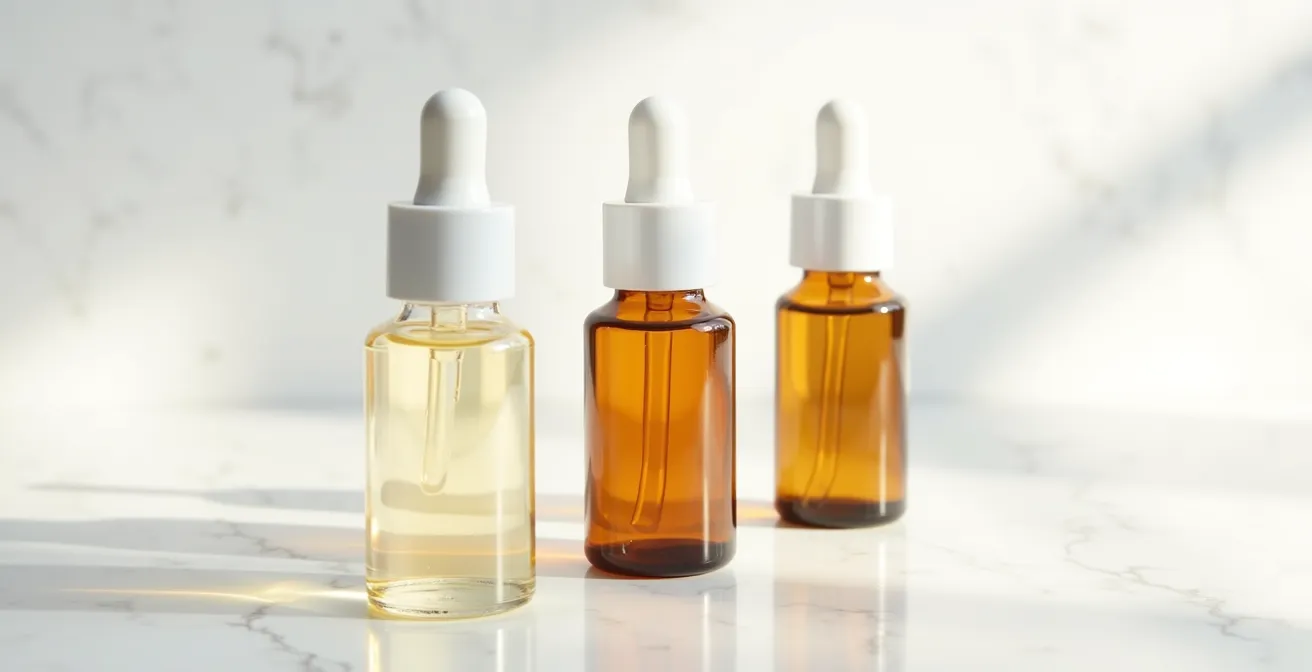
The visual change from clear to amber, as shown above, is a direct indicator of this chemical breakdown. A pale yellow tint is often normal, but once it deepens to orange or brown, the concentration of effective L-ascorbic acid has significantly dropped. To maximize the lifespan and efficacy of your serum, adopting a strict storage protocol is non-negotiable. It ensures you get the full value of the product until the last drop.
Your Action Plan: 3-Step Protocol for Maximum Vitamin C Stability
- Control the Environment: Store your serum in a cool, dark place like a cabinet or refrigerator, always with the cap sealed tightly. This minimizes exposure to the primary catalysts of oxidation: heat, light, and oxygen.
- Monitor for Degradation: Regularly check for changes in color and smell. If the serum turns dark brown or develops a metallic, “hot dog water” scent, its active components have degraded. It’s time to discard it.
- Choose Protective Packaging: When purchasing, prioritize products in dark, opaque glass bottles (like amber or cobalt blue) with an air-restrictive pump or dropper. This packaging is your first line of defense against light and air exposure.
Vitamin C vs Niacinamide: Which Is Better for Brightening Dark Spots?
When targeting hyperpigmentation, both Vitamin C and Niacinamide are top-tier ingredients, but they are not interchangeable. They work on different pathways to achieve a similar goal: a brighter, more even-toned complexion. Understanding their distinct mechanisms of action is the key to using them effectively, either separately or together.
Vitamin C primarily works as a tyrosinase inhibitor. Tyrosinase is the key enzyme responsible for triggering melanin (pigment) production. By inhibiting this enzyme, Vitamin C effectively puts the brakes on the creation of new dark spots, making it particularly effective for sun-induced brown spots and overall skin brightening. Niacinamide, on the other hand, works at a later stage. It doesn’t stop melanin production but instead acts as a transport blocker. It prevents the transfer of melanin from the pigment-producing cells (melanocytes) to the skin cells (keratinocytes). This makes it especially useful for addressing post-inflammatory erythema (the red marks left after a breakout) and improving skin texture.
The question isn’t which one is “better,” but which one is right for your specific concern. For a consumer trying to decide, this breakdown of their complementary actions is essential. As the Software Skincare Experts note in the Software Journal, they can be a powerful duo.
| Aspect | Vitamin C (L-Ascorbic Acid) | Niacinamide |
|---|---|---|
| Primary Action | Tyrosinase enzyme inhibition | Melanin transfer prevention |
| Best For | Sun-induced brown spots & dullness | Post-inflammatory redness & texture |
| Concentration Range | 10-20% | 2-10% |
| pH Requirement | <3.5 for optimal absorption | 5.5-7.0 (flexible) |
| Compatibility | Use first, wait before layering | Can layer after vitamin C dries |
The most important chemical difference to note is their required pH. L-ascorbic acid needs a very low pH (below 3.5) to be stable and penetrate the skin, while Niacinamide performs best at a more neutral pH (5.5-7.0). This is why layering them correctly is critical to avoid compromising the efficacy of either ingredient.
For the best results, dermatologists recommend applying your vitamin C serum first. Let it dry so your skin has the opportunity to absorb the ascorbic acid, and then move on to the niacinamide product.
– Software Skincare Experts, Software Journal
The Tingle Warning: When Does “Active” Become “Irritating”?
A common experience when first using a potent Vitamin C serum is a slight tingling sensation upon application. This is often misinterpreted as a sign of irritation, but from a chemical standpoint, it’s usually an indicator of the product’s low pH. For L-ascorbic acid to be effective and penetrate the skin barrier, it must be formulated at a pH of 3.5 or lower. This acidity can cause a temporary tingling, especially for new users, which is generally a sign that the product is “active” and bioavailable.
However, there’s a fine line between a productive tingle and genuine irritation. If the sensation progresses to stinging, burning, or is accompanied by persistent redness and peeling, your skin barrier is being compromised. This could be due to the concentration being too high for your skin type or an incompatibility with other active ingredients in your routine. Most people can tolerate concentrations of 10-15%, but those with sensitive skin should always start low. A formula with under 5% Vitamin C is a much safer entry point to build tolerance.
The single most important step before incorporating any new active serum into your routine is the patch test. This simple diagnostic tool can save you from widespread inflammation and a damaged skin barrier. It allows you to assess your individual skin’s reaction in a controlled manner.

To perform a patch test, simply apply a small amount of the serum to a discreet area, like your inner arm or behind your ear, for one to two days. Monitor the area for any signs of an adverse reaction such as excessive redness, itching, or swelling. A mild tingle is one thing; a full-blown reaction is a clear signal to stop. Listening to your skin’s feedback is the most crucial part of using high-potency actives safely.
AM or PM: When Is the Best Time to Apply Antioxidants for Protection?
The debate over when to apply Vitamin C is common, but the science points to a clear winner for maximizing its protective benefits. While you can use it at night to aid in the skin’s repair processes, applying it in the morning provides a critical advantage: it works in synergy with your sunscreen to offer comprehensive environmental protection throughout the day.
During the day, your skin is constantly bombarded by UV radiation and pollution, which generate the free radicals that degrade collagen. Sunscreen is your primary shield, reflecting or absorbing UV rays. However, no sunscreen is 100% effective; a small percentage of UV radiation can still penetrate. This is where Vitamin C acts as your skin’s “backup.” It creates a reservoir of antioxidants in the skin that neutralizes the free radicals your sunscreen might miss. This dual-defense strategy—blocking with SPF and scavenging with Vitamin C—provides significantly better protection than either product alone.
The skin’s antioxidant reservoir isn’t infinite; it gets depleted as it fights off free radicals. This is why consistent application is key. Some studies recommend applying vitamin C serum twice daily or even every eight hours for optimal saturation. However, for most users, a single, potent application in the morning is sufficient and practical. As dermatologist Dr. Melissa Piliang explains, the morning application is strategic.
Apply vitamin C serum after cleansing. And although it’s safe to use overnight, Dr. Piliang recommends applying it in the morning because of the way it serves as a backup to sunscreen. They work in synergy.
– Dr. Melissa Piliang, Cleveland Clinic
Think of it this way: applying Vitamin C in the morning is a proactive, defensive move. Applying it at night is a reactive, reparative one. For preventing premature aging, defense is always the best offense.
How to Find Nutrient-Dense Foods in the Dead of Winter?
While the focus of this article is on topical Vitamin C, we cannot ignore the foundational role of internal nutrition. The title’s challenge—finding nutrients in winter—serves as a powerful metaphor for the body’s constant need for this essential vitamin, regardless of external conditions. Your skin is a reflection of your overall health, and topical products work best on a body that is well-supported from within.
Vitamin C is a crucial cofactor in collagen synthesis. This means your body literally cannot produce new, healthy collagen without it. It’s a key player in the hydroxylation of proline and lysine, amino acids that form the stable triple-helix structure of collagen. Without sufficient Vitamin C, this process is impaired, resulting in weaker, less stable collagen. This internal support system is the bedrock upon which your topical skincare routine is built.
Furthermore, as clinical studies consistently show, dietary Vitamin C also functions as a systemic antioxidant, neutralizing free radicals throughout the body before they can contribute to cellular damage. As one study on collagen highlights, “Clinical trials demonstrate vitamin C as a key cofactor in collagen synthesis and as an antioxidant that neutralizes diverse free-radical species, minimizing damage and protecting long-lived collagen fibers in the skin.” This demonstrates that the protective benefits are not limited to topical application.
So, while it may be challenging, ensuring a diet rich in Vitamin C through foods like citrus fruits, bell peppers, broccoli, and even frozen berries during winter is not just about general health—it’s a core component of an effective anti-aging skin strategy. It reinforces the structural integrity of your skin from the inside out, creating a healthier canvas for your serums to work on.
Aging vs Burning: Why Does High SPF Not Guarantee Anti-Aging Protection?
Sunscreen is unequivocally the most effective anti-aging product available, but a common misconception is that a high SPF number provides a complete shield against all sun-induced damage. SPF (Sun Protection Factor) primarily measures protection against UVB rays—the rays that cause sunburn. However, it offers less information about protection from UVA rays, which penetrate deeper into the skin and are the primary drivers of photoaging.
UVA rays are the main culprit behind collagen and elastin degradation, leading to wrinkles, sagging, and hyperpigmentation. While broad-spectrum sunscreens do offer UVA protection, no formula can block 100% of UV radiation. Some rays will inevitably get through, generating free radicals in the skin. In fact, research published in the National Library of Medicine suggests that among all environmental factors, UVR contributes up to 80% of extrinsic skin damage. Relying solely on SPF, even a high one, leaves your skin vulnerable to this residual free radical damage.
This is where the concept of synergistic protection becomes critical. SPF acts as the first line of defense, a physical and chemical shield. Antioxidants like Vitamin C act as the second line, a biological safety net. They don’t block UV rays but instead neutralize the free radicals that are generated by the UV radiation that slips past your sunscreen.
This layered approach provides a much more comprehensive defense against photoaging than either product could alone. The sunscreen reduces the overall UV load on the skin, while the antioxidant serum “cleans up” the oxidative stress that still occurs. This combination doesn’t just prevent burning; it actively mitigates the deep, structural aging caused by daily sun exposure.
Key Takeaways
- Vitamin C’s instability is a feature, not a bug; its willingness to oxidize is what neutralizes skin-damaging free radicals.
- Optimal protection comes from synergy: use Vitamin C in the AM to act as a “backup” that neutralizes the free radicals your SPF misses.
- Storage and packaging are critical; light, air, and heat rapidly degrade Vitamin C, rendering it ineffective. Opaque, airtight bottles are a must.
Why Do Dermatologists Say SPF Is the Best Anti-Aging Cream?
Dermatologists consistently emphasize that the single most effective anti-aging product is not a rare peptide or an exotic extract, but a broad-spectrum sunscreen. The reason is simple and grounded in biochemistry: prevention is exponentially more effective than repair. The vast majority of visible skin aging—wrinkles, laxity, and pigmentation—is a direct result of unprotected exposure to UV radiation.
UV exposure triggers a devastating chain reaction in the dermis. Specifically, as confirmed by research on skin cell models, UV radiation induces the expression of matrix metalloproteinases (MMPs). These enzymes are like demolition crews for your skin; their job is to break down old or damaged proteins. When over-activated by the sun, they go into overdrive, degrading healthy dermal collagen and elastin faster than your body can rebuild them. This enzymatic breakdown is the direct cause of wrinkles and loss of firmness.
While an antioxidant serum is a crucial defensive player, it cannot physically block the UV rays that trigger this entire destructive process. Its role is to mitigate the oxidative stress that results. Sunscreen, by absorbing or reflecting UV radiation, stops the problem at its source. It prevents the MMPs from being activated in the first place. This is why no “repair” cream can ever compete with the preventative power of a daily SPF. As research on age-associated damage suggests, since the skin’s own antioxidant defense systems weaken with age, “exogenous supplementation of antioxidants might be a protective strategy against age-associated skin oxidative damage,” but it remains a secondary strategy to prevention.
Start today by making a broad-spectrum sunscreen the cornerstone of your daily routine, and pair it with a stable Vitamin C serum to build the most resilient, comprehensive defense for your skin’s future.