
Contrary to popular belief, a lack of confidence in your clothing doesn’t come from a poor fashion sense, but from the psychological friction between your internal identity and the story your outfit tells.
- The clothes we wear directly influence our cognitive processes and self-perception, a concept known as “enclothed cognition.”
- Buying for an aspirational life you don’t have creates cognitive dissonance, making you feel like you’re wearing a costume.
Recommendation: Shift your focus from following external trends to identifying your internal “power pieces”—garments that genuinely align with your current life and personality to build authentic confidence.
You’ve seen the outfit everywhere. On social media, in magazines, on the most stylish person in the coffee shop. You finally buy it, excited to feel as confident and put-together as you’ve imagined. But when you wear it, something feels… off. Instead of empowered, you feel like a fraud, a child playing dress-up in someone else’s clothes. This feeling, a kind of fashion imposter syndrome, is incredibly common, yet widely misunderstood. It’s not a sign that you’re “bad at fashion” or that the trend is inherently flawed. It’s a psychological signal that deserves a closer look.
The conventional advice is often to “be authentic” or “find your personal style,” but these platitudes offer little guidance on the deep-seated discomfort you feel. They fail to address the core issue: the powerful, often subconscious, dialogue between your mind and your clothes. Fashion psychology isn’t just about aesthetics; it’s about the cognitive and emotional impact of our wardrobe choices. The friction you experience is real, and it stems from a misalignment between your self-concept and the external message your clothing projects.
But what if the key wasn’t to reject trends entirely, but to understand the psychological mechanisms at play? What if you could learn to use clothing as a tool to reinforce your identity, rather than a costume that obscures it? This article moves beyond surface-level style tips to explore the science of “enclothed cognition” and the cognitive dissonance that arises from an inauthentic wardrobe. We will deconstruct the psychological traps of aspirational buying, explore strategies to reduce decision fatigue, and ultimately guide you toward building a wardrobe that serves as armor, not an uncomfortable disguise.
To navigate this complex relationship between our clothes and our minds, we will explore the core principles of fashion psychology. The following sections break down exactly how your wardrobe impacts your confidence and provide a roadmap for achieving true wardrobe-self alignment.
Summary: Why Trendy Clothes Can Erode Your Confidence
- How Do Your Clothes Actually Change the Way You Think?
- How to Identify Your “Power Pieces” in a Cluttered Closet?
- The Mistake of Buying for the Life You Want vs The Life You Have
- Personal Style or Uniform: Which Approach Reduces Decision Fatigue?
- When to Let Go of an Old Aesthetic That No Longer Serves You?
- Why Does the “20-Year Rule” of Nostalgia No Longer Apply to Gen Z?
- Why Does a Tailored Blazer Make You Stand Straighter?
- The “Power Suit” Effect: How Clothing Structure Alters Body Language?
How Do Your Clothes Actually Change the Way You Think?
The idea that clothing affects our mental state is more than just a feeling; it’s a documented psychological phenomenon. The experience of feeling powerful in a sharp suit or creative in a flowing dress is rooted in a concept called “enclothed cognition.” This isn’t simply about what you wear, but the potent combination of the symbolic meaning of the garment and the physical experience of wearing it. Your brain doesn’t just register that you’re wearing a “doctor’s lab coat”; it begins to adopt the perceived traits associated with that coat—attentiveness, care, and intelligence.
This process is a two-way street. First, a piece of clothing has a symbolic association. A leather jacket might symbolize rebellion and toughness, while a cashmere sweater suggests softness and comfort. When you put on that garment, you activate those symbolic meanings in your brain. This activation then influences your thoughts, feelings, and even your performance on tasks. Wearing clothes that feel inauthentic or misaligned with your identity creates a state of psychological friction. Your brain receives conflicting signals: the “story” of the clothes clashes with your internal self-concept, leading to that nagging sense of being an imposter.
This psychological link was explored in a foundational study on the topic. As researchers Hajo Adam and Adam D. Galinsky noted in the *Journal of Experimental Social Psychology*:
We introduce the term ‘enclothed cognition’ to describe the systematic influence that clothes have on the wearer’s psychological processes.
– Hajo Adam and Adam D. Galinsky, Journal of Experimental Social Psychology
Understanding this concept is the first step toward reclaiming your confidence. It reframes the problem: the issue isn’t your body or your fashion sense, but the cognitive dissonance created by wearing something that tells a story you don’t believe is your own. Your clothing is not just a covering; it’s a cognitive tool that can either enhance or inhibit your state of mind.
How to Identify Your “Power Pieces” in a Cluttered Closet?
A closet overflowing with trendy but unworn items is a common source of frustration. The solution isn’t to add more, but to excavate the “power pieces” you already own. These are the garments that create a feeling of wardrobe-self alignment—they make you feel like the most authentic, capable version of yourself. Identifying them is less about brand names and more about an internal, sensory audit. A power piece is an item that feels right on a psychological and physical level, often combining a perfect fit with a symbolic meaning that resonates with you.
The physical sensation of clothing is paramount. It’s not just about looking good in the mirror; it’s about how the fabric feels, how the garment moves with your body, and whether it constricts you or allows you to exist comfortably. In fact, a recent 2024 study reveals that 66% of UK women believe how their clothes fit is the most significant factor affecting their confidence. A power piece never requires you to constantly adjust or feel self-conscious. It feels like a second skin.
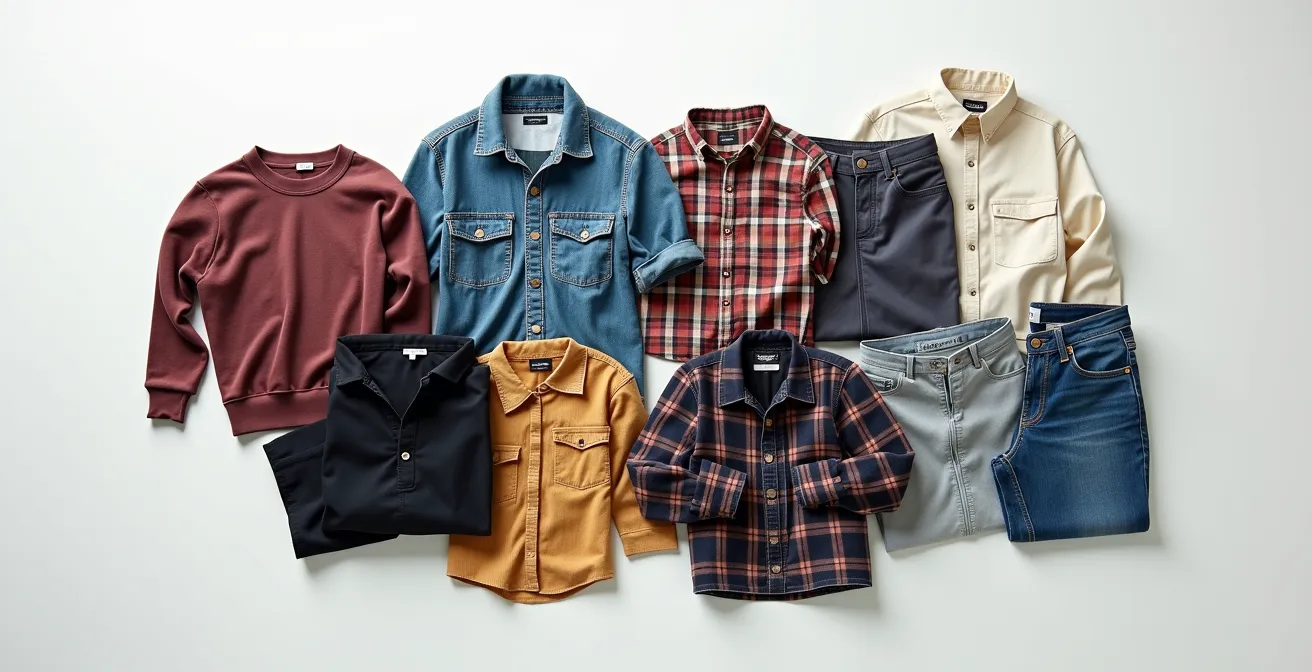
To begin this process, look for the clothes you reach for on days you need to feel your best. Is it a perfectly worn-in pair of jeans? A structured jacket that makes you feel in charge? A soft sweater that feels like a hug? These items are your personal confidence armor. The process is one of rediscovery, focusing on the tactile and emotional response each garment evokes.

As you can see, evaluating your clothes is a sensory process. It involves more than a visual check; it requires you to pay attention to the texture, weight, and structure of the fabric. This tactile connection helps you move past what you *think* you should like and toward what genuinely makes you feel good. This internal validation is the foundation of authentic personal style and the antidote to fashion imposter syndrome.
Your Action Plan: Auditing Your Closet for Power Pieces
- Identify Touchpoints: Lay out the 5-10 items you wear most often. These are the starting point for understanding your true preferences.
- Analyze the Winners: For each item, list three reasons you love it. Is it the fit (e.g., high-waisted, drapes perfectly), the fabric (e.g., soft, structured), or the feeling it gives you (e.g., professional, creative)?
- Check for Coherence: Compare these winning traits to your core personality. If you value comfort and simplicity, but your closet is full of complicated, restrictive items, you’ve found the source of your psychological friction.
- Test for Emotion: Hold up an item you’ve never worn. Does it spark joy or a feeling of “should”? If it feels like a costume for a life you don’t lead, it’s not a power piece.
- Create an Integration Plan: Based on the traits of your power pieces, create a small shopping list to fill gaps with items that share those same successful qualities (e.g., “more structured cotton shirts,” “another pair of wide-leg trousers”).
The Mistake of Buying for the Life You Want vs The Life You Have
One of the biggest traps in fashion is the “aspirational gap”—buying clothes for an idealized version of yourself or a life you hope to lead one day. You buy a sequin dress for glamorous parties you never attend, or a closet full of corporate suits when you work from home. While a little aspiration can be motivating, a wardrobe built entirely on fantasy creates a profound sense of dissonance. Every time you open your closet, you’re confronted with a tangible reminder of the gap between your reality and your aspirations, which can actively harm your self-esteem.
This behavior stems from a fundamental human need to express our identity. According to a 2022 survey from Statista, 68% of U.S. fashion consumers primarily use clothing to express their personality. The problem arises when we attempt to express a personality we haven’t yet earned or a lifestyle we don’t actually live. The result is a closet full of “costumes” rather than functional, authentic clothing. This creates a feedback loop of guilt and inadequacy: you feel bad for not wearing the clothes, and you feel bad for not being the person who *would* wear them.
This internal conflict is a classic example of cognitive dissonance, a state of mental discomfort caused by holding conflicting beliefs or values. As researcher M.J. Sirgy explains, we are driven to resolve these inconsistencies.
Individuals seek to align their behaviours with their self-images to avoid inconsistencies that may cause cognitive dissonance and discomfort.
– M. J. Sirgy, Journal of Community & Applied Social Psychology
The most effective way to close the aspirational gap is to practice radical honesty about your current life. What do you *actually* do every day? What are your real needs? Building a wardrobe that serves the life you have now doesn’t mean giving up on your dreams; it means building a solid, confident foundation from which you can grow. When your clothes reflect and support your real life, they become tools for success, not reminders of a fantasy.
Personal Style or Uniform: Which Approach Reduces Decision Fatigue?
The pursuit of a vast and varied “personal style” can be exhausting. The pressure to create a unique, head-turning outfit every single day contributes to decision fatigue, the mental exhaustion that comes from making too many choices. For many, the most effective way to build confidence and reduce cognitive load is not to expand their options, but to consciously limit them by adopting a personal “uniform.” This doesn’t mean wearing the exact same thing every day, but rather developing a signature formula of silhouettes, colors, and pieces that you know work for you.
Think of iconic figures like Steve Jobs (black turtleneck, jeans) or Carolina Herrera (crisp white shirt). Their uniforms weren’t a sign of creative failure but of strategic brilliance. By automating the daily decision of what to wear, they freed up mental energy for more important choices. A uniform approach allows you to invest in high-quality versions of your favorite pieces, ensuring you always feel polished and comfortable without the morning stress. It’s about creating a system of go-to outfits that are perfectly aligned with your identity and lifestyle.
This approach transforms your wardrobe from a source of anxiety into a tool for efficiency and self-assurance. When you know that every item in your curated collection makes you feel good, the act of getting dressed becomes a simple, positive ritual. This philosophy is at the heart of the capsule wardrobe movement.
Case Study: The Capsule Wardrobe and Mental Clarity
A 2022 study on wardrobe psychology documented the impact of adopting a capsule wardrobe. Participants who limited their clothing choices to a small collection of 15-20 inter-compatible pieces reported a significant reduction in their daily decision-making load and a marked increase in mental clarity. They noted that eliminating the “what to wear” stress each morning allowed them to start their day with a sense of control and confidence, proving that minimalism in fashion can be a powerful tool for both personal expression and psychological well-being.
Ultimately, whether you lean toward an expressive personal style or a streamlined uniform depends on your personality and goals. However, for anyone feeling overwhelmed by choice and experiencing fashion imposter syndrome, embracing a more uniform-based approach can be a revolutionary step toward building genuine, effortless confidence.
When to Let Go of an Old Aesthetic That No Longer Serves You?
Our clothes are often tied to our identity—or, more accurately, to past versions of our identity. The punk-rock t-shirts from your university days, the corporate attire from a job you left, or the bohemian dresses from a previous chapter in your life can linger in your closet like ghosts. Holding onto these pieces isn’t just a matter of clutter; it can psychologically tether you to a past that no longer aligns with who you are today. Letting go of an old aesthetic is a crucial step in making space, both literally and mentally, for your current self to emerge.
The resistance to letting go is often rooted in nostalgia or a fear of losing a part of oneself. You might think, “But this is who I was.” The key is to recognize that personal evolution is natural and healthy. The style that served you as a 20-year-old student may not serve you as a 30-year-old professional, and that’s okay. A style audit should be a regular practice, much like checking in with your personal goals or values. Ask yourself: does this garment reflect who I am now? Does it support the life I’m currently living? If the answer is no, it may be time to thank it for its service and let it go.
This act of conscious curation is not about a lack of imagination, but a deliberate choice to build a wardrobe that is functional and authentic to the present moment. It’s a move away from chaotic accumulation and toward intentional minimalism.
Fashion choices lean toward minimalism, neutral tones, and repetitive combinations not out of apathy, but through conscious decision to build a capsule wardrobe.
– Bardey et al., International Journal of Market Research
Letting go can be a powerful ritual. It acknowledges your growth and signals to your brain that you are embracing your current identity. By clearing out the old aesthetic, you create a clean slate. This allows you to fill your wardrobe with “power pieces” that energize you and align with your present reality, turning your closet from a museum of past selves into a functional toolkit for the person you are today.
Why Does the “20-Year Rule” of Nostalgia No Longer Apply to Gen Z?
For decades, fashion operated on a predictable cycle of nostalgia, often dubbed the “20-year rule.” Styles from two decades prior would re-emerge, reinterpreted for a new generation. The 90s saw a revival of 70s flares, and the 2010s were obsessed with 90s grunge. This paced cycle gave trends a chance to breathe and feel fresh upon their return. However, the rise of social media and ultra-fast fashion has completely shattered this timeline, particularly for Gen Z.
Today, trends don’t recycle; they co-exist in a constant, chaotic churn. The internet has flattened fashion history, making every aesthetic from every decade simultaneously accessible. A teenager can be inspired by a 70s-era Stevie Nicks photo, a Y2K music video, and a 90s sitcom all in the same five-minute scroll. This has led to the death of the monolithic trend and the rise of hyper-specific “cores” (like Cottagecore, Goblincore, or Royalcore) that can live and die within a matter of weeks. There is no longer a 20-year buffer; nostalgia can be for something that was popular just two years ago.
This accelerated, fragmented trend cycle places immense pressure on individuals, especially younger consumers, to constantly adapt and perform. The feeling of fashion imposter syndrome is magnified when the target is always moving. By the time you invest in a trend, it may already be declared “over.” This environment makes it exceptionally difficult to develop a stable, authentic personal style, as the focus is perpetually on external validation from a rapidly shifting digital landscape.
This visual collapse of timelines is the new reality. Instead of a linear progression, we have a swirling vortex of aesthetics. For Gen Z, navigating this requires a strong internal compass. Without it, the temptation to jump from one fleeting micro-trend to another can lead to a wardrobe full of disconnected pieces and a persistent feeling of never quite getting it “right.” The antidote, now more than ever, is to disconnect from the frantic cycle and focus on the principles of timeless, personal alignment.
Why Does a Tailored Blazer Make You Stand Straighter?
The transformative power of a well-fitted blazer is a perfect micro-example of enclothed cognition in action. Many people report an almost involuntary shift in their posture when they put one on—they stand taller, their shoulders pull back, and they feel more composed. This isn’t just a placebo effect; it’s a physical and neurological response to the garment’s structure. A tailored blazer provides a form of gentle, constant feedback to your body.
This phenomenon is linked to proprioception, which is your body’s ability to sense its own position, movement, and orientation in space. The structured shoulders and defined seams of a blazer provide light but persistent pressure on your torso and back. This tactile information acts as a subtle, subconscious cue to your nervous system, encouraging you to maintain a more upright and expansive posture. You’re not consciously thinking, “I must stand up straight,” but the garment itself is physically guiding you to do so.
This physical change in posture then triggers a psychological shift. Expansive, open postures are scientifically linked to feelings of confidence and power. By physically placing your body into a more confident position, the blazer helps to create the very feeling of confidence it symbolizes. It’s a tangible feedback loop: the structure of the clothing improves your posture, and your improved posture enhances your state of mind.
A well-tailored blazer provides light but constant pressure across the shoulders and back…enhancing proprioception and acting as a physical, subconscious cue to maintain a more upright posture.
– Fashion Psychology Researchers, Clinical Psychology Research
This principle extends beyond blazers to any well-structured garment. Clothing with defined lines, a certain weight, or a tailored fit can provide the same proprioceptive feedback. It highlights a crucial lesson: the structure of your clothes matters just as much as the style. When you choose garments that physically support a confident posture, you are giving yourself a powerful tool for influencing your own psychology from the outside in.
Key Takeaways
- Confidence in clothing comes from alignment with your identity, not from following trends.
- The “enclothed cognition” principle shows that clothes directly influence your thoughts and feelings.
- Focus on building a wardrobe for your current life, not an idealized fantasy, to avoid cognitive dissonance.
The “Power Suit” Effect: How Clothing Structure Alters Body Language?
The “power suit” is more than a cultural cliché; it’s the ultimate expression of the principles we’ve discussed. The effect of structured clothing on body language and confidence extends far beyond the simple blazer. A full suit, or any polished, professional ensemble, acts as a comprehensive set of signals to both the wearer and the observer. It leverages enclothed cognition on a larger scale, altering not just posture, but overall physical presence and even cognitive performance. Statistics on wardrobe confidence reveal that 80% of people believe their clothing choices play a significant role in enhancing their self-esteem.
When you wear a structured outfit, it encourages more deliberate and controlled movements. The crisp lines and tailored fit subtly discourage slouching and fidgeting, promoting a more composed and authoritative body language. This external composure is mirrored internally. When you perceive yourself as looking powerful and professional, you begin to feel and act that way. This change in self-perception can have a measurable impact on your abilities in high-stakes situations.
This powerful connection between professional attire and performance has been demonstrated in research, showing that the “power suit” effect is a real, measurable advantage.
Case Study: Professional Attire and Negotiation Success
A study published in Scientific American explored the impact of attire on business outcomes. Researchers found that individuals who wore more formal, professional clothing performed significantly better in mock negotiations. The structured attire not only influenced how they were perceived by their counterparts—as more credible and successful—but it also enhanced the wearers’ own abstract thinking and cognitive performance, leading to more favorable deals. This demonstrates that dressing for power isn’t just about appearances; it actively sharpens the mind.
This brings our exploration full circle. That feeling of being an “imposter” in trendy clothes is the inverse of the power suit effect. While a power suit aligns your external appearance with an internal state of confidence and competence, an ill-fitting trend creates a jarring conflict. The ultimate goal is to curate a wardrobe where every outfit gives you a personalized version of this “power suit” feeling—a sense of complete alignment between the person you are and the story your clothes tell the world.
By understanding these psychological dynamics, you can begin to transform your relationship with your wardrobe. The next step is to consciously apply these insights and start building a style that is an authentic expression of you, for you.