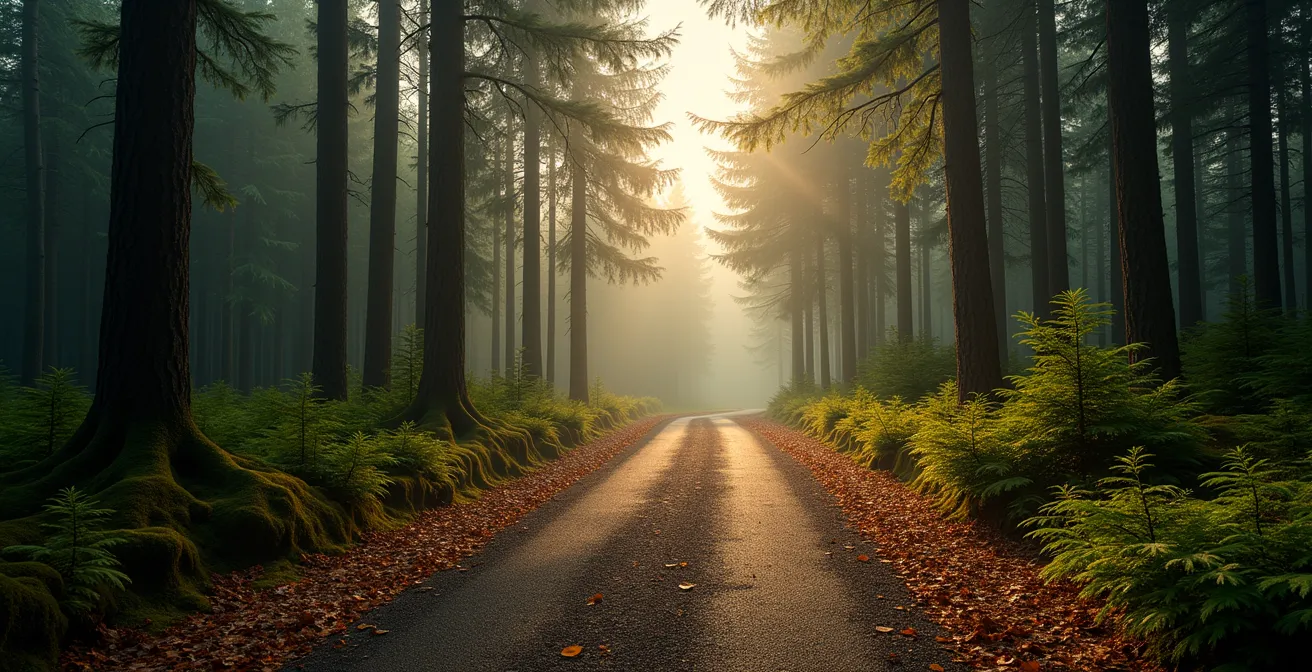
Spending time in unspoiled nature is more than just a mental break; it’s a direct biochemical intervention that actively lowers blood pressure, reduces stress hormones, and boosts your immune system.
- Trees release airborne chemicals (phytoncides) that have been shown to increase our body’s cancer-fighting cells and reduce cortisol levels.
- True solitude and its health benefits are far more accessible in less-crowded state forests than in popular national parks.
Recommendation: Move beyond passive park visits. Plan an immersive, responsible wilderness experience by understanding how to pack correctly, where to go, and how to leave no trace for profound physiological recalibration.
In the relentless hum of urban life, the feeling of being overwrought is a familiar companion. For the stressed urbanite, the standard prescription is often a vague “get some fresh air.” We instinctively feel that a walk in the park or a weekend getaway is good for us, a temporary balm for a frayed nervous system. We associate nature with quiet, relaxation, and a welcome break from deadlines and digital noise. But this view only scratches the surface of a much deeper, more powerful interaction.
What if the profound calm you feel under a canopy of trees isn’t just in your head? What if the forest is actively communicating with your body on a cellular level, triggering measurable physiological changes? The key to unlocking nature’s potent, restorative effects lies not in simply being near it, but in understanding the scientific dialogue it initiates with our biology. This is not about sentiment; it is about science.
This article moves beyond the platitudes to reveal the evidence-based mechanisms at play. We will explore the “why” behind nature’s ability to lower blood pressure—the invisible chemical messages from trees that bolster your immune system. Then, we will transition to the “how”: the practical, responsible strategies for seeking out these restorative experiences safely and effectively, ensuring the wilderness that heals us remains pristine for generations to come.
To navigate this journey from scientific understanding to practical application, this guide is structured to answer your most pressing questions. We will cover everything from the principles of ethical camping to the gear choices that make a critical difference, ensuring you are fully equipped to find your own slice of restorative solitude.
Summary: Why Unspoiled Nature is a Proven Remedy for Modern Stress
- How to Camp in the Wild Without Leaving a Single Trace?
- The Packing Mistake That Leaves Hikers Hypothermic in Summer
- National Park vs State Forest: Which Offers True Solitude?
- How to Reduce Your Backpack Weight by 2kg Without Losing Essentials?
- When to Visit Popular Trails to Avoid the “Instagram Crowd”?
- How Do Trees Communicate with Your Immune System?
- Appreciation vs Appropriation: How to Wear Local Clothing Respectfully?
- Why Are Abandoned Buildings More Historically Telling Than Museums?
How to Camp in the Wild Without Leaving a Single Trace?
The deepest restorative experiences often come from a sense of complete immersion in nature, far from designated campsites. However, this privilege comes with a profound responsibility. The goal of wild camping is not just to enjoy nature, but to pass through it as a ghost, leaving it as untouched as you found it. This philosophy is encapsulated in the Leave No Trace (LNT) principles, a set of ethics designed to minimize our impact. While awareness is growing, current statistics showing that 65% of campers are familiar with the principles still highlight a gap in consistent practice.
True LNT practice is an active, mindful process that begins long before you leave home. It involves understanding the specific regulations of the area, packing in a way that minimizes potential waste, and choosing your campsite with surgical precision. It means camping on durable surfaces like rock or dry grass, never on fragile vegetation. It means understanding how to properly dispose of human waste—by digging a “cathole” 6-8 inches deep at least 200 feet away from any water source, trail, or camp. Every action, from washing dishes to observing wildlife, is filtered through the lens of minimal impact.
Your Action Plan: Auditing Your Wilderness Impact
- Plan Ahead and Prepare: Before you go, research all local regulations, fire bans, and weather conditions. Pack appropriate gear and repackage food to minimize waste. Travel in a small group to reduce social and environmental impact.
- Travel and Camp on Durable Surfaces: Stick to established trails. When camping, select a site on resilient surfaces like rock, gravel, dry grasses, or snow. Avoid setting up camp on fragile vegetation or close to water sources.
- Dispose of Waste Properly: Pack it in, pack it out. This includes all trash, leftover food, and litter. For human waste, dig catholes 6-8 inches deep, at least 200 feet from water, trails, and your camp.
- Leave What You Find: Preserve the past by examining, but not touching, cultural or historic structures and artifacts. Leave rocks, plants, and other natural objects as you find them. Do not build structures, furniture, or dig trenches.
- Minimize Campfire Impacts: Use a lightweight stove for cooking as your primary option. Where fires are permitted, use established fire rings, fire pans, or mound fires. Keep fires small and burn all wood and coals to ash before extinguishing completely.
This isn’t about a restrictive set of rules; it’s about fostering a deeper connection and respect for the wild places that restore us. By adopting these principles, you become a steward of the wilderness, ensuring its serene and unspoiled character remains for all who follow.
The Packing Mistake That Leaves Hikers Hypothermic in Summer
The mountain air is warm, the sun is shining, and the forecast promises a perfect summer day. It seems counterintuitive to worry about getting cold, yet one of the most common and dangerous packing errors occurs in these exact conditions. The mistake is simple: wearing and packing clothes made of cotton. While comfortable for casual wear, cotton becomes a liability in the backcountry. When it gets wet, either from sweat or a sudden rain shower, it loses all its insulating properties and takes an extremely long time to dry.
This creates a perfect storm for hypothermia, a dangerous drop in body temperature that can occur even in mild weather. As wet cotton clings to your skin, it actively pulls heat away from your body, a process known as conductive heat loss. In mountain environments where weather can shift in minutes—a sunny afternoon can quickly turn into a windy, rainy ordeal—a hiker soaked in their own sweat and rain inside a cotton t-shirt is at serious risk. This isn’t a theoretical danger; emergency responders frequently encounter hikers suffering from summer hypothermia, a direct result of improper clothing choices.
The solution is to adopt a layering system built from synthetic or wool fabrics. These materials are “hydrophobic,” meaning they don’t absorb much water and, crucially, they continue to insulate even when damp. They also dry remarkably fast, wicking moisture away from your skin to keep you dry and warm.

A proper system consists of three key parts: a snug-fitting base layer to manage moisture, an insulating mid-layer (like a fleece or puffy jacket) to trap heat, and a waterproof/windproof outer shell to protect you from the elements. By choosing the right materials, you give yourself the ability to adapt to any weather, ensuring a sudden summer storm doesn’t turn a beautiful day into a fight for survival.
National Park vs State Forest: Which Offers True Solitude?
When the desire for quiet and seclusion becomes overwhelming, the immediate thought for many is to head to a famous National Park. With their iconic vistas and protected status, they seem like the ultimate escape. However, this popularity is often their undoing for the solitude-seeker. Major National Parks can be incredibly crowded, with booked-out campsites, packed trails to famous viewpoints, and a constant flow of visitors. While beautiful, they often fail to deliver the deep, restorative quiet a stressed mind craves.
For those seeking genuine solitude, the answer often lies in their less-famous cousins: State Forests and National Forests. These lands are typically managed for multiple uses, including recreation, timber, and conservation, which means they are often less developed and subject to fewer restrictions. This multi-use status translates directly into more freedom and fewer people. Here, you are far more likely to find opportunities for “dispersed camping”—the practice of camping outside of a designated campground, which is often free and offers unparalleled privacy.
The table below, based on data comparing these public lands, breaks down the key differences for someone prioritizing a peaceful escape.
| Aspect | National Parks | State Forests |
|---|---|---|
| Crowd Levels | High, especially at popular sites | Generally low, fewer visitors |
| Regulations | Strict conservation rules | Multi-use, more freedom |
| Dog-Friendly | Usually restricted | Generally allowed |
| Camping Cost | $15-35 per night | Often free dispersed camping |
| Permit Requirements | Often required | Rarely needed |
| Infrastructure | Well-developed trails and facilities | Less developed, more primitive |
Furthermore, these lands are often hiding in plain sight. In fact, 70% of Americans live within 100 miles of a national forest, making true solitude far more accessible than one might think. Choosing a State Forest is a strategic decision to trade iconic (and crowded) landmarks for the profound peace of a forest you might have all to yourself.
How to Reduce Your Backpack Weight by 2kg Without Losing Essentials?
The weight of your backpack is directly proportional to your enjoyment on the trail. A heavy pack grinds you down, turning a restorative walk into a grueling slog. Many hikers resign themselves to this, believing that a heavy load is the price of safety and comfort. However, the philosophy of ultralight backpacking demonstrates that you can dramatically reduce weight without sacrificing essentials. The goal isn’t just about carrying less; it’s about carrying smarter. Shaving off 2 kilograms (about 4.4 pounds) is an achievable goal that can transform your experience.
The process starts not with buying expensive, feather-light gear, but with a change in mindset. The first step is to conduct a ruthless audit of your current pack. Lay everything out and ask of each item: “Is this absolutely essential, or is it a ‘just in case’ luxury?” The second key principle is to prioritize multi-use items. Your trekking pole can double as your tent pole. A bandana can be a pot holder, a towel, a bandage, and a sun shield. Your insulated jacket can be stuffed into a sack to become your pillow. Each item that can serve two or more functions eliminates another item from your pack.
Finally, focus on the “Big Three”: your backpack, your shelter, and your sleep system (sleeping bag and pad). These three items typically account for the majority of a pack’s base weight. Swapping an old, heavy internal-frame pack for a modern frameless one, a bulky two-person tent for a minimalist tarp or bivy sack, or a synthetic sleeping bag for a highly compressible down one can easily save you the target 2kg or more. It’s about a holistic system where every gram is justified.

This minimalist approach does more than just lighten your load. It fosters a deeper sense of self-reliance and connection to the environment. With a lighter pack, you can travel further, with less fatigue, allowing you to focus on the beauty around you rather than the burden on your back. It is the physical embodiment of the “less is more” ethos, applied directly to your wilderness experience.
When to Visit Popular Trails to Avoid the “Instagram Crowd”?
You’ve seen the breathtaking photo online: a lone hiker silhouetted against a stunning alpine lake at sunrise. You plan a trip to experience that same moment of solitary awe, only to arrive and find a queue of people waiting to take the exact same shot. This is the reality of the “Instagram effect,” where geotagging turns once-quiet natural wonders into crowded photoshoots. The desire for solitude and the allure of popular trails seem mutually exclusive. However, avoiding the crowds is not about forgoing beautiful places, but about being strategic with your timing.
The most effective strategy is to operate on a different schedule than everyone else. The vast majority of day-hikers arrive at trailheads between 9 a.m. and 11 a.m. and leave by late afternoon. By simply shifting your own schedule, you can have the trail almost to yourself. Start your hike at dawn to catch the sunrise on the summit and be on your way down as the crowds are just starting their ascent. Alternatively, plan a late afternoon hike to enjoy the golden hour and sunset, long after most people have gone home. Midweek visits, particularly on a Tuesday or Wednesday, are also dramatically quieter than any day from Friday to Monday.
Beyond timing, consider location. For every world-famous trail, there are dozens of equally beautiful but lesser-known alternatives nearby, often in the same park or forest. A bit of research on local hiking forums or by talking to park rangers can uncover these hidden gems. The case of North Cascades National Park is a perfect example; as one of the least-visited national parks, it received just 40,351 visitors in 2023. With over 500,000 acres, this translates to an incredible amount of space per person, offering a tangible sense of solitude that is nearly impossible to find in more famous parks like Zion or Yellowstone.
Choosing to hike on a Tuesday morning or opting for the trail that isn’t trending on social media is a conscious act of reclaiming your experience. It’s about prioritizing the feeling of being in nature over the performance of being seen in it, allowing for a truly restorative and personal connection with the landscape.
How Do Trees Communicate with Your Immune System?
The calming effect of a forest walk is more than a feeling; it’s a physiological event. The primary reason spending time in unspoiled nature lowers blood pressure and reduces stress is due to a direct, biochemical dialogue between trees and your body. This conversation happens through the air, mediated by aromatic compounds called phytoncides. These are antimicrobial essential oils that trees and plants release to protect themselves from insects and disease. When we walk through a forest, we breathe in these molecules, and they have a profound and measurable effect on our biology.
Research has shown that inhaling phytoncides can significantly decrease the levels of stress hormones like cortisol in our bloodstream. This reduction in stress hormones is a direct cause of lowered blood pressure and heart rate, shifting our autonomic nervous system from a “fight-or-flight” state to a “rest-and-digest” state. For instance, research from Mexico demonstrates a 12% reduction in blood pressure among participants after exposure to a forest environment. The effect is tangible and scientifically validated.
But the communication goes even deeper. The impact on our immune system is perhaps the most astonishing discovery. As described by experts, this is not just about relaxation.
Forest bathing for about two hours helped boost immunity, with participants showing increased anti-cancer proteins and immune cells that kill tumors, with effects lasting for at least seven days.
– NPR Life Kit, The Science of Forest Bathing
This boost comes from a significant increase in the activity and number of our Natural Killer (NK) cells, a type of white blood cell crucial for fighting off virally infected cells and tumors. Studies on the Japanese practice of *Shinrin-yoku* (forest bathing) showed that participants who walked in forests for just two hours saw a marked increase in NK cell activity. This isn’t a placebo effect; it is your body responding directly to the chemistry of the forest. You are, in a very real sense, receiving a therapeutic dose of nature.
Appreciation vs Appropriation: How to Wear Local Clothing Respectfully?
As you immerse yourself in the culture of a new place, you may be drawn to the beauty of local garments and textiles. Wearing these items can feel like a way to honor and connect with the culture you’re visiting. However, there is a fine line between respectful appreciation and harmful appropriation. Appropriation occurs when an item of cultural significance is taken out of its context and used as a costume or fashion statement, divorced from its original meaning, often by a member of a dominant culture. Appreciation, on the other hand, involves a genuine desire to learn, honor, and support the culture of origin.
Navigating this requires mindfulness and a willingness to do some research. The key difference lies in context, credit, and compensation. Before purchasing or wearing a garment, ask yourself a few questions. Does this item have a sacred or ceremonial meaning? Is it reserved for people of a certain status or for specific events? A piece of clothing that is part of a spiritual ritual is very different from a textile pattern that is widely used in everyday wear. If you don’t know, it’s your responsibility to find out.
True appreciation involves actively engaging with the culture. This means purchasing items directly from the artisans who made them or from certified fair-trade sources, ensuring the community benefits from your purchase. It also means being prepared to share what you’ve learned. If someone asks you about the beautiful scarf you’re wearing, you should be able to credit its origin and share a piece of its story with respect. If you find yourself unable or unwilling to do this work, it’s a sign that you should probably abstain from wearing the item. Here is a simple framework to guide your choices:
- Context Check: Determine if the garment has sacred or ceremonial significance.
- Credit Research: Learn the origin, meaning, and cultural significance before wearing.
- Compensation Ethics: Purchase directly from artisans or certified fair-trade sources.
- Connection Building: Be able to share the story and significance if asked.
- When in Doubt: Engage with sellers or locals about appropriate wearing occasions.
Ultimately, respect is the guiding principle. By approaching cultural exchange with curiosity, humility, and a genuine intent to honor its origins, you can ensure your choices are appreciative, not appropriative.
Key takeaways
- The health benefits of nature are not just psychological; they are biochemical, driven by airborne phytoncides that lower stress and boost immunity.
- True solitude is more readily found in less-crowded State Forests, which often offer more freedom and fewer regulations than popular National Parks.
- Responsible wilderness engagement—through Leave No Trace principles and proper packing—is essential for both personal safety and environmental preservation.
Why Are Abandoned Buildings More Historically Telling Than Museums?
Museums are invaluable institutions. They preserve priceless artifacts and present a curated, linear narrative of history, guiding us through events in a structured and educational way. Yet, this curation is also their limitation. A museum tells you one story—the official story, the one deemed important enough to preserve behind glass. An abandoned building, however, tells a thousand stories at once, offering an uncurated history that is often more raw, personal, and revealing.
When you step into an abandoned farmhouse or a derelict factory, you are stepping into a space where time has not been neatly cataloged but has simply unfolded. The peeling paint reveals layers of changing tastes and economic realities. A calendar left on a wall freezes a specific moment, a day that was once ordinary and is now a historical marker. Personal effects left behind—a child’s toy, a stack of letters, a pair of work boots—speak to the individual lives that inhabited the space, stories too small or too common for a museum display but no less poignant. These are not artifacts chosen for their significance; their significance comes from the very fact they were left behind.
Furthermore, an abandoned building tells a story of interaction with the environment that a museum cannot. You can see where nature is reclaiming the structure, where water has stained the walls, where roots are breaking through the foundation. It is a living exhibit of decay and resilience, a physical timeline of both human endeavor and natural processes. It shows us what happens after the “official” story ends. It is a narrative of economics, of social change, of migration, and of entropy, all written in dust and decay.
A museum gives you the facts of history. An abandoned building lets you feel its ghost. It provides a multi-sensory, non-linear experience that connects you to the past in a deeply personal and emotional way, allowing you to piece together the narrative yourself from the clues left scattered by time.
Now that you understand both the profound, science-backed benefits of nature and the practical strategies for seeking it responsibly, the next logical step is to put this knowledge into practice. Start by planning your own small, restorative escape.