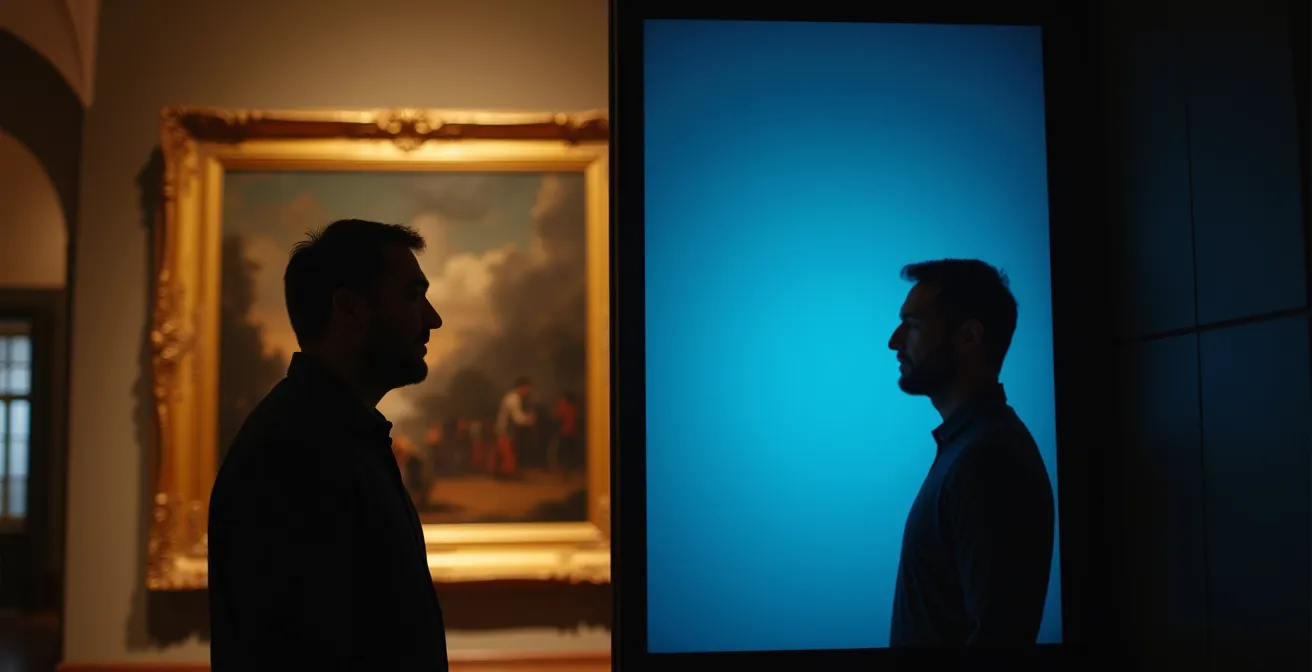
Contrary to the belief that an artwork’s “aura” is lost in digital copies simply due to a lack of originality, the true deficit lies deeper. This exploration reveals that an object’s aura stems from its “temporal thickness”—the accumulated, tangible history of its creation, its environment, its decay, and the human efforts to preserve it. Digital archiving flattens this rich narrative into a single, sterile moment, preserving the image but erasing the story embedded in its very substance.
In an age where entire museum collections are available at our fingertips, a fundamental question lingers in the quiet halls of galleries and the minds of art lovers. Why do we still feel the pull to stand before a physical canvas when a high-resolution digital image is just a click away? We often attribute this to vague notions of “originality” or the inability of a screen to convey true scale and texture. These are valid points, but they only scratch the surface of a much more profound phenomenon. The convenience of digital access seems to promise a democratization of art, yet it simultaneously threatens the very essence of what makes an artwork resonate through time.
The common discourse revolves around the physical experience versus the virtual one, but it rarely delves into the core of what is lost in translation. We accept that the digital is a copy, a ghost of the original. But what if the “aura” of a physical work is not merely in its uniqueness, but in its tangible, evolving history? What if the key lies not in the perfect, static image, but in the imperfect, dynamic object? The true failure of digital archiving is not that it creates a copy, but that it creates a timeless, weightless entity, stripped of the very layers of existence that grant it meaning.
This article moves beyond the surface-level debate to explore a deeper concept: the “temporal thickness” of physical art. We will investigate how an object’s life story—from the artist’s touch to the slow creep of decay and the meticulous hands of a conservator—is what constitutes its irreplaceable aura. By examining the neuroscience of perception, the philosophy of decay, and even the surprising lessons from preserving oral histories and exploring abandoned spaces, we will uncover why the soul of an object can never be truly uploaded.
To navigate this contemplative journey, this article is structured to peel back the layers of what constitutes an artwork’s profound presence. The following sections will guide you through the scientific, historical, and philosophical dimensions of the physical artifact in a digital world.
Summary: The Enduring Aura of the Physical Object
- Why Do We Still Visit Museums When We Can See High-Res Images Online?
- How to Clean an Old Oil Painting Without Damaging the Varnish?
- The Language Extinction Risk: What Happens When We Stop Telling Oral Stories?
- Local Gallery or National Museum: Which Supports Living Artists Better?
- When Is It Too Late to Save a Deteriorating Historical Site?
- Trespassing vs Public Access: How to Explore Without Getting Arrested?
- How to Store Cashmere to Prevent Moth Damage During Summer?
- Why Are Abandoned Buildings More Historically Telling Than Museums?
Why Do We Still Visit Museums When We Can See High-Res Images Online?
The pilgrimage to a museum is not an act of mere information gathering; it is a cognitive and emotional event. The physical presence of an artwork, its “here-and-nowness,” triggers a profoundly different response in our minds than any digital reproduction ever could. This is not simply a romantic notion but a neurological reality. Groundbreaking neuroscience research from the Mauritshuis museum reveals that our brains react with significantly greater intensity when viewing a real artwork compared to its digital counterpart. Key areas involved in self-reflection and episodic memory light up, suggesting that we are not just seeing an object, but are placing ourselves in a relationship with it, weaving it into our own life’s story.
This unique engagement is what the Yale Peabody Museum’s “Mind/Matter” exhibition sought to demonstrate. By showcasing original drawings from neuroscience pioneers alongside interactive stations, the museum highlighted how our perception is an active construction, built within the physical space of the gallery. The experience is not passive consumption; it is an active dialogue between the object and the viewer’s brain. The artwork’s physical scale, its position in the room, and the light that falls upon it are all data points our brain uses to build a unique, unrepeatable moment of perception.
This phenomenon is perhaps best exemplified by the singular power of certain masterpieces. A study on Vermeer’s “Girl with a Pearl Earring” articulated this power with precision, as described by the Mauritshuis Museum Research Team:
The secret behind the attraction of the ‘Girl’ is based on a unique neurological phenomenon. Unlike other paintings, she manages to ‘captivate’ the viewer, in a ‘sustained attentional loop.’
– Mauritshuis Museum Research Team, EEG Study on Vermeer’s Girl with a Pearl Earring
This “attentional loop” is a function of the artwork’s auratic presence. It commands the space and, in turn, commands our focus in a way a glowing rectangle on a screen cannot. A digital image is a piece of information we scroll past; a physical painting is an entity we stand before, a presence that holds our gaze. The digital world offers us a library of ghosts, but only the physical world offers us a genuine encounter.
How to Clean an Old Oil Painting Without Damaging the Varnish?
The question of cleaning an old painting is fraught with peril precisely because it involves interfering with the object’s physical history. This is not a simple act of maintenance; it is an irreversible intervention into the artwork’s “temporal thickness.” As the Smithsonian Museum Conservation Institute Guidelines state, “Cleaning is an irreversible treatment… Permanent damage may easily result from even the most cautious attempts.” This warning underscores a crucial truth: the layers of dust, grime, and yellowed varnish are not just obscuring the image; they are a part of the painting’s journey through time. To remove them is to erase a chapter of its story.
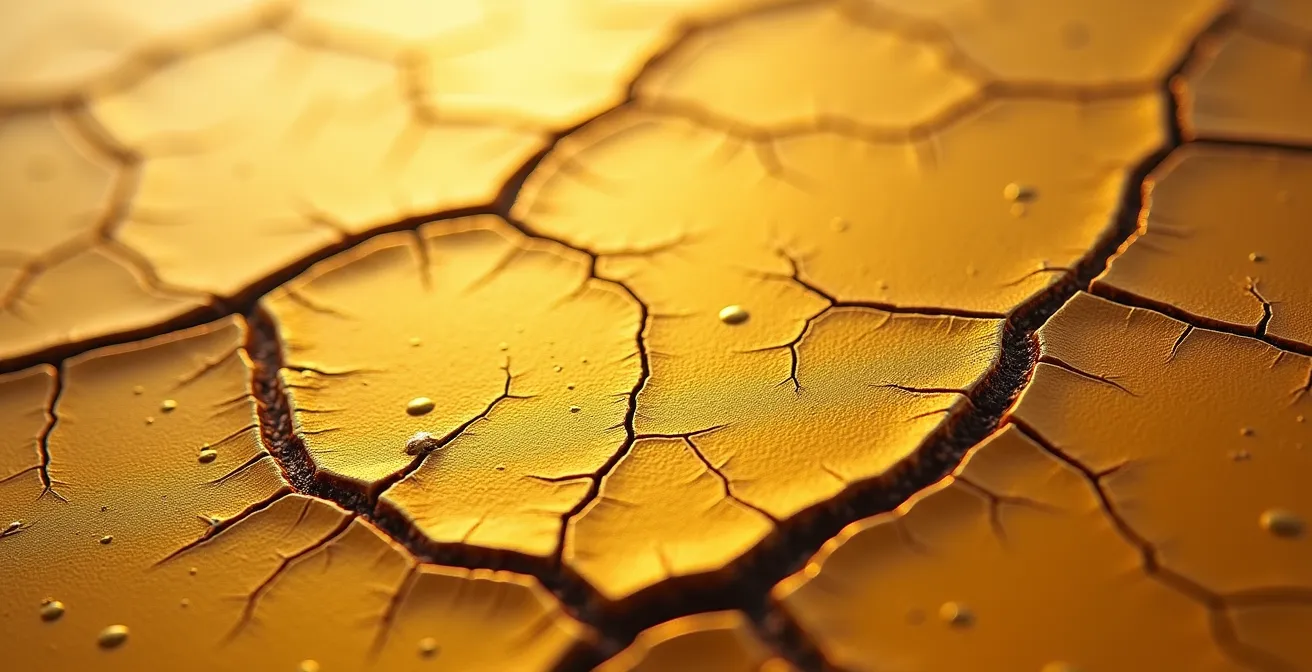
This accumulated history is what gives the surface of an old painting its profound character. The fine network of cracks, the subtle discoloration, the particles of time caught in the varnish—these are not flaws, but a testament to its survival. They form a narrative of decay that a perfect digital scan can document but never embody. The physical object carries its age with a visible, tactile gravity.
The act of conservation itself becomes another layer in this history. Consider the meticulous restoration of Monet’s “Waterlilies” at the Portland Art Museum. For six months, a conservator worked inch by inch, removing old varnish with custom tools. This human intervention, this intimate dialogue with the artist’s brushstrokes, adds a new, invisible layer to the painting’s biography. The restored work is not a return to an “original” state; it is a new state, one that carries the memory of both its creation and its preservation. A digital archive presents a single, idealized moment, but the physical object is a living document of its own complex, layered existence.
The Language Extinction Risk: What Happens When We Stop Telling Oral Stories?
The crisis facing endangered languages offers a powerful analogy for the loss of aura in art. When an oral story is merely transcribed or recorded, its informational content may be preserved, but its living essence—its performative aura—is lost. Storytelling is an event, a shared experience between the teller and the listener. The tone of voice, the gestures, the pauses, the audience’s reactions—these are all integral parts of the narrative, creating an unrepeatable moment in time. A digital file captures the words, but the event itself vanishes.
This vulnerability is why, according to the Digital Preservation Coalition’s assessment, oral histories are classified as ‘Endangered’ with an urgent need for action. The media they are stored on degrades, and the context of their creation fades. The preservation of these stories is not just a technical challenge but a cultural one. As the Refugee Law Project in Uganda discovered when creating a digital archive for forced migrants, the act of recording provides memorialization and therapy. However, as project members noted, the digital archive cannot replicate the live, communal element of traditional storytelling, where the story is a dynamic, co-created experience.
In this sense, a digital copy of a painting is like a written transcript of a vibrant oral tale. It gives you the plot but robs you of the performance. It flattens a multi-sensory, communal event into a silent, solitary piece of data. The “aura” of the oral tradition lies in its liveness, its impermanence, and its human connection. Similarly, the aura of a physical artwork is tied to its unique, unrepeatable presence in a specific time and place. Digital stasis can preserve the record, but it cannot preserve the experience, leaving behind a form of cultural memory that is factually accurate but emotionally and contextually barren.
Local Gallery or National Museum: Which Supports Living Artists Better?
The concept of “aura” is not monolithic; it shifts depending on context. The debate between supporting artists through a local gallery versus a national museum highlights how different environments cultivate different kinds of aura, each with its own relationship to the artist and audience. A local gallery often fosters an aura of intimacy and community. The connection is direct, personal, and rooted in a specific place. A national museum, by contrast, bestows an aura of official consecration and historical importance, placing the work within a grand, institutional narrative.
The digital or NFT space introduces a third type: a “networked aura,” built not on physical presence or institutional validation, but on shares, remixes, and provenance secured by a blockchain. Each of these spaces creates value and supports artists in fundamentally different ways. The following table, inspired by analysis of the digital art market, clarifies these distinctions and shows that digital aura is not a substitute for physical aura, but an entirely different phenomenon.
This comparison shows how different environments cultivate distinct forms of value and presence for an artwork.
| Aspect | Local Gallery | National Museum | Digital/NFT Space |
|---|---|---|---|
| Type of Aura | Intimacy and community | Official consecration | Networked aura through shares/remixes |
| Artist Support | Direct sales, personal connections | Institutional validation | Direct monetization via blockchain |
| Audience Reach | Local collectors | International visitors | Global digital natives |
| Value Creation | Scarcity through limited exposure | Historical importance | Digital provenance via blockchain |
Digital archiving, therefore, does not just “copy” the aura of a painting from a museum; it transmutes it into something else entirely. It replaces the aura of physical presence and historical weight with an aura of network circulation and digital scarcity. While this can create new forms of value, it fundamentally alters the artwork’s relationship to time, space, and the human observer. The question is not which is better, but recognizing that they are incommensurable modes of being. The digital ghost may be valuable, but it can never be the body.
When Is It Too Late to Save a Deteriorating Historical Site?
The question of when a historical site is “beyond saving” forces us to confront our relationship with decay. Often, our impulse is to halt time, to restore a site to a pristine, idealized state. However, this approach can inadvertently destroy the very thing that makes the site powerful: its visible passage through time. The “aura” of a ruin is not in its original grandeur but precisely in its deterioration. As one expert eloquently puts it:
The aura of a historical site is often found precisely in its decay. The erosion, the overgrowth, and the visible passage of time tell a story of impermanence and memory that a perfect digital reconstruction can document but not replicate.
– Heritage Conservation Specialist, Journal of Heritage Science on Digital vs Physical Preservation
This perspective suggests that “saving” a site is not about freezing it. Instead, it is about managing its story. A perfect 3D scan can preserve the informational integrity of a crumbling wall, but it cannot convey the feeling of standing in its shadow, sensing its fragility and resilience. The most thoughtful preservation strategies now embrace this duality. They seek to document both the “informational integrity” through digital means and the “auratic presence” of the physical site, even in its decaying state. This might involve “managed decay,” where natural aging is allowed to continue in a controlled way, or using augmented reality to overlay past states onto the present-day ruin.
The moment it becomes “too late” is not when the last stone crumbles, but when we decide that a perfect digital copy is an adequate replacement for the messy, complex, and deeply moving reality of the physical artifact. The digital archive serves as an essential record, an invaluable map, but the treasure it points to remains the tangible site itself, with all its beautiful, narrative-rich imperfections.
Action Plan: Digitally Archiving a Heritage Site’s Aura
- Document current state: Use high-resolution 3D scanning to capture the site’s condition before any intervention is made.
- Create rich metadata: Inventory not just architectural features but also document decay patterns, material erosion, and other signs of aging as part of the site’s historical record.
- Develop AR experiences: Create augmented reality overlays that allow visitors to see reconstructions of past states while still experiencing the physical presence of the current, decaying site.
- Establish ‘managed decay’ protocols: Define a conservation plan that balances structural preservation with the authentic aging process, accepting that the narrative of decay is part of the site’s value.
- Archive for duality: Consciously archive both the ‘informational integrity’ (the clean digital model) and document the ‘auratic presence’ (photos, videos, and descriptions of the site’s physical experience and atmosphere).
Trespassing vs Public Access: How to Explore Without Getting Arrested?
The allure of urban exploration—of entering forbidden, abandoned, or decaying spaces—offers a raw and potent insight into the nature of aura. The experience derives its power not just from what is seen, but from the act of reaching it. The difficulty, the risk, and the uncurated nature of the encounter create what could be called an “aura of the forbidden.” This is a meaning forged by scarcity and effort. As one urban explorer attests, this is precisely what digital access obliterates.
The risk, the exclusivity, and the uncurated nature of exploring a forbidden place generate a powerful experience of discovery. Digital access through drone footage or Google Earth provides the view but completely obliterates this ‘aura of the forbidden.’ The difficulty and illegality of access act as a powerful filter, making the experience scarce and therefore more meaningful.
– Urban Explorer
This perspective reveals that a significant part of an object’s or a place’s aura is tied to the journey of access. A perfect digital tour of the Chernobyl exclusion zone provides the visuals without the radiation, the anxiety, or the profound sense of transgression. It delivers the information but kills the experience. The friction of access—whether physical, legal, or emotional—is not a bug; it is a feature that generates meaning.
Interestingly, this dynamic is beginning to find a parallel in the digital world itself. The phenomenon of “digital trespassing” or “digital urban exploration” sees researchers and artists exploring forgotten servers, early versions of websites via the Wayback Machine, or defunct virtual worlds. Sifting through corrupted databases and broken links becomes a new form of archaeology. This pursuit creates its own “aura of lost data,” a sense of discovery rooted in navigating digital ruins. It proves that the desire for unmediated, challenging encounters is a fundamental human impulse, one that seeks out friction and imperfection even in the frictionless digital realm. The digital archive may present a clean, accessible final product, but the true explorer knows the story is often in the ruins it was built from.
How to Store Cashmere to Prevent Moth Damage During Summer?
At first glance, the act of storing a cashmere sweater seems worlds away from archiving a masterpiece. Yet, it serves as a perfect, tangible metaphor for the fundamental difference between physical and digital preservation. Preserving a physical object like cashmere is a cyclical, sensory task. It involves tangible actions: cleaning, folding, and placing it in a controlled environment with cedar or lavender. The maintenance is finite and predictable—a seasonal ritual. You can feel the texture of the wool, smell the cedar, and visually inspect for damage. The object has a stable physical reality.
Preserving a digital file, by contrast, is a perpetual, abstract, and thankless task. It is a constant war against entropy. As digital preservation experts warn that archives require constant migration and format updates, it becomes clear that a digital file is never truly “safe.” It is threatened by “bit rot” (the silent, slow degradation of data), format obsolescence (the inability to open old files), and link death. The labor is not a seasonal ritual but a continuous, invisible “gardening” against a tide of digital decay. The process is entirely abstract; you cannot feel or smell bit rot.
This contrast reveals the illusion of digital permanence. We think of the digital as eternal and the physical as fragile. In reality, a 500-year-old painting on a wooden panel has a more stable, predictable physical existence than a 5-year-old digital file stored on a hard drive. The painting’s temporal thickness gives it a resilience that the ephemeral, format-dependent digital file lacks. The effort to preserve the painting adds to its story. The effort to preserve the digital file is a frantic attempt to stop it from ceasing to exist altogether, an effort that leaves no trace on the file itself. The cashmere sweater ages; the digital file either exists perfectly or not at all.
Key Takeaways
- The “aura” of a physical object is not just its originality but its “temporal thickness”—the accumulated history of its existence, decay, and preservation.
- Viewing physical art triggers a deeper neurological engagement, involving memory and self-reflection, which digital reproductions cannot match.
- Decay and imperfection are not flaws but a “narrative of decay” that tells a story of time and memory, an essential part of an object’s aura that digital perfection erases.
- There is a crucial distinction between the “organic aura” of an object in its natural state of decay and the “curated aura” presented by institutions, which offers an official but decontextualized narrative.
Why Are Abandoned Buildings More Historically Telling Than Museums?
The ultimate expression of aura’s power lies in the comparison between a carefully curated museum and a raw, abandoned space. Museums serve an invaluable role, but they present history through a specific lens. They offer what the theorist Wolfgang Ernst calls a “curated aura.”
Museums present a ‘curated aura,’ where objects are decontextualized and placed within an official narrative. Abandoned buildings possess an ‘organic aura’ of things left in situ, allowing for direct, unmediated interpretation of history through decay and disorder.
– Wolfgang Ernst, Aura and temporality: The insistence of the archive
In a museum, an object is isolated, polished, and placed under perfect lighting with a plaque explaining its significance. Its story is told *to* you. In an abandoned building, objects remain in context—a dusty book on a collapsed shelf, a faded photograph on a peeling wall. This disorder preserves the relationships between things, showing how life was actually lived and left behind. This “organic aura” does not provide neat answers; it demands interpretation. The gaps, the chaos, and the missing pieces force our imagination to actively reconstruct the past, creating a far more personal and powerful connection than any pre-packaged narrative.
A digital tour of such a space, much like a museum exhibit, inevitably curates the chaos. It creates a path, focuses on certain details, and tells a story. It cleans up the overwhelming, non-linear encounter with time that defines the experience of being in a ruin. The digital archive, in its quest for clarity and accessibility, strips the object of its context, its mystery, and its power to provoke. It transforms an active site of discovery into a passive piece of content. The abandoned building is more historically telling not because it holds more facts, but because it preserves the raw, unmediated process of history itself—a process of slow decay, sudden abandonment, and eventual rediscovery. It is a story we must piece together ourselves, and in that effort, we find a meaning that no archive can ever give us.
Frequently Asked Questions About Why Are Abandoned Buildings More Historically Telling Than Museums?
What makes abandoned spaces more authentic than museum displays?
Abandoned spaces preserve contextual relationships between objects, showing how things were actually used and left behind, rather than arranged for viewing. This unmediated disorder provides a more direct, unfiltered glimpse into a past moment.
Can digital tours capture the chaos of abandoned places?
Digital tours inherently ‘clean up’ and organize chaos through narrative paths, destroying the non-linear, overwhelming encounter with time itself that defines these spaces. They guide the viewer, rather than allowing for true, unscripted discovery.
Why do gaps and missing pieces enhance historical understanding?
Incomplete evidence forces the viewer’s imagination to actively reconstruct the past, creating more personal and memorable connections than pre-packaged museum narratives. This active participation in interpretation forges a deeper bond with the history of the place.
Recognizing the profound difference between the physical object and its digital ghost is not a call to reject technology. Digital archives are essential tools for access, study, and informational preservation. However, as curators, scholars, and lovers of art, we must resist the temptation to see them as replacements. The aura of an artwork is not an esoteric quality but a tangible one, built from its physical journey through time. It is in the artist’s fingerprint, the crack in the varnish, the scent of old paper, and the weight of its presence in a room. To safeguard our cultural legacy, we must continue to make the pilgrimage, to stand before the object itself, and to allow its deep, layered story to unfold in our presence.