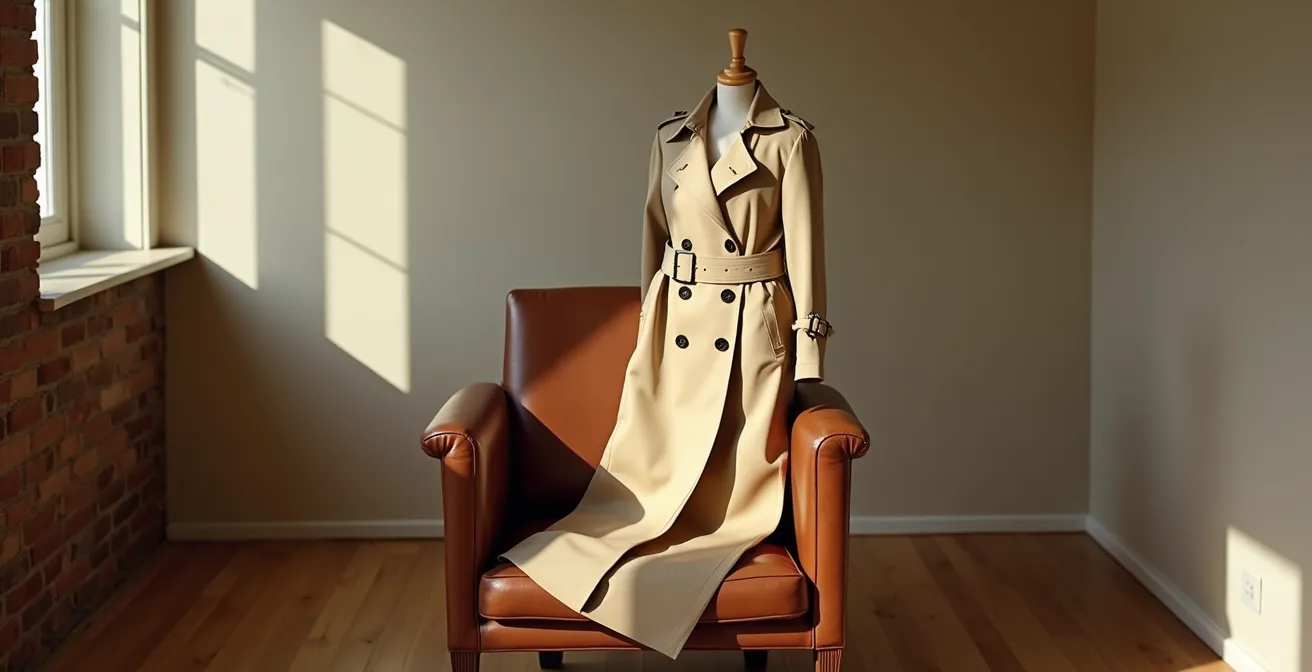
The trench coat’s timelessness isn’t about fashion trends; it’s a masterclass in enduring design principles that treat garments as long-term assets, not disposable goods.
- True classics are defined by their functional origin and material honesty, allowing them to gain character (patina) over time rather than just degrading.
- Lasting style comes from a core wardrobe of adaptable archetypes, so structurally sound they can even frame avant-garde fashion without losing their identity.
Recommendation: Shift your mindset from “cost” to “cost-per-wear” and begin evaluating potential wardrobe additions based on their material quality and functional integrity, not just their fleeting aesthetic appeal.
In a world of accelerating trends and seasonal purges, the trench coat stands as a quiet rebuke. For over a century, it has graced the shoulders of soldiers, silver-screen icons, and style-conscious citizens, seemingly immune to the whims of fashion. We’ve all heard the familiar stories of its military provenance with Burberry and Aquascutum, or seen it romanticized in cinema. These are its history, but they are not the reason for its immortality. The typical advice—to seek out its versatility or classic silhouette—scratches the surface but fails to answer the deeper question that plagues the modern consumer: why does this one garment endure while others become obsolete in a single season?
The answer has little to do with fashion and everything to do with a set of core design principles. The trench coat’s longevity is not an accident of style; it is the direct result of its profound functional integrity, its unapologetic material honesty, and its remarkable structural adaptability. These are not abstract concepts but tangible qualities that we can learn to identify, appreciate, and apply to our own sartorial choices. To understand the trench coat is to understand the difference between a fleeting fad and a sustainable investment.
This exploration will deconstruct the DNA of this iconic garment, not to repeat its history, but to extract its secrets. We will move beyond the superficial to build a framework for a truly timeless wardrobe, treating our clothes not as disposable objects, but as heritage pieces worthy of curation and care. By the end, you will see the trench coat not just as an article of clothing, but as a blueprint for enduring style.
To guide you through this philosophy of lasting style, we will explore the core principles that separate a fleeting purchase from a lifelong investment. This guide breaks down everything from the economics of quality to the art of preservation, using the trench coat as our primary case study.
Summary: Deconstructing the Timelessness of a Wardrobe Icon
- How to Justify Spending $300 on a Classic White Shirt?
- Wool vs Synthetic Blends: How to Spot Quality by Touch?
- The “Modern Twist” Trap: When Does a Classic Become Dated?
- What Are the 5 Non-Negotiable Items for a Classic Wardrobe?
- How to Store Cashmere to Prevent Moth Damage During Summer?
- Viral Fad vs Sustainable Trend: Which One Should You Invest In?
- How to Clean an Old Oil Painting Without Damaging the Varnish?
- How to Incorporate Deconstructed Fashion Into a Daily Wardrobe?
How to Justify Spending $300 on a Classic White Shirt?
The question of price is often the first barrier to building a lasting wardrobe. Faced with a $300 classic white shirt versus a $30 fast-fashion alternative, the choice seems obvious. However, this view fundamentally misunderstands value. The high price of a well-made garment is not an expense but an investment, a concept best understood through the metric of cost-per-wear. A cheap shirt may survive a dozen washes before it loses its shape, its seams fray, and its color dulls. The $300 shirt, crafted from superior cotton with meticulous stitching, is designed to be worn hundreds of times, improving with age. Over its lifespan, its cost-per-wear plummets, ultimately making it the more economical choice.
This shift in consumer perspective is not a niche ideal but a growing market reality. As consumers grow weary of disposable clothing, they are increasingly investing in quality and longevity. This movement is validated by economic forecasts, with some market research predicting a growth of 9.5% CAGR in the sustainable fashion market, projected to reach nearly $19 billion by 2033. Choosing a high-quality piece is a vote for a different kind of fashion economy—one built on durability, craftsmanship, and timelessness. Justifying the initial outlay requires reframing the purchase not as a cost for a single season, but as an acquisition of a long-term asset for your personal collection.
Wool vs Synthetic Blends: How to Spot Quality by Touch?
The second principle of enduring design is material honesty. A classic garment, like the trench coat, derives its longevity from the quality of its components. The original was crafted from gabardine, a tightly woven cotton invented by Thomas Burberry that was breathable yet water-resistant without synthetic coatings. This commitment to high-performance natural fibers is a hallmark of quality. Synthetics like polyester or nylon may mimic the look of wool or cotton, but they lack their essential character. They trap moisture, pill easily, and degrade over time, often ending up in landfills. Natural fibers, by contrast, are designed to live and evolve.
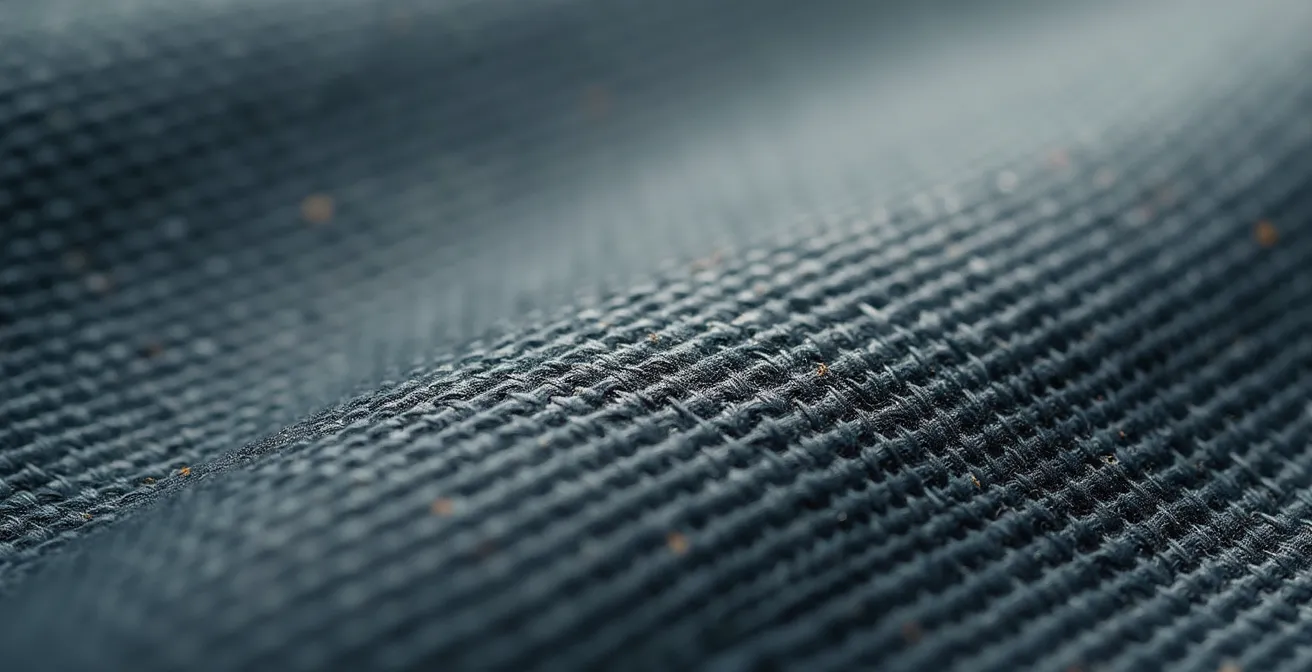
Learning to discern this quality is a sensory skill. It involves moving beyond brand labels and price tags to engage directly with the fabric. A high-quality wool or cotton gabardine feels dense and substantial in your hands. It has a structure and a “voice”—a subtle rustle that speaks to its tight weave. Synthetics often feel slick, unnaturally smooth, or lifelessly limp by comparison. They may have an artificial sheen under light, whereas quality wool possesses a soft, natural luster. Developing this tactile intelligence is crucial for any aspiring collector of timeless pieces.
Here are a few sensory checks to perform when assessing a garment’s quality:
- Touch Test: True gabardine has a dense, tight weave that creates a structural feel. It should feel robust and protective, yet breathable, a quality synthetics cannot replicate.
- Visual Check: Natural fibers display a depth and slight irregularity that signals authenticity. Quality wool has a rich luster, while polyester often has a flat, artificial shine.
- Drape Observation: Watch how the fabric hangs and moves. Natural fibers like wool and cotton create clean lines and fluid movement. Synthetics can appear stiff, boxy, or, conversely, overly flimsy.
- Sound Assessment: High-quality cotton gabardine often produces a distinctive, crisp ‘rustle’ when handled, a testament to its weave density. Cheap polyester blends are typically silent and soft in a way that signals a lack of structure.
The “Modern Twist” Trap: When Does a Classic Become Dated?
Every season, designers release “updated” classics, adding a trendy detail—an oversized lapel, an asymmetric hem, a bold print—to a timeless silhouette. This is the “modern twist” trap. While it promises relevance, it often injects a fatal dose of ephemerality into a garment designed for permanence. A true classic’s power lies in its design DNA—the core set of features that define its form and function. For the trench coat, this includes its double-breasted front, epaulettes, storm flap, and belted waist. These elements are not decorative; they are the survivors of a century of functional evolution.
A classic becomes dated the moment a “twist” overpowers its core DNA. A neon-green trench coat is no longer a trench coat; it is a neon-green coat from a specific, fleeting season. The most successful evolutions are those that respect the original blueprint, making subtle adjustments to proportion or silhouette without sacrificing the garment’s soul. When a classic’s essential features are treated as a canvas for a fleeting trend, its timelessness is compromised.
Case Study: Burberry’s Reverent Evolution
To understand how to successfully modernize a classic, one need only look at Burberry. The House has masterfully evolved the trench coat by introducing subtle shifts, such as dropped waistlines or sleeveless variations that function like elegant, long vests. As seen in collections from Gucci to Peter Do, these adaptations work because they don’t violate the coat’s fundamental principles of protection and structure. They are a dialogue with the original design, not a rejection of it. This reverence for the core DNA is why Burberry’s trench remains the benchmark, while countless imitations have faded into obscurity.
This distinction is increasingly valued by discerning consumers. Market analysis reveals that consumers are willing to spend 9.7% more on classic pieces that are produced sustainably and authentically, signaling a rejection of disposable, trend-led items. Investing in a classic means investing in its original, unadulterated form, trusting that its proven design is more powerful than any passing fad.
What Are the 5 Non-Negotiable Items for a Classic Wardrobe?
The principles embodied by the trench coat—functional origin, material quality, and adaptable design—are not unique to it. They are the building blocks of any truly timeless wardrobe. Building such a collection is not about amassing clothes, but about curating a small number of versatile, high-quality archetypes. These are the non-negotiable pieces that provide the foundation for a lifetime of style. Each one serves a distinct purpose, yet they all work in concert, creating an exponential number of outfits from a minimal base. They are not defined by a brand or a season, but by their archetypal function.
These five items represent a complete sartorial toolkit, each with a rich history rooted in utility. Their power lies in their simplicity and their proven ability to adapt to changing times without losing their essence. They are the blank canvases and structural beams upon which personal style is built.
The following table outlines these five functional archetypes, their historical origins, and their role within a classic wardrobe. As a report from Gentleman’s Gazette on the trench coat’s history illustrates, the value of these pieces is rooted in their proven utility and versatility over decades.
| Archetype | Example Item | Historical Origin | Versatility Score |
|---|---|---|---|
| Protective Outer Layer | Trench Coat | WWI Military (1914) | 10/10 |
| Structural Foundation | Dark Wash Jeans | American Workwear (1873) | 9/10 |
| Blank Canvas | White Oxford Shirt | British Polo (1896) | 10/10 |
| Refined Knit | Cashmere Sweater | Scottish Heritage (15th c.) | 8/10 |
| Go-Anywhere Footwear | Leather Boots | Military/Riding (17th c.) | 9/10 |
Action Plan: Auditing Your Wardrobe for Timelessness
- Identify Archetypes: Go through your wardrobe and categorize key pieces. Do you have a true ‘Protective Outer Layer’ or just a trendy jacket? A ‘Blank Canvas’ shirt or a disposable top?
- Assess Material Quality: For each potential classic, perform the sensory checks. Is it made of honest, natural materials (wool, cotton, leather) or degrading synthetics? Be ruthless.
- Evaluate Functional Integrity: Does the item serve its original purpose well? Are your boots genuinely durable? Does your coat offer real protection? Functionality is the bedrock of longevity.
- Test for Versatility: Can you create at least five distinct outfits with the item using other core pieces from your wardrobe? A true classic should multiply your options, not limit them.
- Create an Investment Plan: Identify the missing archetypes or pieces that need a quality upgrade. Plan to invest in one high-quality, timeless piece per season instead of multiple fast-fashion items.
How to Store Cashmere to Prevent Moth Damage During Summer?
Viewing garments as investments fundamentally changes our relationship with them. It shifts the focus from acquisition to curation and preservation. A timeless piece is not meant to be worn for a season and discarded; it is an artifact intended to last for years, even decades. This requires adopting the mindset of a conservator. Just as a museum protects its collection, we must protect our investment pieces from their natural enemies: pests, moisture, and improper storage. Moths, in particular, pose a significant threat to cherished natural fibers like cashmere and wool.
The common mistake is to believe moths are attracted to the fibers themselves. In reality, they are drawn to residual human oils, skin cells, and food particles left on unwashed clothes. Therefore, the first and most critical step in preservation is meticulous cleaning before storage. Storing a garment dirty is an open invitation to damage. Beyond cleaning, the storage environment itself is key. Plastic garment bags, while seemingly protective, are a death sentence for natural fibers, as they trap microscopic moisture that can lead to mildew and fiber degradation. Breathable storage is non-negotiable.
Adopting a conservator-grade protocol ensures your most prized possessions, like a delicate cashmere sweater, survive the off-season to be enjoyed for many years to come.
- Pre-Storage Cleaning: Always professionally dry clean or hand-wash items before storing them for the season. This removes the organic residues that attract pests.
- Controlled Freezing Method: For ultimate certainty, place clean, dry garments in sealed plastic bags and freeze them at -18°C (0°F) for at least 72 hours. This effectively kills any existing larvae or eggs.
- Archival Wrapping: Wrap pieces in acid-free tissue paper. This buffers the garment from environmental changes and prevents yellowing over time.
- Natural Repellents: Avoid chemical mothballs, whose paradichlorobenzene fumes can damage fibers and are toxic. Opt for natural, effective alternatives like cedar blocks, lavender sachets, or modern pheromone traps.
- Breathable Containers: Store knitwear folded in breathable cotton garment bags or archival boxes. Never hang heavy knits like cashmere, as this will stretch them out of shape.
Viral Fad vs Sustainable Trend: Which One Should You Invest In?
In today’s hyper-connected world, the line between a viral fad and a genuine, sustainable trend can seem blurry. A fad is an aesthetic phenomenon, often driven by social media, that explodes in popularity and vanishes just as quickly. It has no roots and no function beyond its novelty. A sustainable trend, by contrast, is a slow-burning evolution rooted in function, culture, and quality. It solves a problem or serves a purpose, which is why it endures. The trench coat is the ultimate case study in the latter.

Born from the functional need for a lighter, more practical greatcoat for soldiers in World War I, its design was dictated by utility, not by a stylist’s whim. Veterans brought the coats home after the war, and their inherent practicality and handsome structure allowed them to seamlessly transition into civilian life. For over 100 years, the trench coat has adapted to every cultural shift, from the austerity of the post-war era to the glamour of Hollywood and the minimalism of the 21st century. This journey demonstrates all the markers of a sustainable trend: it has a functional origin, it shows adaptability across eras, and it carries a symbolic value that transcends mere aesthetics.
Investing your time and money in sustainable trends over viral fads is not just a stylistic choice; it’s a sound economic one. The fashion industry is undergoing a seismic shift, with projected growth of 19.68% CAGR by 2035 for the sustainable fashion market. This staggering figure confirms that the future of fashion lies not in disposable fads, but in timeless, well-made pieces. Choosing to invest in a classic is to align yourself with this powerful and positive trajectory.
How to Clean an Old Oil Painting Without Damaging the Varnish?
This question, seemingly from another world, holds the most profound secret to a timeless wardrobe. How we care for a piece of fine art is exactly how we should care for a piece of fine clothing. The principles of conservation are universal. An art conservator’s goal is not to make a 200-year-old painting look brand new; it is to stabilize it, preserve its integrity, and honor the story told by its age. The fine network of cracks in the varnish, known as craquelure, is part of its history and charm. To aggressively strip it away would be an act of vandalism.
Similarly, the goal in caring for a heritage garment—be it a vintage trench coat or a grandfather’s cashmere scarf—is not to erase its life. It is to preserve its story. The way a quality cotton gabardine softens and molds to its owner’s body, the subtle fading along the seams, the development of a unique sheen or ‘patina’—these are not flaws. They are marks of character, testaments to a life lived. Trying to scrub them away with harsh chemicals or aggressive cleaning is to misunderstand the very essence of a timeless object.
As one conservation specialist aptly notes when discussing heritage garments:
Just as aged varnish on a painting can be part of its charm, the way a quality trench coat ages and molds to the owner creates its unique patina. The goal isn’t to make it look brand new, but to preserve its integrity and story.
– Conservation specialist, Heritage Garment Care Principles
This perspective demands a gentle, informed approach. Before acting, we must understand the material and test our methods. The core principles of art preservation apply directly to garment care:
- Test First: Just as a conservator tests a cleaning solvent on the edge of a painting, always test a cleaning method on an inconspicuous area of the garment, like an inside seam.
- Understand the Material: Know your fabric. Is it a robust waxed cotton or a delicate silk blend? The material dictates the treatment.
- Use the Gentlest Approach: Start with the mildest effective method. Often, simply airing a garment out or using a soft brush is sufficient. Chemical intervention should be a last resort.
- Preserve the Protective Layer: Never needlessly strip the original finish from a garment, be it the water-repellent coating on a trench or the lanolin in raw wool. This ‘varnish’ is part of its function.
Key Takeaways
- True timelessness stems from an item’s functional purpose, not its aesthetic—a principle called Functional Integrity.
- Invest in ‘material honesty’: natural fibers like wool and cotton that gain a beautiful patina with age, unlike synthetics which simply degrade.
- A classic’s “design DNA” is its strength; beware of “modern twists” that inject temporary trends and compromise long-term relevance.
How to Incorporate Deconstructed Fashion Into a Daily Wardrobe?
The final, and perhaps greatest, test of a classic’s power is its structural adaptability. Can it hold its own in a sartorial dialogue with something completely antithetical to its nature? Deconstructed fashion, pioneered by designers like Martin Margiela, is the perfect foil. It is a style defined by exposed seams, raw edges, and repurposed materials—the very opposite of the trench coat’s meticulous construction and polished finish. Attempting to wear a full deconstructed look can feel intimidating or unwearable for daily life. This is where the classic archetype demonstrates its ultimate utility.
The trench coat, in this context, acts as a frame. Its strong, familiar silhouette provides a grounding structure that makes the avant-garde accessible. Throwing a perfectly constructed trench coat over a deconstructed dress or a raw-hemmed shirt creates a sophisticated tension. The coat says “structure, history, and order,” while the piece beneath it says “rebellion, process, and art.” The combination is not chaotic; it’s a compelling conversation. The classic does not tame the experimental piece, but rather gives it a context, making its challenging ideas more digestible for the everyday world.
This ability to absorb and elevate other styles without losing its own identity is the hallmark of a truly powerful design. The trench coat’s clean lines and undisputed heritage provide a stable anchor, allowing the wearer to explore more radical fashion territories with confidence. It proves that a wardrobe built on timeless foundations is not boring or restrictive; on the contrary, it is the most liberating platform from which to experiment. The classics are not the end of personal style, but the most solid beginning.
By embracing these principles of functional integrity, material honesty, and structural adaptability, you transform your role from a passive consumer to an active curator. You can begin building a collection of garments that not only serve you for a lifetime but also tell a story—your story. Start by evaluating one piece in your wardrobe not for its brand, but for its adherence to these enduring values.