
Sunscreen is not an “anti-aging cream”; it is a non-negotiable medical tool for preventing cellular degradation caused by the full spectrum of UV radiation.
- The SPF number only measures UVB (burning) protection, while UVA (aging) rays are the primary driver of wrinkles and loss of elasticity.
- Up to 80% of visible aging is due to cumulative, daily sun exposure, including on cloudy days and through windows.
Recommendation: The most effective anti-aging strategy is the daily, consistent use of a broad-spectrum sunscreen that explicitly states its UVA protection (e.g., PA++++ rating).
In the relentless search for the ‘fountain of youth,’ consumers are inundated with promises packaged in expensive jars and complex multi-step routines. The market promotes potent retinoids, exclusive peptide complexes, and exotic botanical extracts as the definitive answer to wrinkles and fine lines. Many diligently follow these regimens, believing they are employing the best defense against the visible signs of aging. Yet, a fundamental misunderstanding persists, leading many to neglect the single most critical component of skin preservation.
The common approach is to treat aging as a problem to be corrected after the fact. But what if the most effective strategy was not correction, but unwavering prevention? The clinical consensus is clear: the most powerful anti-aging product is not a complex serum, but the sunscreen you should be wearing every single day. This isn’t about preventing sunburn after a day at the beach; it’s about mitigating the invisible, cumulative cellular degradation that occurs from daily, incidental exposure to UV radiation.
This article will dissect the medical and scientific rationale behind this declaration. We will move beyond the simplistic advice to “wear sunscreen” and explore the distinct roles of UVA and UVB rays, the reality of sun damage on overcast days, the proper application and reapplication techniques, and how to choose the right formulation for your skin. Understanding these principles is the key to transforming your skincare from a hopeful ritual into a clinically effective anti-aging strategy.
Summary: Why SPF Is Clinically Proven as the Top Anti-Aging Defense
- Aging vs Burning: Why Does High SPF Not Guarantee Anti-Aging Protection?
- How to Reapply Sunscreen at 2 PM Without Ruining Your Foundation?
- Mineral or Chemical SPF: Which Is Better for Acne-Prone Skin?
- The “It’s Cloudy” Mistake That Accumulates Significant Sun Damage
- When to Throw Away Last Summer’s Sunscreen Bottle?
- AM or PM: When Is the Best Time to Apply Antioxidants for Protection?
- How to Differentiate Between Retinol Purging and a Breakout?
- Why Is Vitamin C Unstable and How Does It Affect Your Glow?
Aging vs Burning: Why Does High SPF Not Guarantee Anti-Aging Protection?
A pervasive and dangerous misconception is that a high Sun Protection Factor (SPF) number offers complete protection. This is fundamentally incorrect. The SPF value on a bottle primarily measures protection against UVB radiation, the rays responsible for visible sunburn and skin reddening. However, it provides a very poor indication of protection against UVA radiation, the primary driver of photoaging.
UVA rays penetrate deeper into the skin’s dermis, where they degrade collagen and elastin fibers. This process is silent and painless. It doesn’t cause a burn, but it methodically dismantles the skin’s structural support, leading directly to wrinkles, sagging, and a loss of firmness over time. UVB radiation also contributes to aging, but UVA’s deeper penetration and year-round prevalence make it the principal agent of long-term damage. Research comparing the effects of short-term exposure confirms that while UVB might induce more rapid superficial damage, the cumulative impact of UVA is profound.
Therefore, relying solely on a high SPF number like 50 or 100 is a flawed strategy. For true anti-aging defense, you must seek out a “broad-spectrum” sunscreen specifically formulated and tested to block UVA rays effectively. Without robust UVA protection, you are only preventing the burn, not the aging. This is why understanding UVA rating systems is more critical for anti-aging than obsessing over the highest SPF number.
Your Action Plan: Verifying True Anti-Aging (UVA) Protection
- Review Your Product: Check for a “PA++++” rating, commonly found on Asian sunscreens, which signifies the highest level of UVA protection.
- Decode European Labels: Look for a “PPD” (Persistent Pigment Darkening) value of 16 or higher, or a UVA logo in a circle, indicating strong UVA defense.
- Confirm Broad-Spectrum Claims: Ensure the label explicitly states “Broad-Spectrum” and protects against both UVA and UVB rays, a requirement in regions like the U.S.
- Re-evaluate SPF’s Role: Internalize that the SPF number measures UVB (burning) defense, not the comprehensive UVA (aging) defense crucial for preventing wrinkles.
- Seek Advanced Filters: Prioritize products containing stabilized, modern UVA filters such as Mexoryl, Tinosorb, or Avobenzone to ensure long-lasting protection.
How to Reapply Sunscreen at 2 PM Without Ruining Your Foundation?
The principle of sunscreen efficacy relies on consistent application and, crucially, reapplication. A single morning application is insufficient, as sunscreen’s protective filters degrade with sun exposure and simply wear off over a few hours. For anyone wearing makeup, the mandate to reapply every two hours presents a significant practical challenge. Attempting to rub a traditional lotion over a perfectly set foundation is a recipe for a cakey, streaky mess.
Fortunately, the cosmetic industry has developed innovative solutions designed specifically for this purpose. The goal is to add a fresh layer of UV protection without disturbing the makeup underneath. These modern formats deposit a fine layer of sunscreen actives on top of the skin, reinforcing the protective barrier. The key is to choose a method that aligns with your skin type and desired finish. For instance, those with oily skin may prefer a mattifying powder, while those with dry skin might benefit from the hydrating qualities of a mist or stick.
This illustration highlights a popular and effective method: using a cushion compact. The sponge applicator allows for a gentle patting motion, depositing a thin, even layer of SPF over existing makeup without rubbing or smearing. This technique provides effective reapplication while maintaining the integrity of your foundation.
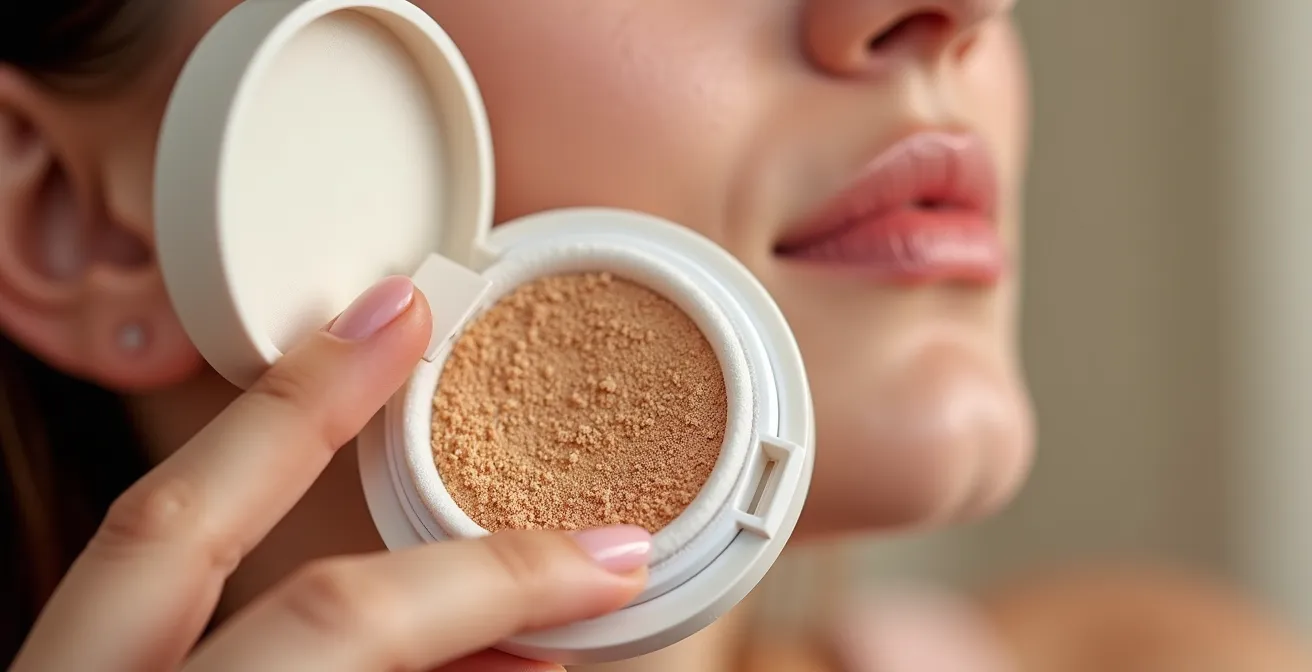
As you can see, the application is controlled and targeted. Choosing the right tool makes reapplication a simple touch-up rather than a complete do-over. The following table compares the most common methods for reapplying sunscreen over makeup, helping you select the best option for your needs and lifestyle.
| Method | Protection Level | Finish | Best For | Portability |
|---|---|---|---|---|
| SPF Spray Mist | Moderate | Dewy | All skin types | Excellent |
| SPF Stick | High | Natural | Dry skin | Excellent |
| Cushion Compact | Moderate-High | Matte to Dewy | Oily skin | Good |
| Powder SPF | Low-Moderate | Matte | Oily skin | Excellent |
Mineral or Chemical SPF: Which Is Better for Acne-Prone Skin?
For individuals with acne-prone or sensitive skin, the choice of sunscreen can feel like a minefield. Many formulations can feel heavy, clog pores, and trigger breakouts, leading some to forgo sun protection altogether—a dangerous decision. The primary distinction lies between mineral (or physical) and chemical sunscreens, and for acneic skin, the evidence strongly favors one category.
Chemical sunscreens work by absorbing UV radiation and converting it into heat. This category includes ingredients like oxybenzone, avobenzone, and octinoxate. While often formulated to be lightweight and cosmetically elegant, the ingredients themselves or the chemical reaction on the skin can sometimes cause irritation, allergic reactions, and sensitivity for reactive skin types.
Mineral sunscreens, on the other hand, use active mineral ingredients—typically zinc oxide and/or titanium dioxide—to create a physical barrier that sits on top of the skin and reflects UV rays. Zinc oxide is particularly beneficial for acne-prone skin. It is known for its calming and anti-inflammatory properties. Furthermore, specific research demonstrates that mineral sunscreens with zinc oxide can inhibit the growth of Cutibacterium acnes, the bacteria implicated in acne formation. This makes mineral formulations not just inert, but potentially beneficial for managing breakouts.
When selecting a sunscreen for acne-prone skin, it is also crucial to inspect the “inactive” ingredients list for common pore-clogging culprits. Even a well-formulated mineral sunscreen can cause breakouts if it is in a base containing comedogenic oils or esters. Always look for products explicitly labeled as “non-comedogenic.”
- Avoid Coconut Oil (highly comedogenic)
- Skip Isopropyl Myristate (known pore-clogger)
- Avoid Denatured Alcohol (can trigger irritation and breakouts)
- Check for Butyloctyl Salicylate (potentially comedogenic)
- Choose non-nano zinc oxide for a gentler formulation
The “It’s Cloudy” Mistake That Accumulates Significant Sun Damage
One of the most common and damaging skincare myths is the belief that sunscreen is only necessary on bright, sunny days. This leads many people, especially those skeptical of daily use, to skip protection on overcast days, during winter, or when sitting indoors near a window. From a clinical perspective, this is a critical error in judgment that significantly accelerates photoaging.
UV radiation is not contingent on visible sunlight or heat. Up to 80% of the sun’s UV rays can penetrate through clouds, haze, and fog. While UVB rays (the burning rays) are partially blocked, UVA rays (the aging rays) remain remarkably consistent. This means that on a cool, gray day, your skin is still being bombarded with the very radiation that destroys collagen and causes wrinkles, sun spots, and a loss of skin elasticity. This damage is insidious because it occurs without the warning signal of a sunburn.

The same principle applies to being indoors. Standard glass windows effectively block most UVB rays, which is why you won’t get a sunburn sitting by a window. However, they do a very poor job of filtering out UVA rays. If you spend your days working in an office with large windows or have a long commute by car, you are accumulating significant UVA exposure over months and years. This cumulative, incidental exposure is a primary contributor to the visible signs of aging. It’s not the few days a year you spend at the beach that define your skin’s fate; it’s the small, daily doses of UVA you receive without even realizing it.
When to Throw Away Last Summer’s Sunscreen Bottle?
Using an expired or improperly stored sunscreen is almost as dangerous as using no sunscreen at all. It provides a false sense of security while leaving your skin vulnerable to the full spectrum of UV radiation. Sunscreen is not an inert cream; it is a drug product whose active ingredients degrade over time, a process that is rapidly accelerated by heat and light.
By law in many regions, sunscreens are required to maintain their stated SPF value for three years. This means an unopened, properly stored bottle is generally safe to use until its printed expiration date. However, this three-year rule becomes irrelevant the moment the bottle is opened and exposed to the elements. Once you start using a sunscreen, you should aim to finish it within one season or, at most, 12 months. Last summer’s half-used bottle is a liability.
Heat is the primary enemy of sunscreen stability. Leaving a bottle in a hot car, in direct sunlight at the beach, or even in a steamy bathroom can cause the chemical filters to break down and the emulsion to separate, rendering it ineffective long before its official expiration date. A sunscreen stored in a car where temperatures can soar can lose a significant portion of its efficacy in just a few hours. Always store your sunscreen in a cool, dark place. Before using an old bottle, perform a sensory check: any change in color (often yellowing), texture (separation of oil and water), or smell (a rancid or plastic-like odor) is a definitive sign that the product must be discarded immediately.
AM or PM: When Is the Best Time to Apply Antioxidants for Protection?
While sunscreen is the first line of defense against UV radiation, it is not an impenetrable shield. Some UV rays will inevitably reach the skin, where they can generate highly reactive molecules called free radicals. This process, known as oxidative stress, is a major pathway for cellular damage, inflammation, and accelerated aging. This is where antioxidants play their crucial, synergistic role.
Antioxidants are compounds that can neutralize free radicals before they have a chance to harm skin cells, including damaging cellular DNA. As confirmed by high-level dermatological research, UVA can indirectly damage DNA by generating reactive oxygen species (ROS), and mitochondria are a primary source of this damage in UV-irradiated skin cells. By scavenging these ROS, antioxidants essentially provide a second layer of defense that backs up your sunscreen.
Given this mechanism, the timing of antioxidant application is critical. While they can provide some benefit at night by helping to repair damage, their primary protective function is most needed during the day. Applying an antioxidant serum in the morning (AM), before your sunscreen, creates a reservoir of protection in the skin. This reservoir works throughout the day to neutralize the free radicals generated by exposure to UV radiation, pollution, and other environmental stressors. Using them at night is beneficial, but using them in the morning is non-negotiable for maximum photoprotection. A classic and effective combination is a serum containing Vitamins C, E, and Ferulic Acid, which work synergistically to bolster the skin’s defenses and even enhance the protective power of your sunscreen.
How to Differentiate Between Retinol Purging and a Breakout?
Retinoids are a cornerstone of anti-aging dermatology, renowned for their ability to accelerate cell turnover and boost collagen production. However, their introduction into a skincare routine can often trigger an initial period of breakouts, leaving users confused and discouraged. It’s crucial to differentiate between “purging,” a temporary and ultimately positive reaction, and a standard “breakout,” which indicates the product is not suitable for your skin.
Purging is the skin’s reaction to an active ingredient that increases cell turnover. The retinol speeds up the process of bringing microcomedones—tiny, invisible clogged pores that are already forming under the surface—to a head. This results in a sudden flare-up of small, often superficial bumps in the areas where you typically get acne. While frustrating, this is a sign that the product is working to clear out congestion. A purge typically resolves within 4-6 weeks as the skin adjusts.
A breakout, in contrast, is an adverse inflammatory reaction. It may be caused by irritation from the retinol itself or by other comedogenic ingredients in the product’s base formula. Breakout pimples often appear in new areas where you don’t usually experience acne, tend to be deeper, more cystic and inflamed, and will persist or worsen beyond the 6-week mark. This is a sign to discontinue use. The following guide can help diagnose the reaction.
| Factor | Purging | Breakout |
|---|---|---|
| Location | Occurs in usual breakout zones | Appears in new areas |
| Duration | Clears faster (4-6 weeks) | Lingers longer (8+ weeks) |
| Appearance | Smaller, less inflamed bumps | Deep, cystic, painful spots |
| Timing | Starts 2-4 weeks after retinol | Can occur anytime |
| Pattern | Gradually improves | May worsen over time |
While products like retinol are powerful, they are secondary. The foundational truth remains. As dermatologist Dr. Libby Rhee, M.D. states in Good Housekeeping, a crucial perspective must be maintained:
It’s estimated that 80% of the skin changes we attribute to chronological aging, like wrinkles and dark spots, are due to the cumulative effects of day-to-day sun exposure. In that sense, they are largely preventable with the daily and consistent use of broad spectrum sunscreen. Sunscreen is the best anti-aging defense, no matter what other anti-aging products you apply.
– Dr. Libby Rhee, M.D., Good Housekeeping Beauty Lab
Key Takeaways
- True anti-aging protection comes from blocking UVA rays, not just having a high SPF (UVB) number. Look for “Broad-Spectrum” and a PA++++ rating.
- Sun damage is cumulative and occurs even on cloudy days and through windows. Daily sunscreen use is non-negotiable.
- Reapplying sunscreen over makeup is essential and can be done without ruining your look using modern formats like SPF mists, sticks, or cushion compacts.
Why Is Vitamin C Unstable and How Does It Affect Your Glow?
Vitamin C, particularly in its pure form as L-ascorbic acid, is a gold-standard antioxidant. It is scientifically proven to neutralize free radicals, support collagen production, and brighten the complexion. However, its significant drawback is its inherent instability. L-ascorbic acid degrades rapidly when exposed to three key elements: light, air, and water.
This instability is a major challenge in cosmetic formulation. When a Vitamin C serum oxidizes, it not only loses its efficacy but can potentially become pro-oxidant, creating the very damage it is meant to prevent. The tell-tale sign of oxidation is a change in color, with the serum turning from clear or pale yellow to a darker yellow, orange, or brown. Once this happens, the product is no longer beneficial and should be discarded.
To combat this, it is critical to select products designed with stability in mind. This involves two key aspects: formulation and packaging.
- Formulation: Many modern products use more stable Vitamin C derivatives, such as Tetrahexyldecyl Ascorbate (THD) or Ethylated L-Ascorbic Acid. These forms are less prone to oxidation and are often more gentle on the skin. Another strategy is to use anhydrous (water-free) formulas, which remove one of the key degradation triggers. The inclusion of other antioxidants like Vitamin E and Ferulic Acid can also help to stabilize the L-ascorbic acid and boost its performance.
- Packaging: Never buy a Vitamin C serum packaged in a clear glass bottle with a simple dropper. Look for products in opaque, airless pump bottles. This type of packaging protects the formula from both light and air, dramatically extending its effective lifespan and ensuring the product you apply is still potent. Proper storage in a cool, dark place is also essential.
Ensuring your Vitamin C is stable is the only way to guarantee you are receiving its full protective and glow-enhancing benefits. An oxidized product is, at best, a waste of money and, at worst, detrimental to your skin’s health.
Frequently Asked Questions About Sunscreen Efficacy and Aging
What are the visual signs of expired sunscreen?
The most common signs that a sunscreen has expired or degraded are a change in color (it often turns yellow), a separation of the formula into distinct oil and water phases, or the development of a rancid, off, or plastic-like odor.
Can sunscreen stored in a hot car still be effective?
No, it should not be considered effective. Extreme heat, such as that inside a car on a sunny day, can cause the active ingredients in sunscreen to break down significantly in just a few hours. This degradation makes the printed expiration date irrelevant and renders the product unreliable for protection.
Ultimately, the most profound anti-aging action you can take is to commit to a strategy of diligent, daily prevention. Start today by making a broad-spectrum, high-UVA-protection sunscreen a non-negotiable part of your morning routine, 365 days a year.