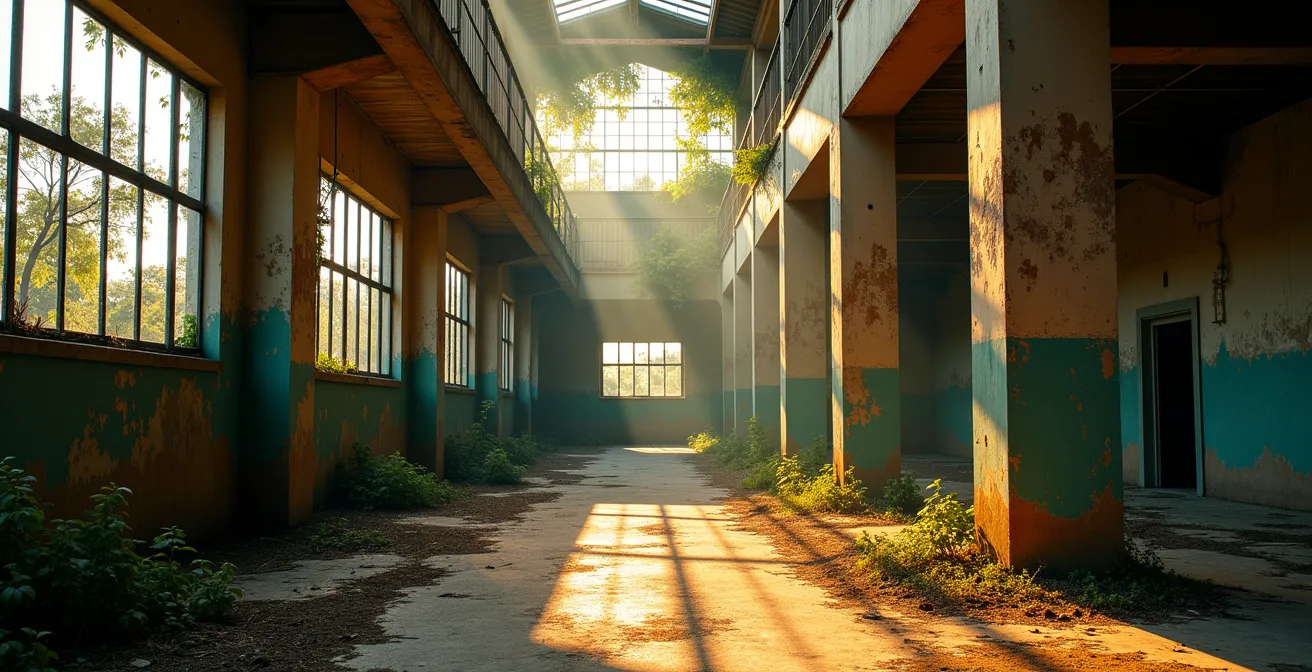
We often think of abandoned buildings as empty shells, voids where history used to be. The truth is far more profound. These spaces are not silent; they are active historical documents where the very process of decay, neglect, and reclamation by nature tells a raw, uncurriculated story about our society, economy, and the passage of time—a story that polished museum exhibits are specifically designed to erase.
There is a unique silence that hangs in the air of an abandoned place. It’s a quiet filled not with absence, but with the weight of untold stories. For the adventurous traveler or photographer, the allure of “Urbex” (urban exploration) goes far beyond the thrill of discovery. It’s a pilgrimage to the footnotes of history, to places that have slipped through the cracks of official narratives. We are conditioned to seek history behind the velvet ropes of a museum, presented in clean, well-lit displays with neat placards explaining their significance. We are told what to see, what to think, and what it all means.
This curated experience, while valuable, is inherently sanitized. It removes the object from its context, polishing away the grime, the rust, and the slow, inevitable collapse that is, in itself, a crucial part of the story. But what if the real narrative isn’t just in the artifacts that are saved, but in the very process of what is left to be forgotten? What if the language of decay—the peeling paint, the water stains, the way a floorboard sags—is a more honest historical text than any museum catalog? This guide is not about glorifying trespassing or destruction. It is an exploration into a different kind of historical literacy: learning to read the uncurated archives of our cities.
We will delve into the ethics and methods of this practice, from distinguishing public access from illegal entry to the techniques for finding and documenting these temporal capsules. We’ll explore how to capture their soul through a camera lens and understand the complex social narratives, like gentrification, that they reveal. Ultimately, we will confront the most vital question: what is the “aura” of a physical place, and why does it resonate so much more deeply than any digital or curated re-creation? Prepare to see the forgotten corners of your world not as ruins, but as revelations.
For those who prefer a visual format, the following video offers a powerful immersion into the atmosphere of one such magnificent abandoned site, complementing the practical advice and historical reflections in this guide.
This article is structured to guide you from the practical foundations of urban exploration to a deeper philosophical understanding of its importance. The following summary outlines the journey we are about to take into the heart of forgotten history.
Summary: Uncovering the Narrative Power of Urban Decay
- Trespassing vs Public Access: How to Explore Without Getting Arrested?
- How to Find “Secret” Spots in Your City Using Google Satellite View?
- The Floorboard Danger Sign You Must Recognize in Abandoned Houses
- How to Shoot Sharp Photos in Dark Basements Without a Tripod?
- Golden Hour or Blue Hour: Which Lighting Mood Suits Industrial Decay?
- Why Does Street Art Correlate with Rising Rent Prices?
- When Is It Too Late to Save a Deteriorating Historical Site?
- Why Does Digital Archiving Fail to Capture the “Aura” of Physical Art?
Trespassing vs Public Access: How to Explore Without Getting Arrested?
The first and most critical distinction for any urban historian is the line between respectful observation and illegal trespass. A museum has clear opening hours; an abandoned building has a complex web of legal and ethical boundaries. The golden rule is simple: if a property is posted with “No Trespassing” signs, fenced off, or has locked doors, entering it is illegal and disrespectful to the core ethos of exploration. The goal is not to conquer a space, but to listen to it. Often, the most powerful views and photographs can be taken from public land—a sidewalk, a nearby park, or an adjacent street. This approach respects property rights and ensures your safety.
True urban exploration is an art of quiet observation, not forced entry. The community of explorers is built on a foundation of respect, a code of conduct that separates them from vandals and thieves. This philosophy is about preservation through witness, not destruction through entitlement. The legendary explorer Ninjalicious, in his seminal guide, laid out the foundational principles that continue to guide the community. As he wrote in Access All Areas: A User’s Guide to the Art of Urban Exploration:
The key rules of urban exploration are as follows: 1. No theft 2. No vandalism 3. No unnecessary destruction 4. Leave nothing behind but footprints
– Ninjalicious, Access All Areas: A User’s Guide to the Art of Urban Exploration
Adhering to this code is not just about avoiding arrest; it’s about preserving the integrity of these fragile sites. Breaking a window or forcing a door invites further destruction and often leads to the site being sealed off permanently, silencing its story for everyone. The true explorer understands that they are a guest in a place where time has stopped, and they must tread with the utmost care. The most profound connection comes from what you can see and feel, not what you can break or take.
How to Find “Secret” Spots in Your City Using Google Satellite View?
The modern explorer’s toolkit begins not with a crowbar, but with a browser tab. Digital tools like Google Maps have revolutionized the discovery phase, turning it into a form of environmental forensics from above. The key is learning to read the digital landscape for signs of abandonment. From a satellite perspective, look for tell-tale signatures: roofs that are discolored, caving in, or covered in vegetation; overgrown parking lots where painted lines are fading into the grass; and roads or paths that seem to lead nowhere. These are the digital breadcrumbs that point toward a forgotten structure.
Once you spot a potential site, the investigation deepens. Drag the “Pegman” for Street View onto the nearest accessible road. This ground-level perspective is invaluable. Does the building look derelict up close? Are windows boarded up? Is the yard a jungle of weeds? This step helps confirm your satellite-based hypothesis and, crucially, allows you to check for “No Trespassing” signs or indications of active security from a safe, legal distance. You can use the “Save” feature in Google Maps to pin these potential locations, creating a private map for future, on-the-ground reconnaissance. While Google is the standard, don’t overlook Bing Maps, which offers a unique “Bird’s Eye View” that provides a different isometric angle, often revealing details hidden in a top-down satellite image.
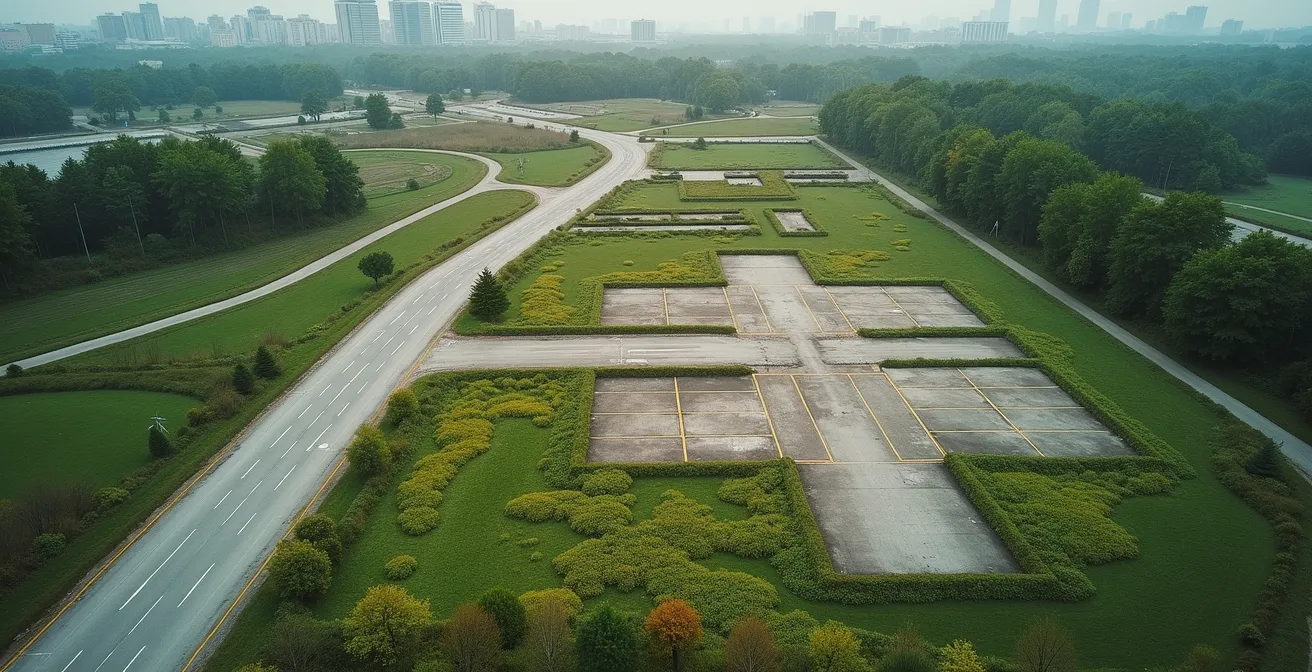
This process of digital scouting is more than just finding locations; it’s the first step in understanding a site’s story. By cross-referencing these visual cues with historical archives or old city maps, you begin to piece together the narrative before you even set foot nearby. However, remember that this data can be years old; a building that looks intact online may be nothing but a pile of rubble in reality. This is why a methodical audit is crucial.
Your 5-Step Audit for a Potential Urbex Site
- Access Points & Legal Boundaries: Identify all public roads and areas from which the site can be legally viewed. Use Street View to scout for fences, gates, and “No Trespassing” signs that define the legal perimeter.
- Information Gathering: Use satellite views to assess the building’s condition and Google searches to find historical data, old photos, or news articles about its past. This is where you build the context of the story.
- On-Site Reconnaissance: From a legal and safe distance, observe the site. Does the reality match the online data? Look for signs of recent activity (tire tracks, fresh graffiti, new boards on windows) that could indicate active use or security patrols.
- Assessing the ‘Story’ & Risks: Determine the unique narrative potential of the site. Simultaneously, perform a visual risk assessment from afar. Are there obvious signs of structural failure, a collapsed roof, or fire damage?
- Exploration & Documentation Plan: If and only if access is clearly legal and safe, formulate a plan. What gear is needed (camera, flashlight)? What is your primary documentation goal (architecture, decay, atmosphere)? What are your entry and exit points and times?
The Floorboard Danger Sign You Must Recognize in Abandoned Houses
While the stories within abandoned buildings are captivating, the structures themselves are often treacherous. An explorer’s greatest tool is not a camera, but a profound sense of caution. The most common and deadly trap is the very ground beneath your feet. Years of exposure to moisture turn solid wood into a sponge. A floorboard that looks perfectly stable can conceal dry rot, termite damage, or water-logged weakness. The most critical danger sign to recognize is a “springy” or “bouncy” feeling underfoot. If you step onto a floor and it gives even slightly, stop immediately and retreat. Test the area ahead of you by tapping it with a heavy object or a sturdy stick, listening for a hollow, dead sound instead of a solid thud.
Look for visual cues of water damage, the primary culprit of structural failure. Dark stains on ceilings and walls are obvious red flags, as they indicate where water has been pooling and seeping downwards. Pay close attention to the areas around window frames, roof leaks, and in basements. Mounds of discolored, crumbling plaster or wood dust on the floor are signs that the material above is actively disintegrating. Remember that the danger is not just falling through a floor, but also having a compromised ceiling or roof collapse from above. Every step in an abandoned building must be deliberate and informed by a constant, 360-degree assessment of your surroundings.
However, the dangers are not only physical. The presence of explorers, even respectful ones, can pose a danger to the site itself. The attention brought by a popular video or photo set can be a death sentence for a fragile location, attracting vandals who lack the explorer’s ethical code. The professional explorers behind “The Proper People” learned this harsh lesson firsthand.
Once, in 2016, they explored an abandoned nuclear power plant. After they uploaded their video about it, the site was broken into and vandalized; now its security is so thick no one can visit it.
– Professional Urban Explorer Experience, Tubefilter
This highlights a core responsibility: discretion. Sharing a location publicly can destroy it. The greatest danger you might pose is not with your footsteps, but with your Instagram post. A true historian protects their archive, even if it means keeping its existence a secret. This balance between documentation and preservation is a constant, delicate negotiation.
How to Shoot Sharp Photos in Dark Basements Without a Tripod?
Documenting the soul of an abandoned place often means venturing into its darkest corners, where the most evocative textures of decay reside. Basements, cellars, and windowless corridors are challenging environments for photography, but they are not impossible, even without a tripod. The secret is to master two principles: stability and light manipulation. Without a tripod, your own body becomes the stabilization system. Instead of standing in the middle of a room, lean against a solid wall or a sturdy pillar. Tuck your elbows firmly against your torso to create a stable “human tripod.” Control your breathing: press the shutter button gently at the end of an exhale, when your body is most still.
Use your camera’s features to your advantage. A higher ISO will make the sensor more sensitive to light, but it will also introduce digital “noise” or grain. Embrace it. This grain can add to the gritty, textural feel of the environment. More importantly, use a wide aperture (a low f-stop number, like f/1.8 or f/2.8) to let in as much light as possible. This creates a shallow depth of field, beautifully isolating a specific detail—a rust pattern, a single discarded object—while blurring the background into a mysterious darkness. This isn’t just a technical trick; it’s a storytelling device, focusing the viewer’s attention on one fragment of the larger narrative.
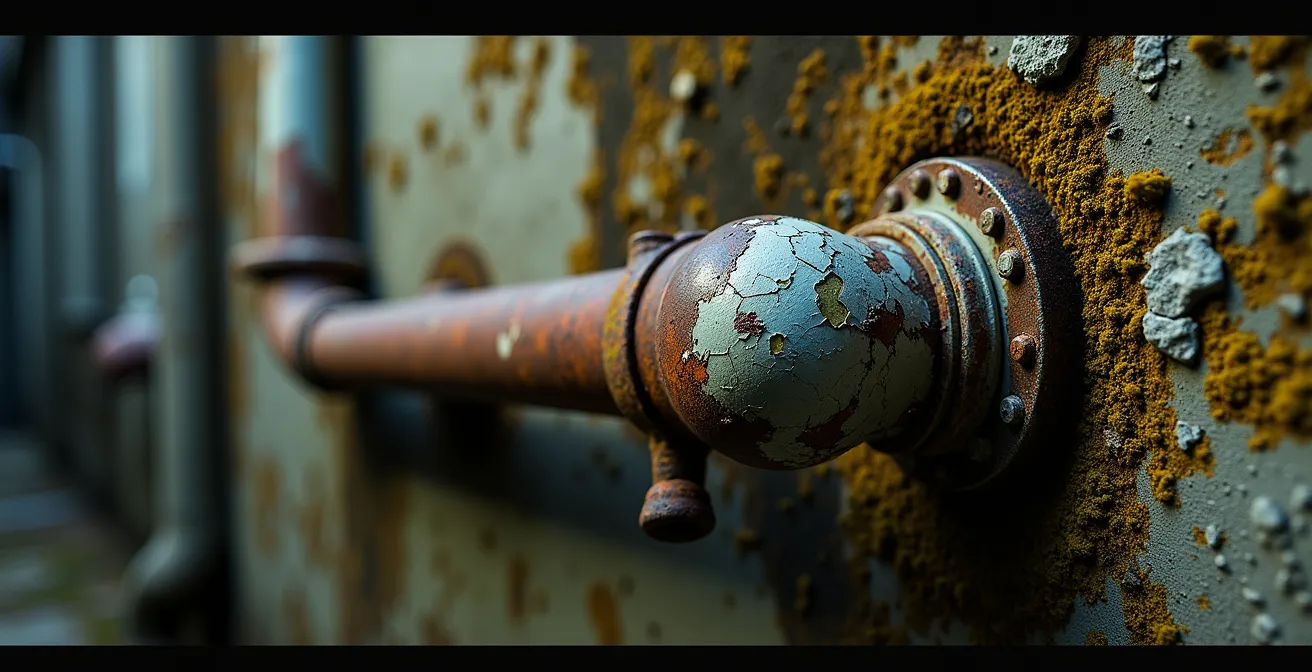
When there is truly no ambient light, you must create your own. This doesn’t require expensive flashguns. A simple flashlight or even the screen of your smartphone can be used for “light painting.” With your camera set on a stable surface (a ledge, a pile of rubble), open the shutter for a long exposure (several seconds). During this time, “paint” the scene by moving your light source across the areas you want to illuminate. This technique creates dramatic, cinematic shadows and highlights the incredible textures of decay in a way that flat, even lighting never could. You are not just taking a picture; you are collaborating with the darkness to reveal its secrets.
Golden Hour or Blue Hour: Which Lighting Mood Suits Industrial Decay?
The choice of when to photograph a location is as important as how. The quality and color of light dramatically alter the mood of an image, and for the metallic skeletons and crumbling concrete of industrial decay, the “magic hours” offer two distinct narrative possibilities. The Golden Hour, the period shortly after sunrise or before sunset, bathes a scene in warm, soft, golden light. This light is forgiving and romantic. It can bring a sense of nostalgic warmth to the coldness of rust and concrete, highlighting the human stories that once filled the space. It evokes a feeling of a fond, wistful memory, a beautiful sunset on an industrial empire.
Conversely, the Blue Hour—the brief window of twilight before sunrise or after sunset when the light is a deep, diffused blue—offers a completely different emotional palette. This cool, ethereal light accentuates feelings of emptiness, melancholy, and mystery. It renders metal structures as stark silhouettes against a rich, indigo sky, emphasizing their skeletal forms and the sheer scale of their abandonment. The Blue Hour is less about nostalgia and more about the sublime, haunting beauty of the present state of decay. It transforms a factory into a forgotten cathedral, a silent monument to a bygone era.
There is no “correct” choice; the decision depends on the story you want to tell. Are you memorializing the warm, vibrant life that once was, or are you documenting the cold, majestic silence that remains? For many dedicated explorers, this choice is part of a larger philosophy of authentic documentation.
Case Study: The Cinematic and Documentarian Approach
As the world of urban exploration became more crowded on platforms like YouTube, the explorers known as “The Proper People” made a conscious shift. Their goal was to move beyond simple vlogs and adopt a more cinematic, documentarian style. This meant making deliberate artistic choices, like selecting the right lighting to convey a specific mood, to honor the places they visited. As they note, this focus on quality and respect was more important than chasing views, and it involved a commitment to protecting the sites from the negative impacts of internet fame. This approach treats the documentation not as content, but as a form of digital preservation, an act of cinematic stewardship.
By choosing your light, you are choosing your narrative lens. The Golden Hour whispers of the past, while the Blue Hour intones the solemnity of the present. Both are valid ways to translate the building’s silent story into a visual language that others can feel and understand, moving beyond a simple snapshot to create a piece of temporal art.
Why Does Street Art Correlate with Rising Rent Prices?
An abandoned building’s story doesn’t end when the last worker leaves. It enters a new chapter, often written on its walls. The appearance of graffiti and street art is a form of reclamation, a community’s dialogue with a dead space. But this dialogue has a complex and often ironic consequence. While early, unsanctioned graffiti might signal neglect, the arrival of large-scale, colourful murals often heralds the beginning of gentrification—a process known as “artwashing.” These murals, perceived as a sign of a “cool” and “vibrant” neighborhood, attract developers and new, wealthier residents. The very art that gives a neighborhood its edgy identity becomes the catalyst for its commercialization.
The Wynwood district of Miami is the textbook example. Once a neglected industrial area, it was transformed by street artists into a world-famous outdoor art gallery. The result? The neighborhood became a major tourist destination, and property values skyrocketed. The artists and long-time residents who gave the area its cultural capital were priced out. Today, Wynwood is one of Miami’s least affordable neighborhoods, with a $3,950 median rental price. This pattern reveals a layer of socio-economic stratigraphy on the building’s surface: the initial tags of neglect are covered by commissioned murals of revitalization, which are in turn followed by the glass facades of new condominium developments.
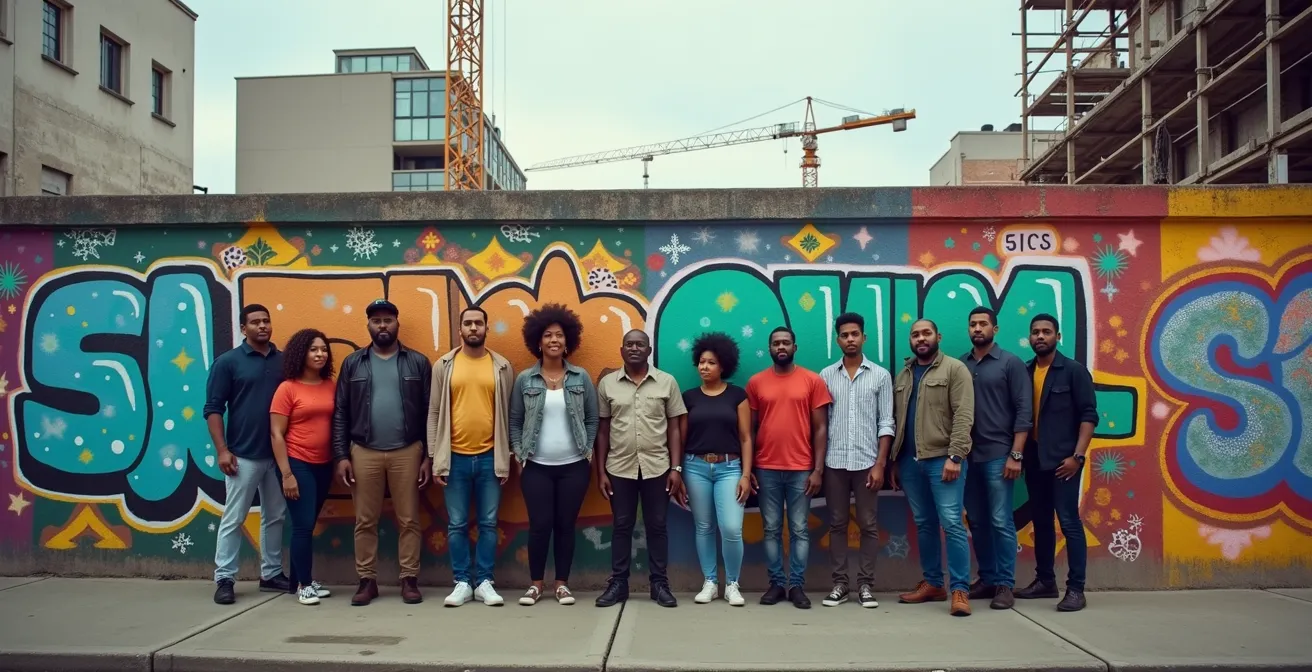
This process exposes a painful paradox about the value of art in our society. Artists often act as the canaries in the coal mine of urban change, drawn to affordable, neglected areas where they can create freely. Yet, their creative energy is the very thing that makes these areas desirable and, ultimately, unaffordable for them. It is a cycle of creative destruction and reconstruction. Filmmaker Colin K. Gray, who documented this phenomenon, perfectly captures the tragic irony:
Artists are often the vanguard, and then the victims of this gentrification tsunami. They are part of the fabric of these communities; they helped make a place rich and culturally diverse and cool and vibrant, and then they’re often the ones who are [later displaced]… It brings up big questions about what is the value of art?
– Colin K. Gray, Unzipped: An Autopsy of American Inequality (2021 documentary)
For the urban historian, the art on an abandoned wall is therefore more than decoration. It’s a real-time indicator of economic currents and a poignant symbol of a neighborhood in flux, telling a story of cultural creation and displacement that a museum exhibit on gentrification could only ever describe in the abstract.
When Is It Too Late to Save a Deteriorating Historical Site?
Every abandoned building exists on a timeline, caught between the memory of what it was and the inevitability of its collapse. This raises a constant, difficult question for communities and preservationists: at what point is a site beyond saving? The answer is rarely simple, involving a complex calculus of structural integrity, financial cost, and cultural significance. From a purely engineering standpoint, a building might be deemed “too late” when its foundational structures are irrevocably compromised or when the cost of stabilization far exceeds the price of demolition and new construction. This is often the cold, economic reality that dooms many historic sites.
However, the economic argument can also be a powerful force for preservation. Heritage tourism is a significant economic driver. Studies show that tourists visiting historical sites tend to stay longer and spend more, providing a tangible return on investment for preservation efforts. For example, one report calculated the average spending from heritage tourists at $336.24 per person per overnight trip. This data provides a compelling counter-argument to the demolition crew, suggesting that saving a building is not just an expense, but an investment in a community’s economic future. When a building can generate more value as a restored landmark than as an empty lot, the argument for saving it becomes much stronger.
Ultimately, the question of “when is it too late” transcends economics. It is a question of memory. A building is more than bricks and mortar; it’s a vessel for human experience, a physical anchor for a community’s collective story. The decision to let a place die is a decision to erase those stories. Local historian and preservation advocate Matt Schultz beautifully articulates this deeper value:
The preservation of objects, landscapes, or structures help us to remember experiences, good or bad… A tapestry is woven through the buildings, stories of the past and present residents make this community special. Through projects such as the restoration of the Lansdowne Theater, I have heard from hundreds of people who have fond, funny, or heartbreaking stories that happened in the community.
– Matt Schultz, Local historian and preservation advocate
Perhaps, then, it is only “too late” when the last person who holds a memory of the place is gone. As long as a story is attached to the stones, there is an argument for preservation. The true loss is not the collapse of a roof, but the fading of the memories it once sheltered. The urban explorer, in documenting these places in their final days, performs a vital act of remembrance before the story disappears forever.
Key Takeaways
- The ethos of urban exploration is “take nothing but pictures, leave nothing but footprints,” prioritizing respect over access.
- Digital tools like satellite imagery are for reconnaissance, not a replacement for on-the-ground assessment of safety and legality.
- Decay is a language; the artistic choices in photography (lighting, composition) are what translate that language into a human-readable story.
- An abandoned building’s narrative continues after closure, with street art often acting as a real-time indicator of gentrification and economic change.
Why Does Digital Archiving Fail to Capture the “Aura” of Physical Art?
In an age where anything can be digitized, photographed, and shared globally in an instant, it’s tempting to believe that we can perfectly preserve an abandoned building online. We can create stunning photo galleries, drone fly-throughs, and virtual reality tours. Yet, anyone who has stood inside a decaying cathedral of industry knows that something essential is lost in translation. This intangible, non-reproducible quality is what the philosopher Walter Benjamin famously called the “aura” of a work of art: its unique presence in time and space. A digital photograph is a copy without an aura; it can show you what a place looked like, but it can never let you experience what it *felt* like.
The aura of an abandoned place is a multisensory experience. It’s the specific smell of damp plaster, decaying paper, and pigeon droppings. It’s the feeling of the cold air on your skin, the texture of dust under your fingertips, the way your footsteps echo in a vast, empty hall. It’s the subtle narrative clues that a camera lens might miss: a draft from a broken window, a floor that creaks in a certain way, the sound of the wind itself playing the building like an instrument. This sensory richness creates a profound, almost spiritual connection to the place and its history. One explorer eloquently captured this sensory dimension:
As we exit the property, we try to snap more photos of the exterior to capture the forgotten beauty of this long-abandoned house. The house itself whistles a little in the wind, the cracks in the glass allowing the air inside to resonate.
– Sensory Experience of Abandoned Places, Urban Plains
This is not to devalue digital preservation. For many explorers, it is a core part of their mission—a way to save the memory of a place before it is demolished. It’s a vital act of archival, creating a record for future generations.
Case Study: The Mission of Digital Preservation
The documentarians behind “The Proper People” began their journey by casually documenting sites, but their mission evolved as they witnessed the fragility of these places. They came to view their work not just as entertainment, but as a form of stewardship. They see their videos as a crucial way to digitally preserve these buildings, creating a lasting record that will exist long after the physical structures have vanished. Their work becomes an elegy, a way to keep the story alive once the physical source of the aura is gone.
Digital archiving, then, is like pressing a flower in a book. You preserve its shape and color, but you lose its fragrance, its texture, its life. It is an echo, not the voice itself. It fails to capture the aura because the aura is not just in what you see, but in the act of being there, of breathing the same air the past once did. It is this irreplaceable, physical communion with history that draws the explorer back, again and again, to stand in the silence and listen.
Ultimately, a museum preserves objects by halting their story, freezing them in a moment of curated perfection. An abandoned building tells a richer, more complex tale because its story is never-ending. The narrative is written in rust, moss, and gravity—a continuous process of change that reflects the world around it. To learn to read this language is to unlock a more honest, profound, and deeply human connection to history. The next time you see a boarded-up facade or a crumbling factory wall, don’t just see a ruin; see an open book.