
The right clothing doesn’t just make you look more confident; it physically and psychologically rewires your presence from the inside out.
- Structured garments create a “postural feedback loop,” instinctively causing you to stand taller and project authority.
- This phenomenon, known as “enclothed cognition,” demonstrates that what you wear directly influences your cognitive processes and abstract thinking.
Recommendation: Shift your focus from “dressing for success” to selecting clothes that provide the physical structure and psychological comfort needed to trigger an internal state of confidence.
For decades, professionals have been told to “dress for the job you want.” This advice, while well-intentioned, treats clothing as a mere costume, an external signal to others. It suggests that confidence is something you wear like a mask. We focus on colors, trends, and brand names, hoping these external markers will project an image of authority and competence. This approach, however, misses the most profound truth about the relationship between our attire and our psyche.
What if the real power of a “power suit” isn’t about how others see you, but about how it fundamentally changes how you see—and carry—yourself? The true key to unlocking sartorial self-assurance lies not in the image your clothes project, but in the internal postural and cognitive shifts they trigger. It’s a dialogue between fabric and mind, where the structure of a garment provides proprioceptive cues that alter your physical stance, which in turn feeds back to your brain, boosting feelings of confidence and control.
This article moves beyond superficial style tips. We will deconstruct the psychological and postural mechanisms at play, exploring the science of “enclothed cognition.” We will examine why a tailored blazer makes you stand straighter, how ill-fitting shoes can sabotage your presence, and why authenticity in your wardrobe is more powerful than any fleeting trend. Prepare to understand your wardrobe not as decoration, but as a tool for shaping your internal state.
To navigate this exploration of sartorial psychology, this guide is structured to build from foundational concepts to practical applications. The following sections will provide a clear path to mastering your professional presence from within.
Summary: The “Power Suit” Effect: How Clothing Structure Physically Alters Your Body Language
- Why Does a Tailored Blazer Make You Stand Straighter?
- How to Dress for Your Shape to Highlight Assets vs Hiding Flaws?
- The Comfort-Confidence Connection: Why Ill-Fitting Shoes Ruin Your Presence?
- Navy vs Black: Which Color Commands More Trust in Negotiations?
- Why Does Choosing Your Outfit the Night Before Reduce Morning Anxiety?
- How Do Your Clothes Actually Change the Way You Think?
- How to Ask for a Home Office Stipend Without Sounding Greedy?
- Why Does Wearing “Trendy” Clothes That Don’t Fit Your Personality Lower Confidence?
Why Does a Tailored Blazer Make You Stand Straighter?
The immediate change in posture when you slip on a well-fitted blazer is not just your imagination; it’s a powerful demonstration of a postural feedback loop. A tailored jacket, with its structured shoulders and defined seams, acts as a gentle, persistent physical cue. Your body’s proprioceptive system—its ability to sense its own position in space—responds to this structure. The slight weight on the shoulders and the crisp lines along the torso encourage you to lift your chest, pull your shoulders back, and lengthen your spine to “fill” the garment properly. This isn’t a conscious effort; it’s an instinctual adjustment.
This physical change is intrinsically linked to a psychological one through a concept known as enclothed cognition. It posits that clothing has a symbolic meaning and that the physical experience of wearing it triggers associated mental processes. The blazer symbolizes professionalism, authority, and competence. When you physically embody the posture of an authority figure, your brain receives signals that reinforce that identity. You don’t just look more confident; you begin to feel it internally.
Case Study: The Symbolic Power of a Coat
The foundational study on enclothed cognition illustrates this perfectly. Researchers found that participants who wore a lab coat described as a doctor’s coat showed improved performance on attention-related tasks compared to those wearing the same coat described as a painter’s. This demonstrates that it’s the combination of the physical act of wearing the garment and its symbolic meaning that shapes our cognitive performance. A blazer works similarly, combining its physical structure with its powerful professional symbolism to elevate both posture and mindset.
Ultimately, the tailored blazer acts as a scaffold for a more powerful nonverbal presence. It guides your body into a posture of confidence, and this physical alignment sends a clear message to your own brain that you are capable, poised, and in control. The straightening of your spine is the first, crucial step in this internal transformation.
How to Dress for Your Shape to Highlight Assets vs Hiding Flaws?
A common mistake in professional dressing is to focus on hiding perceived flaws. This mindset is rooted in insecurity and often leads to choices—like bulky sweaters or shapeless garments—that actually diminish your presence. The goal of a body language coach is to shift this perspective entirely: from hiding to strategic highlighting. Your objective is not to conceal your body, but to guide the viewer’s eye and create a balanced, confident silhouette.
This approach is about managing proportions to create visual harmony. For instance, if you have broader shoulders, wearing a slightly fuller A-line skirt or trousers that have more volume at the hem can create a balanced hourglass shape. Conversely, if you have wider hips, adding structure to your shoulders with a well-fitted blazer accomplishes the same goal. It’s a game of strategic volume and fit, not of camouflage. The aim is to create an overall impression of poise and balance, which communicates confidence far more effectively than any attempt to hide.
The following illustration showcases how different clothing choices can create balanced and powerful silhouettes by playing with proportion and line, rather than by attempting to obscure the body’s natural form.
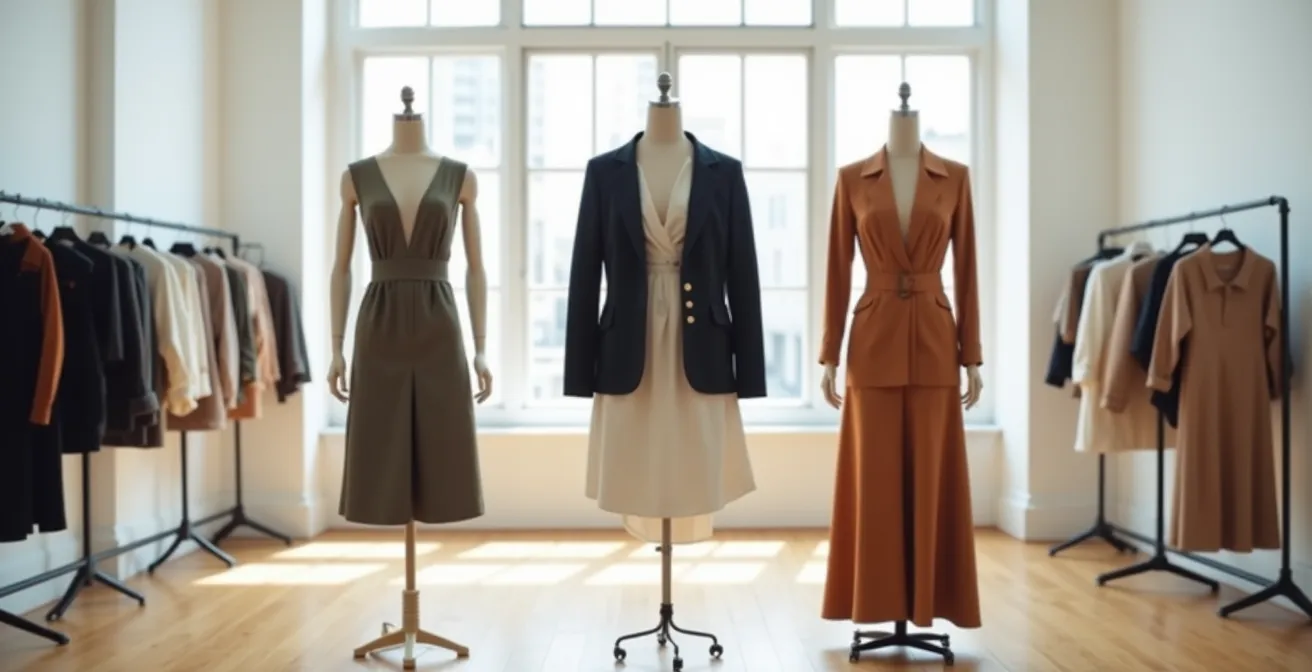
As the visual demonstrates, confidence comes from celebrating and balancing your shape, not from fighting it. By mastering these principles, you take control of your visual narrative. You are no longer a passive subject of your clothes, but an active architect of your presence. This mastery translates directly into a more grounded and assured body language, as you are comfortable and in command of your appearance.
- Use color blocks strategically to direct the viewer’s gaze to your preferred focal points.
- Choose clothes that allow for confident, expansive movement rather than restrictive garments.
- Create balance through strategic volume and fit instead of hiding perceived flaws.
- Select well-fitted pieces that align with your personal style for authentic confidence.
- Focus on proportion and silhouette rather than individual body parts.
The Comfort-Confidence Connection: Why Ill-Fitting Shoes Ruin Your Presence?
Your foundation begins at your feet. No amount of powerful attire can compensate for a base that is unstable or in pain. Ill-fitting shoes are a primary saboteur of professional presence because they introduce physical discomfort that directly translates into unconfident body language. When your feet hurt, your posture collapses. You may shift your weight awkwardly, take tentative steps, or hold tension in your shoulders and jaw. Your focus is involuntarily drawn downward to the source of your pain, rather than outward to the people you are engaging with. This creates a closed-off, distracted, and hesitant demeanor.
Conversely, comfortable and stable footwear provides a solid foundation for a confident stance. It allows you to stand tall, distribute your weight evenly, and move with purpose and grace. This connection between footwear and stability is not just subjective. A 2020 study in Scientific Reports found that participants perceived minimal shoes as 21.4 points more stable than conventional shoes, suggesting that better ground-feel can significantly improve one’s sense of balance. When you feel physically grounded and stable, your mental state follows suit, allowing you to project an aura of unwavering composure.
The pursuit of comfort is not an excuse for unprofessionalism; it is a prerequisite for authentic confidence. As footwear researchers have noted, true comfort is a measurable science.
Simple visual analog scales provide reliable overall assessment of footwear comfort, with well-fitted, lightweight shoes with soft midsoles generally perceived as most comfortable.
– Footwear Research Team, Journal of Foot and Ankle Research systematic review
Choosing shoes that are both appropriate for the setting and biomechanically sound is an investment in your presence. It ensures that your energy is projected outward in negotiation and collaboration, rather than being squandered on managing physical discomfort. Your power pose is only as strong as its foundation.
Navy vs Black: Which Color Commands More Trust in Negotiations?
While both navy blue and black are staples of professional wardrobes, their psychological impacts in a high-stakes setting like a negotiation are subtly but significantly different. Your choice between them should be a strategic one, based on the specific nonverbal message you wish to convey. Black is the color of absolute authority. It is powerful, definitive, and formal. It creates high contrast, which commands attention and can signal dominance. However, this same power can sometimes be perceived as intimidating or unapproachable, potentially creating defensive barriers in a collaborative negotiation.
Navy blue, on the other hand, projects what can be described as approachable authority. It is still a color of power and professionalism, but it carries psychological associations with calmness, stability, and reliability. It is generally perceived as less severe than black, which can help in fostering rapport and encouraging openness from the other party. In a negotiation where building trust is as important as projecting strength, navy can be the more strategic choice. It says, “I am in command, but I am also here to listen and find a solution.”
This table breaks down the nuanced psychological differences and best-use cases for each color in a professional context, helping you make a more calculated decision based on your objectives.
| Aspect | Navy | Black |
|---|---|---|
| Perception | Approachable Authority | Absolute Authority |
| Trust Factor | Calm, trustworthy, reliable | Powerful but potentially intimidating |
| Collaboration | Fosters rapport and openness | Can create defensive barriers |
| Best Context | Team negotiations, client meetings | Formal presentations, power positioning |
| Contrast Impact | Softer with light blue, powerful with white | Always high contrast, commanding |
The choice is not about which color is “better,” but which color is the right tool for the specific interaction. Understanding these subtleties allows you to use color as a deliberate part of your nonverbal communication strategy, aligning your appearance with your intended outcome.
Why Does Choosing Your Outfit the Night Before Reduce Morning Anxiety?
The practice of selecting your outfit the night before is often touted as a simple time-saving hack, but its benefits are far more profound, touching on the core of cognitive psychology. The primary advantage is the reduction of decision fatigue. Your brain has a finite amount of mental energy for high-quality decisions each day. The morning, when you are often preparing for the most critical tasks, is a terrible time to waste this precious resource on a low-stakes choice like what to wear.
By making that decision in the calm of the evening, you conserve your executive function for the high-stakes decisions that await you at work. This act of preparation is also a form of “priming.” You are not just picking clothes; you are pre-committing to a specific professional identity for the next day. This primes your brain for success and reduces the “what if” anxiety that can plague a rushed morning routine. This link between preparation, mindset, and performance is well-documented.
Case Study: Conserving Mental Energy for Peak Performance
Harvard professor Amy Cuddy’s research on “power posing” showed that adopting expansive postures for just two minutes can dramatically increase confidence levels and impact hormonal balances. While not directly about clothing, the principle is the same: a small, preparatory physical act can create a significant psychological shift. Choosing a powerful outfit the night before acts as a preparatory “power pose” for your mindset, conserving the mental energy you need for critical thinking and negotiation the next day.
Despite this, many underestimate the connection between their attire and their mental state. A revealing survey of over 4,000 respondents found that while 46% of Americans claim clothing choices don’t affect their emotions, 43% simultaneously admit their work performance varies with what they wear. This disconnect highlights a lack of awareness about the very real impact of sartorial choices on our daily cognitive load and emotional state. Preparing your outfit is a simple, powerful ritual to protect your most valuable asset: your mental clarity.
How Do Your Clothes Actually Change the Way You Think?
The idea that clothing influences thought is the very essence of “enclothed cognition.” This is not a metaphor; it is a demonstrable psychological phenomenon. What you wear creates a “cognitive costume” that can either enhance or inhibit specific modes of thinking. The effect is so consistent that a 2023 meta-analysis of 40 studies confirmed that clothing systematically influences our thinking, feelings, and behavior. The clothes we wear are not passive observers of our day; they are active participants in our cognitive processes.
Formal attire, for example, has been shown to enhance abstract and strategic thinking. When you wear a suit or other structured business wear, you are not just signaling professionalism to others; you are signaling it to yourself. Studies have shown that individuals in formal wear perform better as negotiators and are more adept at big-picture thinking. The formality of the attire seems to create a psychological distance, allowing the brain to process information more abstractly and less personally. This is the “Power Suit Effect” in its purest cognitive form: the clothes literally help you think like a leader.
This image conceptually illustrates the difference between the structured, logical thinking associated with formal wear and the more fluid, creative cognition linked to casual attire.

Conversely, more casual or creative clothing can foster divergent, out-of-the-box thinking. This is why many creative industries adopt a more relaxed dress code. The key takeaway is that you can strategically choose your “cognitive costume” to match the mental task at hand. If you need to focus on a detailed financial report, formal wear might put you in the right frame of mind. If you are brainstorming a new marketing campaign, something less restrictive might unlock your creativity. Understanding this allows you to dress with intention, using your wardrobe as a tool to optimize your own mind.
How to Ask for a Home Office Stipend Without Sounding Greedy?
In the age of remote and hybrid work, your “professional presence” extends to your digital environment. A poorly lit, uncomfortable home office setup can project an image just as unprofessional as a wrinkled shirt. Asking for a home office stipend, therefore, should not be framed as a request for a personal perk. Instead, it must be positioned as a strategic investment in maintaining peak professional performance and the company’s image. The “Power Suit Effect” applies here: just as the right attire enhances your performance in the office, the right equipment enhances your performance and presence online.
The key is to shift the focus from your comfort to the company’s outcomes. A proper ergonomic chair isn’t just about your back; it’s about reducing fatigue to maintain high productivity throughout the day. A high-quality webcam and microphone aren’t for your vanity; they are about ensuring the company is represented with clarity and professionalism in every client-facing video call. You are not asking for money; you are proposing a solution to uphold professional standards in a distributed work environment.
By framing your request around mutual benefit and return on investment (ROI), you transform the conversation from one of personal need to one of professional strategy. This proactive, outcome-oriented approach demonstrates your commitment to excellence, regardless of your physical location.
Your Action Plan: Framing the Stipend Request
- Frame the request around maintaining the company’s professional image during video calls.
- Connect proper ergonomic setup to your ability to sustain high performance and productivity.
- Present potential ROI by explaining how a proper home office setup increases efficiency by reducing physical and mental fatigue.
- Reference the ‘power suit effect’: argue that just as professional attire boosts office performance, a professional WFH setup ensures peak remote productivity.
- Position the request as a strategic investment in company outcomes rather than a matter of personal comfort.
This approach demonstrates foresight and a deep understanding of what it takes to be a top performer in a modern work context. It is not about sounding greedy; it is about being a dedicated professional who requires the right tools to do the best possible job.
Key Takeaways
- Your clothing creates a postural feedback loop; structured garments physically cue your body to adopt a more confident stance.
- The science of “enclothed cognition” proves that the symbolic meaning and physical sensation of your clothes directly alter your thought processes.
- True confidence comes from sartorial authenticity—wearing clothes that align with your personality, not just fleeting trends.
Why Does Wearing “Trendy” Clothes That Don’t Fit Your Personality Lower Confidence?
In the pursuit of looking current or fitting in, many professionals fall into the trap of adopting trends that are misaligned with their core personality. While the clothes may be stylish, the internal result is often a subtle but corrosive drop in confidence. This occurs because of a psychological phenomenon known as cognitive dissonance: a state of mental discomfort experienced when holding two or more contradictory beliefs, ideas, or values. When you wear an outfit that feels inauthentic, you are creating a conflict between your external appearance and your internal sense of self.
Your body language betrays this internal conflict. You might fidget, make self-conscious adjustments to your clothing, or adopt a more closed-off posture. You are broadcasting discomfort because you *feel* like you are in a costume that isn’t yours. Instead of the clothing serving as a seamless extension of your identity, it becomes a source of distraction and self-doubt. You spend mental energy questioning whether you “pull it off” rather than focusing on the task or conversation at hand.
Case Study: The Discomfort of Inauthenticity
Research on the psychology of clothing consistently shows that when our attire aligns with our mood and personality, we feel more secure and self-assured. Conversely, wearing clothes that feel out of place for our environment or our identity triggers discomfort and social anxiety. This demonstrates the critical importance of sartorial authenticity; your clothes should feel like a second skin, not an ill-fitting costume, to truly support a confident state of mind.
True, sustainable confidence comes from sartorial authenticity. This means curating a wardrobe that not only fits your body but also reflects your personality, values, and professional goals. When your external appearance is in perfect harmony with your internal identity, there is no dissonance. Your clothing becomes a powerful, nonverbal affirmation of who you are, freeing up all your mental and emotional resources to be fully present, engaged, and authoritative.
To truly harness the power of your wardrobe, begin by evaluating your clothes not just for how they look, but for how they make you feel—physically and psychologically. Start today by consciously selecting one item that makes you feel both powerful and authentic, and observe the internal shift in your posture and mindset. This is the first step toward mastering your presence from the inside out.