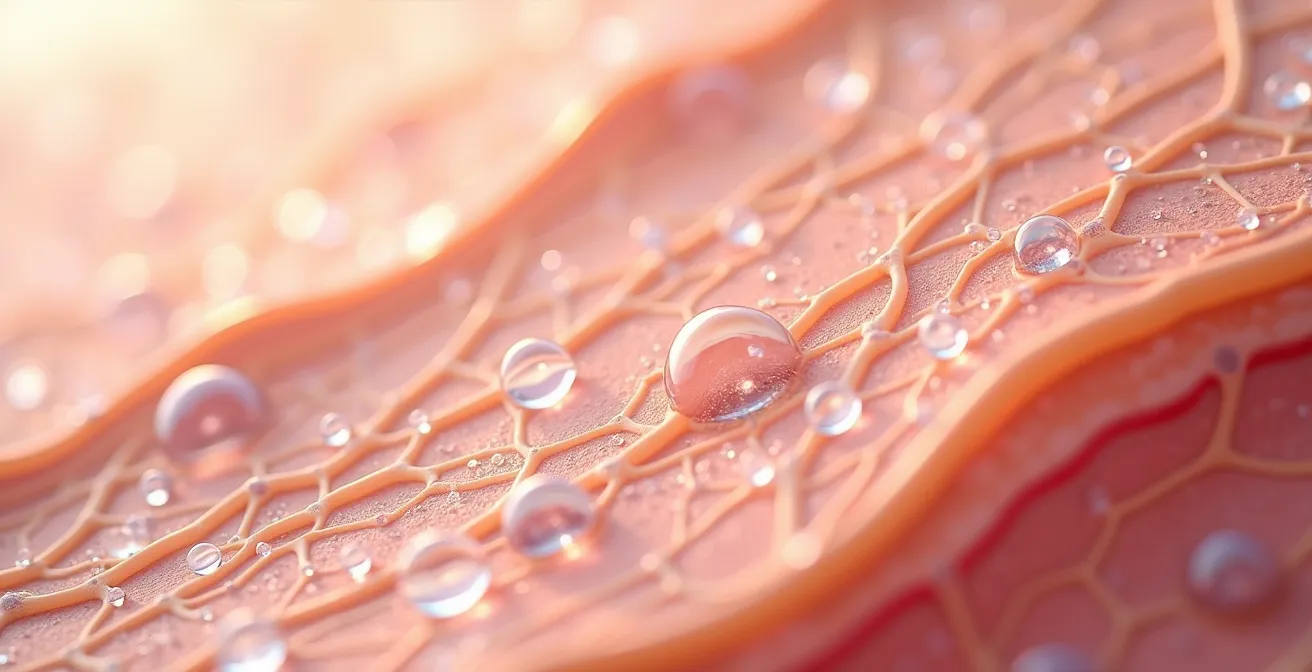
Dehydration doesn’t just remove water from your skin; it triggers a systemic crisis that actively deepens fine lines.
- Even a 2% drop in hydration spikes cortisol, a stress hormone that degrades your skin’s protective barrier.
- This weakened state acts as a ‘glycation amplifier,’ making sugar’s aging effects on collagen more destructive.
Recommendation: Focus on a dual-action approach: systemic hydration to calm internal stress and targeted topicals to repair the barrier and block moisture loss.
You look in the mirror after a long day and they’re there: fine lines around your eyes and mouth that seem to have appeared from nowhere, making you look tired and older. The common advice is simple: drink a glass of water, apply a thick cream. We’re told these are just “dehydration lines,” temporary grooves in the skin’s surface. But this explanation barely scratches the surface of a profound physiological process.
The truth is that dehydration is far more than a simple lack of moisture. It acts as a systemic stressor on the entire body, initiating a destructive cascade of events that reaches deep into your skin’s architecture. While we focus on external solutions, we often miss the internal battle being waged. But what if the key wasn’t just to re-moisten the surface, but to interrupt the very chain reaction that turns a temporary lack of water into the blueprint for permanent wrinkles? What if factors like a slight dip in concentration, a sugar craving, or a poor night’s sleep were all part of the same damaging feedback loop?
This article uncovers the hidden mechanisms at play. We will dismantle the process piece by piece, from the hormonal response triggered by minimal water loss to the way it amplifies damage from sugar and free radicals. By understanding this interconnected system, you can move beyond temporary fixes and adopt a strategy that builds true, resilient skin from the inside out.
To fully grasp how to combat this issue, this guide breaks down the interconnected factors that contribute to the problem. Explore the topics below to build a complete understanding and an effective action plan.
Summary: Uncovering the True Impact of Dehydration on Skin Aging
- Drinking Water vs Moisturizer: Which Actually Plumps the Skin?
- How to Combat “Tired Face” When You Only Get 5 Hours of Sleep?
- The Sugar Habit That Destroys Your Natural Glow via Glycation
- How to Use Facial Massage to Boost Circulation Instantly?
- How Long Does It Take for a Diet Change to Show on Your Skin?
- How Does a 2% Drop in Hydration Affect Your Concentration at Work?
- What Do Free Radicals Actually Do to Collagen Fibers?
- Why Does Dehydration Cause “Fake Hunger” Pangs in the Afternoon?
Drinking Water vs Moisturizer: Which Actually Plumps the Skin?
The debate between internal hydration and topical moisturizers is often framed as a competition, but the reality is a synergistic partnership. Drinking water is the non-negotiable foundation, supplying moisture to the deepest layers of your skin and your entire body. However, this water is prone to escaping through a process called Transepidermal Water Loss (TEWL). This is where topical products become essential, not as a source of water, but as a sophisticated system to manage the water you already have.
The most effective strategy involves a hydration cascade. First, you hydrate from within. Then, you apply serums containing humectants like hyaluronic acid. These molecules are moisture magnets; in fact, research shows hyaluronic acid can hold up to 1000 times its weight in water. It draws moisture from the deeper skin layers up to the surface, creating a plumping effect. But this is only step two. Without a final “locking” step, that moisture will quickly evaporate.
The final, critical step is applying an occlusive moisturizer containing lipids, ceramides, or fatty acids. These ingredients form a protective seal on the skin’s surface. They repair your natural moisture barrier and dramatically slow down TEWL. So, water provides the volume, the serum pulls it to the surface, and the moisturizer locks it in place. One without the others is an incomplete strategy, leading to only temporary results.
How to Combat “Tired Face” When You Only Get 5 Hours of Sleep?
A “tired face” after a short night’s sleep isn’t just about dark circles; it’s a visible sign of a body under stress. Sleep deprivation is a potent systemic stressor that triggers a surge in cortisol, the body’s primary stress hormone. This hormonal spike has a direct and damaging effect on your skin. Cortisol is known to break down collagen and elastin, but more immediately, it compromises your skin’s protective barrier, leading to a significant increase in moisture loss.
This explains why fine lines are suddenly so much more prominent. The skin’s structure hasn’t changed overnight, but its hydration level has plummeted, causing the surface to deflate and settle into any underlying imperfections. Studies have quantified this effect, showing that after just five nights of two hours’ sleep deprivation, studies found a 45% increase in fine lines and wrinkles. This isn’t just an illusion; it’s a measurable consequence of internal stress manifesting externally.
To combat this, your morning routine needs to shift from simple cleansing to active barrier repair. Instead of harsh scrubs, use a gentle, milky cleanser. Follow immediately with products rich in ceramides, niacinamide, and lipids. These ingredients are the building blocks of your skin barrier and work to “patch” the damage caused by cortisol, helping to lock in moisture.
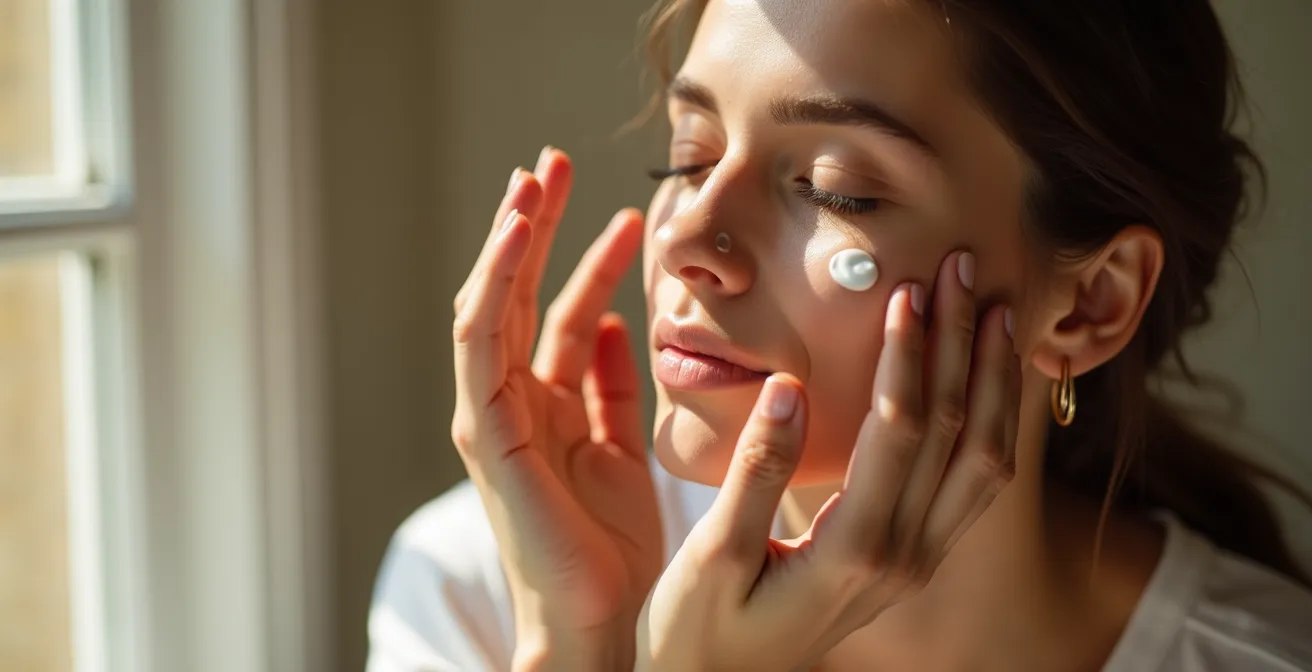
Applying a ceramide-rich cream isn’t just about adding moisture; it’s a strategic move to rebuild your skin’s defenses. This approach addresses the root cause—a compromised barrier—rather than just masking the symptom of a tired appearance. It helps your skin better retain the water it has, restoring plumpness and minimizing the look of sleep-deprived lines.
The Sugar Habit That Destroys Your Natural Glow via Glycation
Glycation is a chemical reaction where excess sugar molecules in your bloodstream attach themselves to proteins, primarily the collagen and elastin that give your skin its structure and bounce. This process creates harmful new molecules called Advanced Glycation End-products (AGEs). These AGEs turn your flexible, springy collagen fibers into stiff, brittle, and cross-linked structures that are unable to function properly. The result is a loss of elasticity, inflammation, and the formation of deep, static wrinkles.
Worse yet, dehydration acts as a glycation amplifier. In a dehydrated state, the concentration of sugar in your tissues is higher, accelerating the formation of AGEs. Furthermore, dehydrated collagen fibers are structurally weaker and more susceptible to this sugar-induced damage. So, a diet high in sugar combined with inadequate water intake creates a perfect storm for accelerated skin aging. This internal damage is difficult to reverse, as glycated collagen resists the natural enzymatic processes that normally break down old proteins.
While cutting sugar is the first line of defense, new research offers hope for mitigating the damage. For instance, new research from Beiersdorf shows NAHP can prevent glycation by up to a 68% reduction in AGE formation, demonstrating that targeted ingredients can offer protection. The table below, based on data from scientific analyses, starkly illustrates the difference between healthy and damaged collagen.
| Property | Healthy Collagen | Glycated Collagen |
|---|---|---|
| Structure | Flexible, springy network | Stiff, cross-linked fibers |
| Water Binding | Effectively holds moisture | Loses water-binding ability |
| Texture | Smooth, elastic | Brittle, hardened |
| Degradation | Normal turnover by MMPs | Resists degradation, accumulates |
| Visual Effect | Plump, hydrated skin | Deep lines, dehydrated appearance |
As the table from an analysis on glycated collagen shows, the process doesn’t just create wrinkles; it fundamentally robs the skin of its ability to hold water, perpetuating a cycle of dehydration and damage.
How to Use Facial Massage to Boost Circulation Instantly?
Facial massage is often seen as a relaxing luxury, but its benefits are deeply physiological, especially for dehydrated and tired-looking skin. The primary function is to stimulate lymphatic drainage, a process that is critical for skin health but often becomes sluggish due to stress, lack of sleep, and dehydration. Your lymphatic system is your body’s waste removal network, and when it stagnates, toxins and excess fluid build up in your tissues, leading to puffiness, dullness, and a poor environment for cellular health.
By manually stimulating this system, you are actively helping to flush out these stagnant fluids. This not only reduces puffiness almost instantly but also improves the hydration cascade by clearing the pathways for nutrient and oxygen delivery to the skin cells. It’s like clearing a traffic jam to allow delivery trucks to get through. A healthy, flowing lymphatic system ensures your skin cells are properly nourished and hydrated from the inside.
Case Study: The Power of Lymphatic Drainage
The efficacy of this technique was powerfully demonstrated in a case where an esthetician treated a client with severe, persistent swelling six months after facelift surgery. By performing lymphatic drainage massage three times a week for two weeks, she was able to eliminate nearly all visible swelling. The massage successfully mobilized stagnant fluids that the body couldn’t flush on its own, showcasing how this technique directly enhances the skin’s internal fluid dynamics far beyond simple circulation.
You don’t need a professional to reap the benefits. A simple, at-home routine can be incredibly effective when done correctly. The key is to use extremely light, feather-like pressure and move in the direction of lymphatic flow—generally from the center of the face outwards and then down the neck.
Your Action Plan: The 5-Step Lymphatic Drainage Facial
- Open the Nodes: Create a ‘V’ or scissors shape with your index and middle fingers. Place them on either side of your ears and gently pump 5-10 times to activate the major lymph nodes in the face.
- Sweep the Cheeks: Using a feather-like movement with flat fingers, sweep from the sides of your nose, out towards your ears, and then down the sides of your neck. Repeat 5-10 times.
- Depuff the Eyes: Use your index or ring finger to perform a gentle pumping or sweeping motion from the inner corner of your under-eye area, out towards your temple, and then down the side of your neck.
- Release the Forehead: Massage your forehead using upward and outward strokes, moving from your brows towards your hairline. This helps release tension and encourages drainage.
- Final Flush: Finish by sweeping your fingers from your ears down along the sides of your neck to your collarbone. This ensures all the mobilized fluid is directed towards the body’s central lymphatic ducts for processing.
How Long Does It Take for a Diet Change to Show on Your Skin?
When we embark on a skin-friendly diet, we often hope for overnight results. However, true, lasting change operates on a biological timeline dictated by your skin’s natural regeneration process. The skin’s surface is in a constant state of renewal, a process known as cell turnover. For a person in their 30s, this cycle takes approximately 28 days. This means the dull, dehydrated cells you see on the surface today will be naturally shed and replaced by new cells from the deeper layers over the next month.
This is a crucial timeframe to keep in mind. The nutrients from your improved diet—like omega-3 fatty acids for building strong cell membranes, vitamin C for collagen synthesis, and antioxidants for fighting free radicals—are used to build these *new* cells. You are essentially providing better raw materials for the “skin of the future.” You won’t see the full benefit of your dietary changes until these healthier, more robust, and better-hydrated cells have made their journey to the surface.
Therefore, patience is key. You might notice some initial improvements in inflammation or puffiness within a week, but the real changes in texture, glow, and hydration align with the skin’s natural 28-day cell turnover cycle. This is the minimum time required to see the structural benefits of your new eating habits. It’s a process of rebuilding from the inside out, not a quick surface fix.

Focusing on a diet rich in colorful fruits, leafy greens, healthy fats from fish and nuts, and lean proteins provides the essential toolkit for this renewal. This dietary investment is what helps reverse the effects of cellular collapse by ensuring the next generation of skin cells is stronger, plumper, and more resilient than the last.
How Does a 2% Drop in Hydration Affect Your Concentration at Work?
That familiar mid-afternoon brain fog and inability to focus may have a simpler cause than you think: mild dehydration. It’s a common misconception that you need to feel thirsty to be dehydrated. In reality, by the time the thirst signal kicks in, your body is already experiencing a deficit. A hydration drop of as little as 2% is enough to impair cognitive performance, including attention, memory, and motor skills. But the impact goes far beyond your productivity; it directly triggers a stress response that sabotages your skin.
This small hydration deficit is interpreted by your body as a systemic stressor. It’s a signal that something is wrong, prompting your adrenal glands to release cortisol. This hormonal response, designed for “fight or flight” situations, has devastating consequences for your skin’s health and appearance. As experts from the Cleveland Clinic have noted, this process is a direct physiological threat:
A 2% hydration drop is a physiological stressor that can trigger a cortisol release…simultaneously degrading your skin’s barrier and inhibiting repair.
– Research on stress-hydration connection, Cleveland Clinic Hydration Research
This cortisol-induced degradation of the skin barrier leads to a measurable increase in Transepidermal Water Loss (TEWL). Research confirms that psychological stress causes a significant TEWL increase, meaning your skin literally loses its ability to hold onto water. So, the very moment your focus starts to drift at your desk, a parallel process is occurring on your face: your skin’s defenses are weakening, and moisture is evaporating, causing fine lines to appear deeper and more defined. This reveals a direct, real-time link between your mental state and your skin’s physical condition.
What Do Free Radicals Actually Do to Collagen Fibers?
Free radicals are unstable molecules generated by factors like UV radiation, pollution, and even the body’s own metabolic processes. Their instability causes them to “steal” electrons from healthy molecules in a process called oxidation. When the target of this theft is collagen, the structural protein that gives skin its firmness, the damage is profound and visible. This isn’t a gentle degradation; it’s a violent, fragmenting attack.
Think of healthy collagen as a strong, interwoven net that supports your skin. Free radicals act like molecular scissors, randomly snipping the ropes of this net. This creates fragmented, useless pieces of collagen that can no longer provide structural support. The skin’s foundation is literally dismantled from within. This process leads to what can be described as cellular collapse: the epidermis, or top layer of skin, loses its underlying support and sags into the newly formed voids.
The situation is made worse by dehydration. A dehydrated epidermis is less plump and has less volume, so it collapses more dramatically into these structural gaps. This is why lines look so much deeper. The underlying damage from free radicals creates “structural potholes,” and dehydration deflates the surface, making these potholes starkly visible as deep creases.
Case Study: Visualizing Free Radical Damage
Research models from a 2022 study on skin aging effectively demonstrate this process. They show how free radicals fragment collagen fibers into useless pieces that are incapable of supporting the skin’s structure. These fragments also trigger an inflammatory response, which can lead to further degradation of the surrounding healthy collagen. When combined with the surface-level deflation of a dehydrated epidermis, the skin collapses into these “potholes,” creating the appearance of deep crevices rather than simple fine lines.
This mechanism reveals that fine lines are not just a surface issue. They are the external manifestation of internal, structural damage that is significantly exacerbated by a lack of hydration. Protecting against free radicals with antioxidants and maintaining hydration are two sides of the same coin in the fight for smooth, resilient skin.
Key takeaways
- Dehydration is a systemic stressor that elevates cortisol, directly damaging the skin’s moisture barrier.
- A compromised barrier accelerates water loss and acts as a ‘glycation amplifier,’ making sugar more harmful to collagen.
- True skin resilience comes from a dual approach: hydrating from within to calm internal stress and using targeted topicals to repair the external barrier.
Why Does Dehydration Cause “Fake Hunger” Pangs in the Afternoon?
That sudden, urgent craving for a snack around 3 p.m. might not be hunger at all. It’s often a misinterpreted signal for thirst. This curious case of biological miscommunication originates in the hypothalamus, the part of the brain responsible for regulating both hunger and thirst. When the body’s water levels are low, the signals it sends can become confused, and the brain may register the need for water as a need for food. This is particularly common in the afternoon when we’re post-lunch and potentially under-hydrated from the day’s activities.
This same principle of misinterpretation applies directly to our skincare habits. When our skin is dehydrated, it sends out distress signals. It might feel tight, look dull, or show more prominent fine lines. We see these symptoms and often misinterpret them as signs of aging, reaching for heavy anti-aging creams, potent retinoids, or rich oils. We try to “feed” the skin a complex treatment when its primary signal is one of simple thirst.
Case Study: The Hypothalamus and Skin Signal Confusion
The hypothalamus’s confusion between thirst and hunger provides a perfect analogy for skincare. Just as the brain can mistake dehydration for a need for calories, we often mistake the skin’s need for water as a need for heavy, oil-based products. As our bodies are made up of about 60% water, its primary need is hydration. A case study on this phenomenon shows that while heavy creams can provide a temporary surface fix, they don’t address the underlying water deficit. The skin continues to send distress signals because its fundamental need for hydration and barrier support remains unmet, leading to a frustrating cycle of using the wrong solutions for the right problem.
Recognizing this “fake hunger” phenomenon is a revelation. The next time you feel that afternoon slump and craving, try drinking a large glass of water before reaching for a snack. Similarly, when your skin looks tired and lined, your first response should be to address its hydration levels—both internally by drinking water and externally with humectants like hyaluronic acid—before concluding that you need a more aggressive anti-aging product. More often than not, you are simply misreading the signs.
By adopting this holistic view, you can finally move beyond treating symptoms and begin building a foundation of true skin health. The next logical step is to consciously integrate these principles into your daily routine for lasting results.