In low-humidity climates, the debate isn’t Hyaluronic Acid vs. Glycerin; the key is building a sealed hydration ecosystem that prevents moisture from escaping your skin.
- Humectants can draw moisture *from* your skin if the air is too dry (below 40-50% humidity), worsening dehydration.
- Application strategy—using damp skin and layering correctly—is more critical than the specific humectant you choose.
Recommendation: Always apply your humectant serum to damp skin and immediately seal it with an occlusive cream containing ceramides to trap the hydration.
If you live in a dry climate, you know the frustrating paradox: you slather on hydrating serums, yet your skin feels tight and parched by midday. You’ve probably been told that hyaluronic acid (HA) is the holy grail, a miracle molecule that holds 1,000 times its weight in water. On the other side, there’s trusty, less glamorous glycerin, a humectant that’s been around for decades. The internet often pits them against each other in a simple showdown, forcing a choice between the modern marvel and the old-school workhorse.
This debate, however, misses the fundamental point for anyone battling environmental dryness. Your skin isn’t a simple sponge; it’s a complex ecosystem, and in low humidity, it behaves like a desert. In these conditions, simply adding a humectant can backfire spectacularly, causing it to draw moisture from the deeper layers of your skin and release it into the arid air. This process, known as transepidermal water loss (TEWL), is the true enemy.
But what if the solution wasn’t choosing one ingredient over the other? What if the real key lies in thinking like a beauty climatologist? This guide reframes the question entirely. It’s not about which humectant is “best,” but about how to architect a complete, multi-layered water-management system. We’ll explore the molecular architecture of different humectants, the non-negotiable laws of application, and how to build a routine that creates a resilient, sealed barrier against a dry environment.
This article will guide you through the essential principles of hydrating your skin in challenging climates. By understanding the science behind how these ingredients interact with your environment, you can move beyond the hype and build a routine that delivers true, lasting moisture.
Summary: The Climatologist’s Guide to Mastering Skin Hydration
- Why Does Low Molecular Weight Hyaluronic Acid Penetrate Deeper?
- How to Apply Humectants on Damp Skin for Maximum Effect?
- The Evaporation Trap: Why Using Serum Without Cream Worsens Dryness?
- Polyglutamic Acid vs HA: Is the Upgrade Worth the Extra Cost?
- Where to Place Hydrating Serums in a 10-Step Routine?
- Ceramides or Hyaluronic Acid: Which Is Essential for Barrier Repair?
- How to Boost Your Home Wi-Fi Signal Through Concrete Walls?
- Why Does Your Skin Barrier Get Damaged Despite Using Expensive Products?
Why Does Low Molecular Weight Hyaluronic Acid Penetrate Deeper?
Not all hyaluronic acid is created equal. The effectiveness of an HA molecule is fundamentally determined by its size, or molecular weight, measured in daltons (Da) or kilodaltons (kDa). Think of your skin’s surface, the stratum corneum, as a fine-mesh sieve. Large, high-molecular-weight (HMW) HA molecules are excellent at what they do, but they are too big to pass through the mesh. They remain on the surface, forming a hydrating film that can smooth and plump the skin temporarily, but they don’t deliver moisture to the deeper layers.
This is where low-molecular-weight (LMW) hyaluronic acid comes in. These smaller, fragmented molecules are designed to be small enough to penetrate the sieve. As recent dermatology research confirms, HA molecules between 20-300 kDa can successfully navigate through the stratum corneum. In contrast, molecules over 1000 kDa remain firmly on the surface. This ability to travel deeper allows LMW-HA to provide hydration from within, potentially stimulating the skin’s own production of hyaluronic acid and offering more sustained benefits.
However, penetration comes with a caveat. Because LMW-HA can travel deeper, it also has the potential to trigger inflammatory responses in some sensitive skin types. This is why many modern formulations use a multi-weight blend of HA. This strategy offers the best of both worlds: large molecules for surface hydration and plumping, medium molecules for mid-level support, and small molecules for deeper, more lasting moisture. It’s a sophisticated approach to ensure the entire atmospheric column of your epidermis is properly humidified.
How to Apply Humectants on Damp Skin for Maximum Effect?
Applying a humectant to dry skin, especially in a low-humidity environment, is a critical mistake. Humectants are “water magnets” (hygroscopic), meaning they draw moisture from the most accessible source. In a dry room, your skin’s deeper layers contain more water than the air. Applying a serum directly to a dry face will cause it to pull that precious internal moisture to the surface, where it quickly evaporates. You must provide an external water source for the humectant to grab onto instead.
Think of this process as creating an “atmospheric river” for your skin. You want to channel a stream of external water into your epidermis, with the humectant acting as the current. This is why applying serums to damp skin is non-negotiable. Immediately after cleansing, while your skin is still moist, or after misting your face generously with water, you create the perfect water-rich environment for the humectant to bind with.
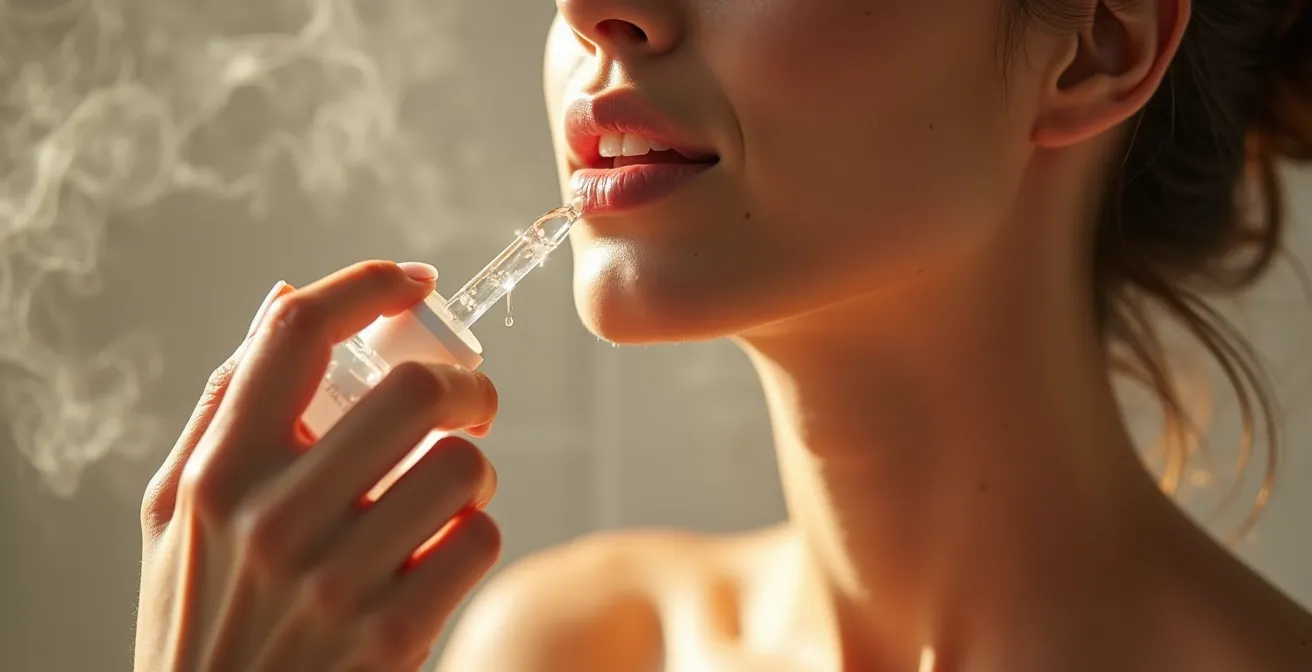
As the visual demonstrates, the presence of water droplets on the skin’s surface provides the perfect reservoir for your serum. This simple step transforms your humectant from a potential moisture thief into a powerful delivery system, pulling external hydration into the skin instead of pulling internal hydration out. For a truly effective routine in arid conditions, you can adopt an advanced strategy known as the “hydration sandwich.”
Your Action Plan: The Humectant Sandwich Technique
- Mist your face with thermal or soft water immediately after cleansing.
- Apply your humectant serum (HA or glycerin) to the damp skin within 60 seconds.
- Mist your face again lightly to create a water-rich buffer zone.
- Seal immediately with an occlusive moisturizer containing ceramides or squalane.
- Apply products after a lukewarm shower when skin temperature is slightly elevated for better absorption.
The Evaporation Trap: Why Using Serum Without Cream Worsens Dryness?
You’ve correctly applied your humectant serum to damp skin. The molecules are now plump with water, saturating the upper layers of your epidermis. But in a dry climate, you have just started a race against time. The single most important factor determining your skin’s hydration level is not just the water you put in, but the water you prevent from leaving. This is where the concept of the skin’s “dew point” becomes critical.
In meteorology, the dew point is the temperature at which air becomes saturated with water vapor. For skincare, we can think of a similar threshold for relative humidity. While there’s no single magic number, dermatological research indicates that below 40-50% relative humidity, the environment becomes aggressively “thirsty.” The dry air exerts a powerful osmotic pull, and any unsecured moisture on your skin’s surface will rapidly evaporate into the atmosphere. If you leave a humectant serum exposed, it will give up its newly acquired water to the air, and once that’s gone, it will start pulling more from your dermis.
This is the evaporation trap. Using a hydrating serum without an occlusive top layer is like filling a bucket with a hole in it. The only way to stop this transepidermal water loss (TEWL) is to create a physical barrier. This is the primary job of a good moisturizer. Ingredients like ceramides, squalane, petrolatum, or shea butter are occlusive or semi-occlusive. They form a protective film over the skin that dramatically slows down the rate of evaporation, effectively “trapping” the hydration and the humectant molecules underneath, allowing them to do their job for hours.
Polyglutamic Acid vs HA: Is the Upgrade Worth the Extra Cost?
Just as the hydration conversation evolved from glycerin to hyaluronic acid, a new player has entered the scene: polyglutamic acid (PGA). Marketed as an even more powerful hydrator, PGA is a large molecule derived from fermented soybeans. Its primary claim to fame is its incredible water-holding capacity. While HA is famous for holding up to 1000 times its weight in water, some data suggests PGA can hold up to 5,000 times its weight. However, the story is more nuanced than a simple numbers game.
PGA molecules are significantly larger than even high-molecular-weight HA. This means they do not penetrate the skin at all. Instead, PGA forms a flexible, mesh-like film on the skin’s surface. This film does two things: it draws moisture to the surface for an instant plumping and dewy effect, and it acts as a semi-occlusive barrier that helps slow down water evaporation. This makes it an excellent ingredient for combating surface flakiness and creating a smooth canvas for makeup.
So, is it an upgrade? It depends on your goal. If you want deeper, multi-level hydration, a well-formulated, multi-weight HA serum is still the superior choice. If your primary concern is surface dehydration and creating a primer-like finish, PGA excels. The decision can be broken down:
- Choose PGA if: Your main goal is to combat surface dehydration and flakiness, or you need a smoothing, primer-like effect under makeup, especially in extremely low humidity.
- Choose HA if: Your priority is achieving deeper hydration at multiple layers of the skin for more long-term benefits.
- Choose both if: Your budget allows for a synergistic approach. Use a smaller-molecule HA serum first to penetrate, then layer a PGA product on top to help seal the surface.
Ultimately, many experts are concluding that these two ingredients are not rivals, but complementary partners in a sophisticated hydration strategy. As the research team at Twelve Beauty puts it:
The debate isn’t ‘PGA vs. HA’ but ‘PGA + HA’ – they are a team, not rivals
– Twelve Beauty Research Team, Glycerin vs Hyaluronic Acid: Which is Better for Your Skin?
Where to Place Hydrating Serums in a 10-Step Routine?
The common advice to layer skincare products from “thinnest to thickest” is a useful starting point, but it’s an oversimplification. From a formulation science perspective, two other factors are more important for ensuring maximum absorption and efficacy: molecular weight and pH. The smallest molecules must go first to have the best chance of penetrating, and pH-dependent actives need to be applied at their optimal pH without being neutralized by the next product.
Hydrating serums containing humectants like hyaluronic acid and glycerin are generally formulated at a skin-neutral pH (around 5.5 to 6.5). This makes them relatively flexible. However, they should always be applied after any low-pH treatment products, such as Vitamin C (L-Ascorbic Acid) serums or AHA/BHA exfoliants. These actives require a low pH (typically below 4) to be effective. Applying a neutral-pH serum immediately after can raise the skin’s pH too quickly, neutralizing the acid before it has had time to work. A wait time of 15-20 minutes after an acid is often recommended.
After your actives have been absorbed, the path is clear for your hydrators. Here, the molecular weight rule takes precedence. You would apply your smallest molecule humectants first (like a low-weight HA or glycerin serum) and then layer larger molecule products (like a PGA serum) over the top. This ensures each ingredient reaches its intended destination. The final step is always your moisturizer, which has the largest molecular structure and serves as the occlusive seal.
The following table, based on common formulation principles, provides a clear sequencing guide for integrating hydrators with other actives.
| Step Order | Product Type | pH Range | Wait Time |
|---|---|---|---|
| 1 | Low-pH Actives (Vit C, AHA) | <4 | 15-20 min |
| 2 | Hydrating Serum (HA/Glycerin) | 5.5-6.5 | 2-3 min |
| 3 | High MW Serums (PGA) | 6-7 | 1-2 min |
| 4 | Moisturizer with Ceramides | 5.5-7 | No wait needed |
Ceramides or Hyaluronic Acid: Which Is Essential for Barrier Repair?
When your skin’s barrier is compromised, it becomes like a leaky roof, unable to keep water in or irritants out. The debate between using hyaluronic acid or ceramides for repair is based on a misunderstanding of their roles. They aren’t in competition; they perform two completely different, yet equally essential, jobs. Using the classic “brick and mortar” analogy for the skin barrier helps clarify this.
Your skin cells (corneocytes) are the “bricks.” Hyaluronic acid and other humectants are like the water supply system that ensures these bricks and the surrounding environment are properly hydrated. However, the “mortar” that holds these bricks together and makes the wall strong and impermeable is the lipid matrix. This mortar is primarily composed of three key lipids: ceramides, cholesterol, and free fatty acids. Without this lipid mortar, the wall crumbles, leaving gaps that allow water to escape and irritants to enter, no matter how much water you pump into the system.
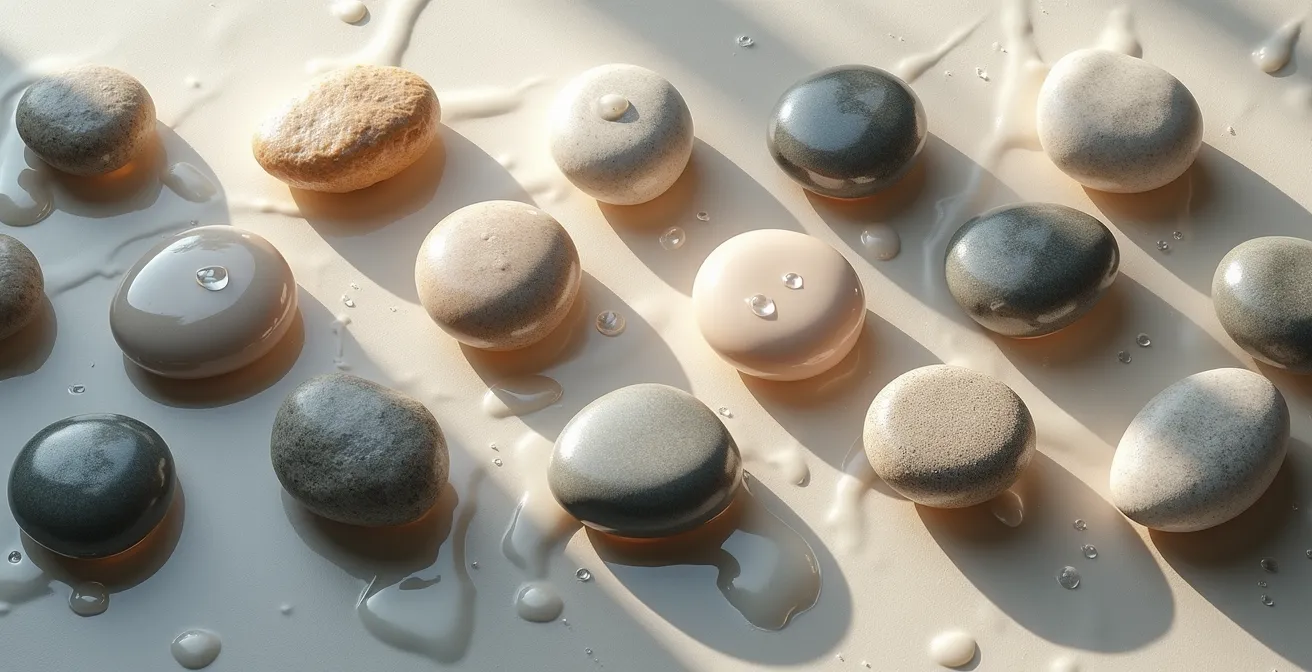
Therefore, for true barrier *repair*, ceramides are not just important; they are structurally essential. Hyaluronic acid hydrates a damaged barrier, which can reduce feelings of tightness, but it cannot rebuild it. To rebuild the mortar, you need to supply the building blocks. Furthermore, formulation matters immensely. As clinical research establishes, the optimal formulation requires a specific 3:1:1 ratio of ceramides, cholesterol, and fatty acids to effectively integrate into the skin’s own lipid matrix and perform repairs. Applying just ceramides alone is far less effective. So, the answer is clear: you need HA for hydration, but you absolutely need a well-formulated ceramide product to repair the barrier itself.
How to Boost Your Home Wi-Fi Signal Through Concrete Walls?
Let’s use a surprising analogy to understand a common skincare frustration: why does a routine that once worked suddenly stop being effective? Think of your skin barrier as the walls of your home and your skincare ingredients as the Wi-Fi signal. When your barrier is healthy, it’s like drywall—ingredients can penetrate effectively. But when it becomes compromised, thickened, or chronically inflamed, it’s like a concrete wall, blocking the signal.
You can try to “boost the signal” by applying more of the same product (like turning up the router’s power), but if the barrier is impenetrable, the effort is wasted. This is often the plateau people experience with hyaluronic acid. Their skin becomes so accustomed to it, or the underlying barrier issue is so significant, that it no longer responds. In this scenario, you need to change the “frequency” of the signal.
This is where “ingredient cycling” and switching to different humectants comes in. Instead of more HA, you could switch to a product based on glycerin or urea. These are often smaller molecules than many forms of HA and may have different pathways into the skin. As some cosmetic chemists note, humectants like glycerin are not only cost-effective but their small molecular size allows for easy absorption and long-lasting hydration. By introducing a different type of humectant, you’re trying a new frequency that might be able to get through the “concrete wall” where the old one was blocked. This doesn’t mean HA is bad; it just means your skin’s “reception” has changed, and a tactical switch can break through the plateau and get the hydration signal flowing again.
Key Takeaways
- In dry climates (<50% humidity), humectants need an occlusive top coat to prevent them from pulling moisture out of your skin.
- Application is key: always apply humectant serums to damp skin to provide an external water source.
- Barrier health is paramount. Ceramides are the “mortar” that repairs the skin barrier, while hyaluronic acid is the “water” that hydrates it; both are necessary.
Why Does Your Skin Barrier Get Damaged Despite Using Expensive Products?
One of the most perplexing issues in modern skincare is barrier damage that occurs despite a dedicated, and often expensive, routine. The price tag of a product does not guarantee its compatibility with your skin’s ecosystem. There are two primary, often-overlooked culprits: preservative overload and poor formulation technology.
The more products you layer, the more you expose your skin to a cocktail of different ingredients that were never designed to be mixed. Chief among these are preservatives. While essential for product safety, each formula has its own system. A 10-step routine could mean exposing your skin to 10 different preservative systems every single day. For some individuals, this cumulative exposure can become an irritant, slowly chipping away at the barrier’s integrity over time. It’s a “death by a thousand cuts” scenario, where the very routine designed to help is causing low-grade, chronic irritation.
More importantly, an expensive ingredient is useless if it’s not delivered to the skin correctly. The formulation is everything. Ceramides, for instance, are notoriously difficult to formulate. They are waxy solids that require specific heating processes and need to be combined with cholesterol and fatty acids in a precise ratio to be effective. A product can claim to contain ceramides, but if they aren’t formulated for delivery, they will simply sit on the surface without integrating into your barrier.
Case Study: The Power of Formulation Technology
A prime example of formulation-over-price is the use of controlled-release systems. In one clinical study, a test product was shown to be effective for barrier repair not just because it contained the right ingredients (ceramides 1, 3, and 6-II, triglycerides, and cholesterol), but because it delivered them using a multi-vesicular emulsion (MVE) system. This technology releases the ingredients slowly over time, mimicking the skin’s natural processes and ensuring a steady supply for repair, proving that the delivery vehicle is often more important than the cost of the passengers.
To build your personalized hydration ecosystem, start by auditing your current routine against these climatological principles. Focus on smart application, minimalist layering, and investing in products with proven formulation technology over expensive hero ingredients alone.