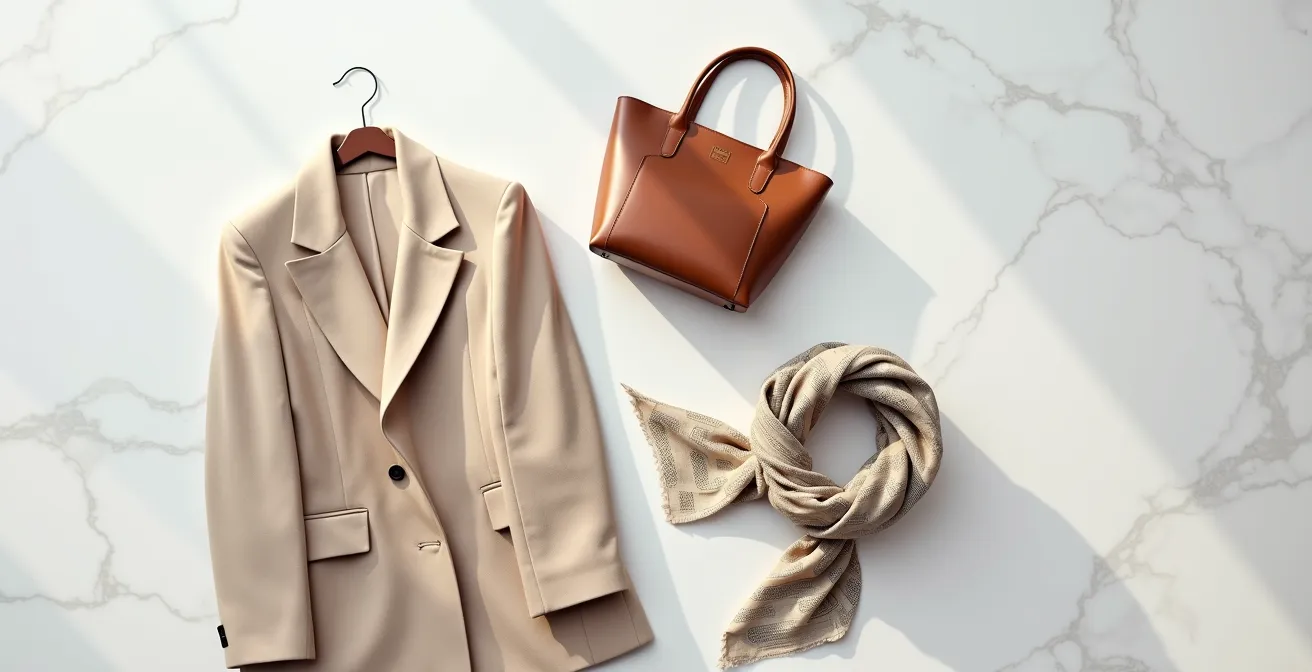
The secret to elevating a simple outfit isn’t adding more items; it’s creating a single, powerful focal point using the “Rule of Three.”
- Instead of counting pieces, focus on establishing a clear visual hierarchy with one “hero” accessory.
- Transform any look by strategically using intentional contrast in texture, shine, or structure.
- Invest intelligently by prioritizing items with high versatility and a low cost-per-wear, like a quality handbag.
Recommendation: Audit your accessories not by quantity, but by their ability to create a singular, compelling statement.
For the minimalist, the wardrobe is a sanctuary of clean lines and timeless staples. Yet, this curated simplicity often comes with a quiet frustration: the feeling that something is missing, that an outfit is ‘fine’ but not ‘finished.’ The common advice, “just add an accessory,” is as vague as it is unhelpful. Many have tried, adding a necklace here, a bracelet there, only to feel cluttered rather than chic. The result is often a collection of disparate whispers rather than a clear, confident statement.
The problem isn’t the accessories themselves, but the lack of a guiding principle. You’ve likely heard of the “Rule of Three,” often misinterpreted as a simple instruction to wear three visible items. This superficial understanding leads to outfits that are technically complete but lack soul and intention. It’s the reason why adding five subtle, delicate pieces can feel more chaotic and less impactful than adding one single, well-chosen statement item.
But what if the true ‘Rule of Three’ was less about arithmetic and more about artistry? What if it was a framework for creating a visual hierarchy on your body, a way of directing the eye and telling a story with your style? This guide reframes the rule not as a counting game, but as a strategic approach to dressing. It’s about understanding that a basic outfit (your first two pieces) becomes exceptional when you introduce a third element that serves as a deliberate focal point.
We will explore why one bold choice triumphs over many minor ones, how to select the right materials and tones for your personal palette, and how to avoid the dreaded “Christmas tree” effect. By mastering this principle, you will unlock the ability to transform any simple ensemble from basic to brilliant, using the pieces you already own or investing in new ones with surgical precision.
This article provides a complete framework for mastering this concept. From choosing the right metals to deciding where to allocate your budget, each section builds upon the last to give you a comprehensive and practical understanding of strategic accessorizing.
Summary: How to Master the “Rule of Three” for Elevated Style
- Why Does One Statement Piece Work Better Than Five Subtle Ones?
- Silver or Gold: How to Choose Metal Tone Based on Skin Undertone?
- The “Christmas Tree” Effect: Signs You Are Wearing Too Many Accessories
- How to Transform Office Wear into Evening Wear Using Only Accessories?
- Why Skimming Headlines Creates a False Sense of Knowledge?
- Bag vs Shoes: Where Should You Spend the Bulk of Your Accessory Budget?
- Sneakers or Loafers: Which Shoe Instantly Upgrades a Casual Outfit?
- How to Style Joggers Without Looking Like You Just Woke Up?
Why Does One Statement Piece Work Better Than Five Subtle Ones?
The human eye craves order and a clear point of focus. When you wear multiple small, subtle accessories, you create visual noise. The eye doesn’t know where to land, jumping between a delicate necklace, a thin bracelet, a small ring, and simple earrings. Nothing stands out, so the overall effect is diluted and forgettable. A single statement piece, however, acts as a powerful anchor. It establishes an undeniable focal point, creating a visual hierarchy that makes the entire outfit feel more intentional and cohesive. This one “hero” piece does the heavy lifting, drawing attention and defining the look’s entire mood.
Think of it as a principle of communication. Five people whispering at once creates an unintelligible murmur, while one person speaking clearly and confidently commands the room. Your statement piece is that confident voice. It could be a sculptural necklace, a bold cuff, an architectural ring, or a vibrant handbag. The power lies in its singularity and its ability to contrast with the simplicity of your base outfit. This is particularly true for rings, which have become a dominant category in the jewelry market; recent market research reveals that 33.8% of jewelry purchases are for rings, underscoring their popularity as accessible statement items.
The goal is not to be loud, but to be clear. A statement piece doesn’t have to be massive or ostentatious. It can be defined by its unique texture, its striking color, or its interesting shape. By consolidating your expressive energy into one key item, you achieve a look that is both impactful and effortlessly chic. This deliberate choice demonstrates confidence and a strong understanding of personal style, proving that in fashion, less is often more powerful.
Your Action Plan: The Visual Impact Assessment
- Focal Point Test: Stand five feet from a full-length mirror. In the first three seconds, what is the one thing your eye is drawn to? If you can’t decide, your outfit lacks a clear focal point.
- Build-Up and Edit: Start with your base outfit and remove all accessories. Add them back one at a time, observing in the mirror. Note the precise moment the look goes from “curated” to “cluttered.” That’s your limit.
- The Squint Test: Squint your eyes while looking at your reflection. This blurs the details and highlights the dominant shapes and points of light. If multiple items are competing for attention, remove the weakest one.
- Photo Proof: Take a quick photo of your outfit on your phone. Does your eye jump between multiple points of interest? If so, consolidate your accessories into one primary statement.
- Final Review: Before leaving, apply the classic Coco Chanel advice: look in the mirror and remove one accessory. This final edit often provides the perfect balance.
Silver or Gold: How to Choose Metal Tone Based on Skin Undertone?
Choosing between silver and gold is a fundamental step in building a cohesive accessory wardrobe. While personal preference is key, understanding how metal tones interact with your skin’s undertone can elevate your look from good to harmonious. Your undertone is the subtle, underlying color beneath your skin’s surface, which doesn’t change with tanning. The simplest way to identify it is by looking at the veins on your wrist in natural light. Bluish or purple veins typically indicate a cool undertone, while greenish veins suggest a warm undertone. If you see a mix of both, you likely have a neutral undertone.
For cool undertones, metals like silver, platinum, and white gold are incredibly flattering. They complement the pink and blue hues in the skin, creating a bright and crisp look. For warm undertones, gold, brass, and copper resonate beautifully with the skin’s golden or peachy hues, producing a rich, radiant effect. Those with neutral undertones have the versatility to wear either, or even mix them freely. However, the old rule of never mixing metals is long gone. The modern approach is about intentional mixing, not rigid separation. As a recent analysis of the fashion jewelry market shows, the trend is driven by consumers embracing personalized, mixed-metal combinations.
This shift towards personalization allows for more dynamic styling. A great strategy is the 70/30 rule: let your dominant, most flattering metal make up 70% of your jewelry, and use the other 30% as an accent. This creates intentional contrast without looking accidental. The visual below demonstrates how different metals can enhance the warmth or coolness of a complexion.
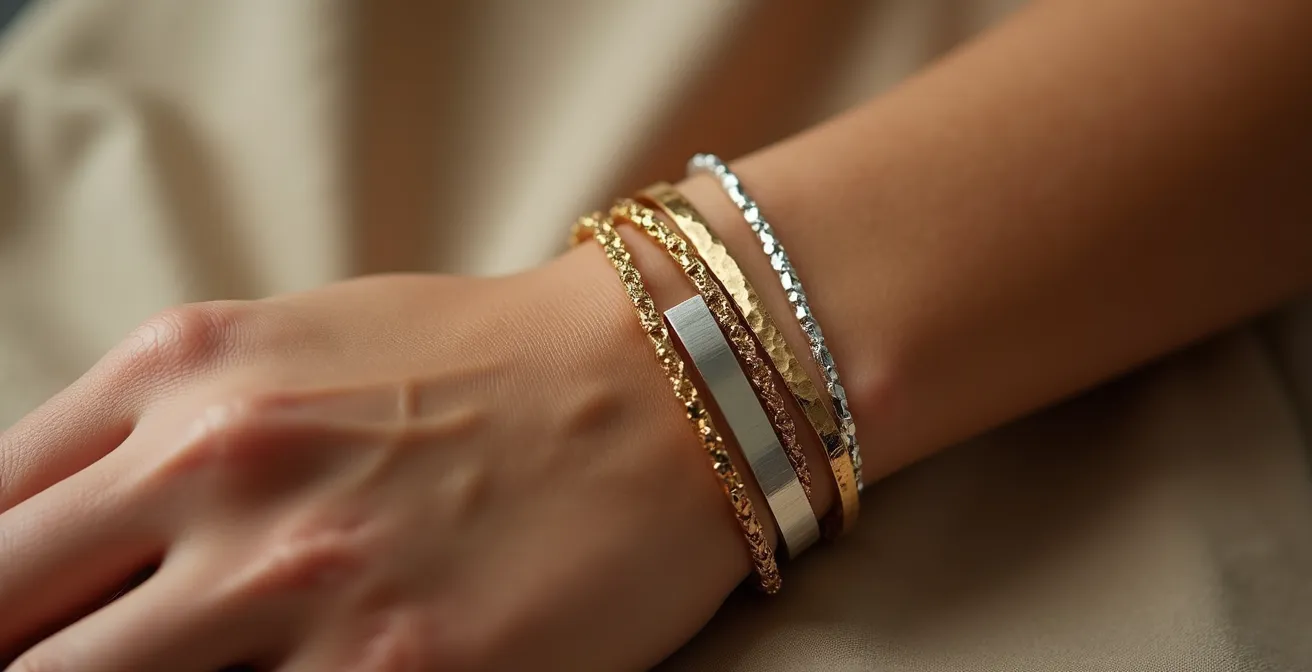
This table provides a practical guide for selecting and mixing metals based on your undertone, whether for a daytime look or an evening upgrade. The key is to make your choices feel deliberate, turning your jewelry into a seamless extension of your personal aesthetic.
| Skin Undertone | Primary Metal | Mixing Strategy | Evening Upgrade |
|---|---|---|---|
| Cool (pink/blue veins) | Silver, platinum, white gold | 70% silver, 30% gold accent | Add rose gold for warmth |
| Warm (green veins) | Gold, brass, copper | 70% gold, 30% silver accent | Layer mixed metals boldly |
| Neutral (both vein colors) | Both work equally | 50/50 or match to outfit temperature | Stack both freely |
The “Christmas Tree” Effect: Signs You Are Wearing Too Many Accessories
There’s a fine line between being accessorized and being decorated. The “Christmas Tree” effect occurs when you cross that line. It’s the visual chaos that results from wearing too many competing pieces, where the accessories wear you, not the other way around. The core issue returns to the lack of a focal point. When every part of your outfit is shouting for attention—a statement necklace, chandelier earrings, stacked bracelets, and a cocktail ring—the result is an overwhelming and distracting aesthetic. A polished look is about curation and editing, not accumulation.
As fashion consultant Imogen Lamport notes, the goal is to find a hero piece. In her words:
The third piece is your hero – a garment or accessory that has enough interest or detail to draw attention to it and make the whole outfit look more exciting.
– Imogen Lamport, Inside Out Style Blog
Recognizing the signs of over-accessorizing is the first step toward mastering this balance. One of the most obvious indicators is noise and restriction. If your bracelets clink loudly with every movement or your necklace gets tangled when you sit down, it’s a sign to simplify. Another test is the two-second rule: if you look at a photo of yourself and can’t immediately identify the main “story” or hero piece of your look within two seconds, you’re likely over-accessorized. Finally, consider the three-color rule. If your accessories, in combination with your outfit, introduce more than three dominant colors, the look can quickly become disjointed. True style lies in the confidence to let one or two beautiful pieces shine on their own.
How to Transform Office Wear into Evening Wear Using Only Accessories?
The transition from a professional day look to a sophisticated evening ensemble doesn’t require a full wardrobe change. For the minimalist, the secret lies in a few strategic accessory swaps that can be done in under five minutes. This “desk-to-dinner” transformation is an exercise in applying the Rule of Three with intention, focusing on three key elements: Scale, Shine, and Statement. A simple base outfit, like black trousers and a white silk shirt, acts as the perfect blank canvas.
First, address the Scale. Swap out your small, discreet daytime stud earrings for a pair of more dramatic drop or chandelier earrings. This single change instantly frames the face differently and signals a shift in mood. Second, introduce Shine. Replace a conservative leather watch or belt with something metallic. A slim gold belt, a silver cuff, or even shoes with a metallic finish can catch the low evening light and add a dose of glamour. The growing demand for adaptable jewelry is clear, as industry analysis shows a 6.2% CAGR growth in fashion jewelry, driven by the popularity of versatile day-to-night pieces.
The final move is the Statement. Switch your practical work tote for a smaller, more elegant clutch. This is not just a functional change; it’s a symbolic one. A clutch is inherently less utilitarian and more focused on form, immediately elevating the entire look. A case study from Nordstrom’s styling program proved this “Three S’s” strategy effective, with 80% of clients reporting increased confidence at after-work events by using a pre-packed “evening kit” of transformative accessories.
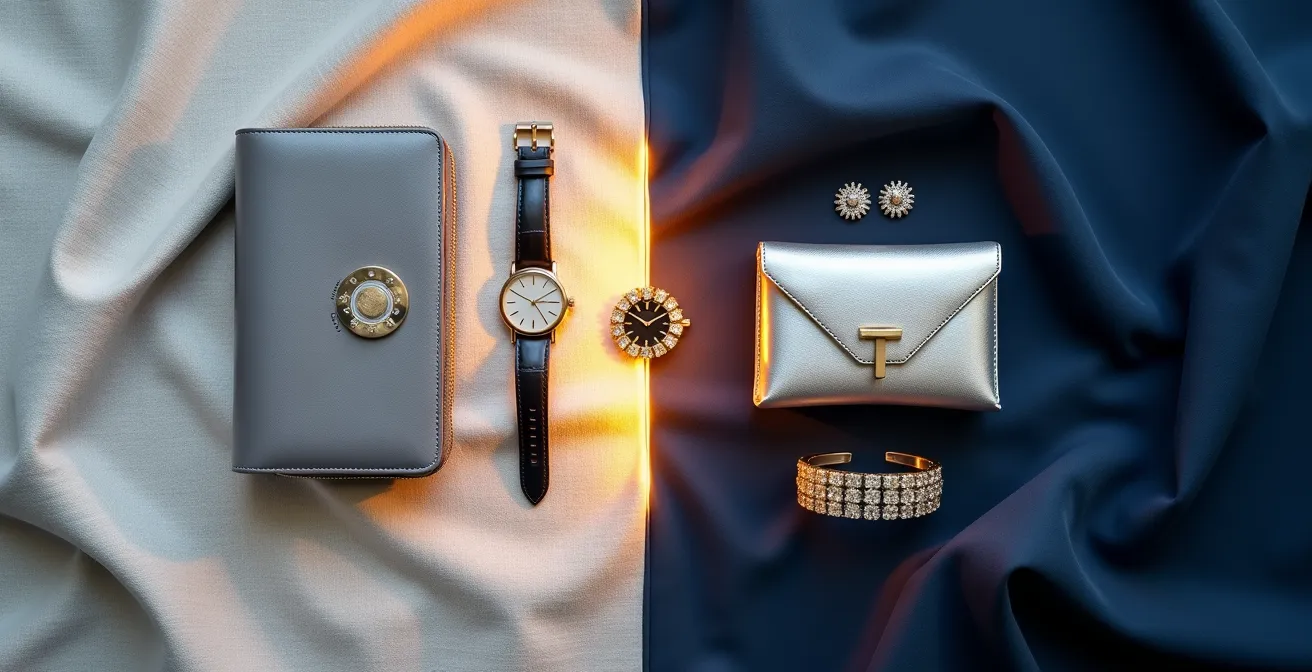
The “Three S’s” Transformation: A Stylist’s Method
A fashion consultant developed a highly effective strategy for a client needing to transition a basic office outfit (black trousers, white shirt) into an evening-appropriate look. The method, dubbed the “Three S’s,” relied on three quick swaps from a pre-packed kit. First, Scale: stud earrings were replaced with dramatic chandelier drops. Second, Shine: a metallic belt was added to catch the light. Third, Statement: the large work tote was switched for a sleek clutch. According to the consultant’s case study, the entire transformation took less than five minutes and significantly boosted the client’s confidence for after-work networking events.
Why Skimming Headlines Creates a False Sense of Knowledge?
In fashion, as in life, headlines offer a tempting shortcut to knowledge. “Wear black to look slim,” “florals for spring,” or “invest in a capsule wardrobe.” We skim these rules, feel a flash of understanding, and believe we’ve mastered the concept. However, this creates a false sense of knowledge, what is known as the illusion of explanatory depth. You know the “what” (the rule) but not the “why” (the principle). This is precisely why so many well-intentioned efforts to build a great wardrobe fail. The real magic isn’t in the rule itself, but in its nuanced application—something you only grasp by digging deeper.
The idea of a “capsule wardrobe” is a perfect example. A person might skim headlines and conclude that having a wardrobe of all-black items is the key to versatility. But as one personal stylist’s case study revealed, this can be a trap. The client owned 47 black items but still felt she had nothing to wear. The headline—”black goes with everything”—was true on the surface, but it ignored the crucial details: fit, fabric, texture, and proportion. A drapey, matte black t-shirt has a completely different energy than a structured, shiny black blazer. By failing to understand the principles *behind* the headline, the client had amassed a collection of items that, despite being the same color, were stylistically incompatible.
The Anti-Skim Wardrobe Audit: From 47 Black Items to 300% More Outfits
A personal stylist worked with a client who believed she understood the “capsule wardrobe” concept from reading fashion headlines. Her interpretation led her to own 47 black items, yet she consistently struggled to create cohesive outfits. The stylist’s audit revealed the flaw in this headline-deep knowledge. By analyzing the overlooked characteristics—structured vs. drapey, matte vs. shiny—they were able to edit the collection down to just 12 versatile black pieces. According to the stylist’s success story, this curated selection resulted in a 300% increase in possible outfit combinations, proving that understanding the underlying principles is far more valuable than simply following a rule.
The same applies to the Rule of Three. The popular understanding, as often seen on platforms like TikTok, is to simply add a third layer. But as the TikTok fashion community itself often demonstrates, the most successful looks are those that understand it’s about creating a focal point, not just adding a piece. Skimming gives you the formula; deep understanding gives you the artistry.
Bag vs Shoes: Where Should You Spend the Bulk of Your Accessory Budget?
When building a minimal but high-impact wardrobe, every investment counts. The perennial question for accessories is where to allocate the majority of your budget: on a quality handbag or on premium shoes? While both are essential, a strategic analysis based on cost-per-wear, versatility, and retained value points to a clear winner. For the discerning minimalist, the handbag is almost always the smarter primary investment.
A high-quality leather handbag can be used almost daily, regardless of the season or specific outfit, leading to an exceptionally low cost-per-wear. Shoes, on the other hand, are more specialized. They are subject to weather conditions, comfort requirements for the day’s activities, and style pairings, which naturally limits their use. Furthermore, shoes endure significantly more physical stress, requiring more frequent and costly maintenance like resoling. A well-cared-for bag, by contrast, often develops a beautiful patina with age and requires minimal upkeep.
From a financial perspective, the argument for the bag becomes even stronger. Investment-quality handbags retain a significant portion of their value on the resale market, sometimes even appreciating. Shoes, with few exceptions, have a much lower resale value due to wear and hygiene concerns. When making a significant purchase, it’s wise to assess the item in person, which is a common practice for discerning buyers; market data reveals that 63% of luxury accessory purchases are made in physical stores, allowing for a tactile quality assessment. This hands-on approach is crucial when deciding on a piece you’ll use for years.
The following table breaks down the investment logic, illustrating why a $500 bag often provides far greater long-term value than $500 shoes.
| Factor | Investment Bag ($500) | Investment Shoes ($500) |
|---|---|---|
| Average Uses/Year | 200+ days | 100 days (weather/comfort dependent) |
| Lifespan | 5-10 years with care | 2-3 years with resoling |
| Cost Per Wear (Year 1) | $2.50 | $5.00 |
| Versatility Score | High (works with most outfits) | Medium (style-specific) |
| Maintenance Cost | $20-50/year | $100-150/year (resoling/repairs) |
| Resale Value | 40-60% retention | 15-30% retention |
Sneakers or Loafers: Which Shoe Instantly Upgrades a Casual Outfit?
The right pair of shoes can single-handedly redefine a casual outfit, but the choice between sneakers and loafers isn’t about which is “better”—it’s about understanding the power of intentional contrast and structure. While both can elevate a look, they do so in different ways. The key factor for an instant upgrade isn’t the shoe *type* but its *quality of structure*: clean lines, refined materials, and deliberate proportions.
Loafers are the masters of creating “high-low tension.” When paired with casual items like jeans or even tailored joggers, a structured leather loafer introduces an element of classic polish. It borrows from a more formal language of dress, creating a sophisticated juxtaposition that feels intentional and chic. A styling analysis found that pairing leather loafers with simple jeans increased the outfit’s “polish perception” by 40%. The exposed ankle and refined shape instantly lend an air of effortless elegance.
Minimalist leather sneakers, on the other hand, upgrade an outfit through modern refinement. A sleek, clean, well-structured sneaker offers a sharp, contemporary edge that a bulky, athletic-style shoe cannot. When a casual outfit is paired with premium leather sneakers, the message is one of considered comfort and modern taste. The same styling study showed that sleek white sneakers achieved a 35% improvement in polish perception. The upgrade comes from the shoe’s structure acting as a deliberate counterpoint to the relaxed nature of the clothes. Ultimately, whether a loafer or a sneaker, the upgrade is achieved when the shoe’s structure is a clear and intentional choice, not an afterthought.
Choosing the right shoe depends entirely on the context and the specific message you want to send.
- For a “smart casual” signal (e.g., brunch, casual Friday): Loafers provide an instant hit of sophistication.
- For a modern, urban edge (e.g., weekend exploring): Minimalist leather sneakers are unmatched for their blend of comfort and style.
- For creative or all-day events: Well-structured sneakers in premium materials offer style endurance without sacrificing comfort.
- For an evening casual look: Loafers often win due to the leg-elongating effect of an exposed ankle.
Key takeaways
- The Rule of Three is a principle of visual hierarchy, not just counting items. Your goal is to create one strong focal point.
- True style comes from understanding the “why” behind fashion rules, not just skimming headlines. Nuance in fit, fabric, and proportion is everything.
- Invest strategically in accessories with the lowest cost-per-wear and highest versatility. A quality handbag is often a smarter long-term investment than shoes.
How to Style Joggers Without Looking Like You Just Woke Up?
Styling joggers to look chic rather than sloppy is the ultimate test of the Rule of Three, and a perfect illustration of how intentional contrast can elevate even the most casual of pieces. The transformation from loungewear to a polished, deliberate outfit hinges on a formula that balances comfort with structure. The current obsession with elevated casual wear is undeniable, with fashion search data indicating a 156% increase in searches for athleisure styling. Mastering this look is essential for a modern wardrobe.
The process begins with the joggers themselves (Piece #1). Opt for a pair with a tapered leg in an elevated fabric like Tencel, modal, or ponte knit. These materials have a better drape and structure than standard cotton fleece. Next, the top (Piece #2) should create contrast. Instead of a loose t-shirt, choose a more fitted top like a silk camisole or a crisp, classic button-down shirt. This juxtaposition of a relaxed bottom with a more structured top is the foundation of the look.
The magic, however, happens with the third piece. This is where you inject a strong dose of intention. A structured blazer creates a powerful high-low tension, instantly making the look office-appropriate in a creative field. A classic trench coat lends timeless elegance, while a luxurious cashmere cardigan adds textural depth and a sense of quiet luxury. The final touches are non-negotiable: swap sneakers for heeled boots or pointed-toe flats to elongate the leg line, and add one single, polished accessory—like a structured handbag or a statement watch—to serve as the outfit’s focal point. This proves that with the right framework, any piece can be made to look sophisticated.
Now that you have the framework, the next step is to look at your own wardrobe not as a collection of random items, but as a set of ingredients. Start by identifying the potential “hero” pieces and the blank canvases, and begin experimenting with creating your own powerful visual stories.