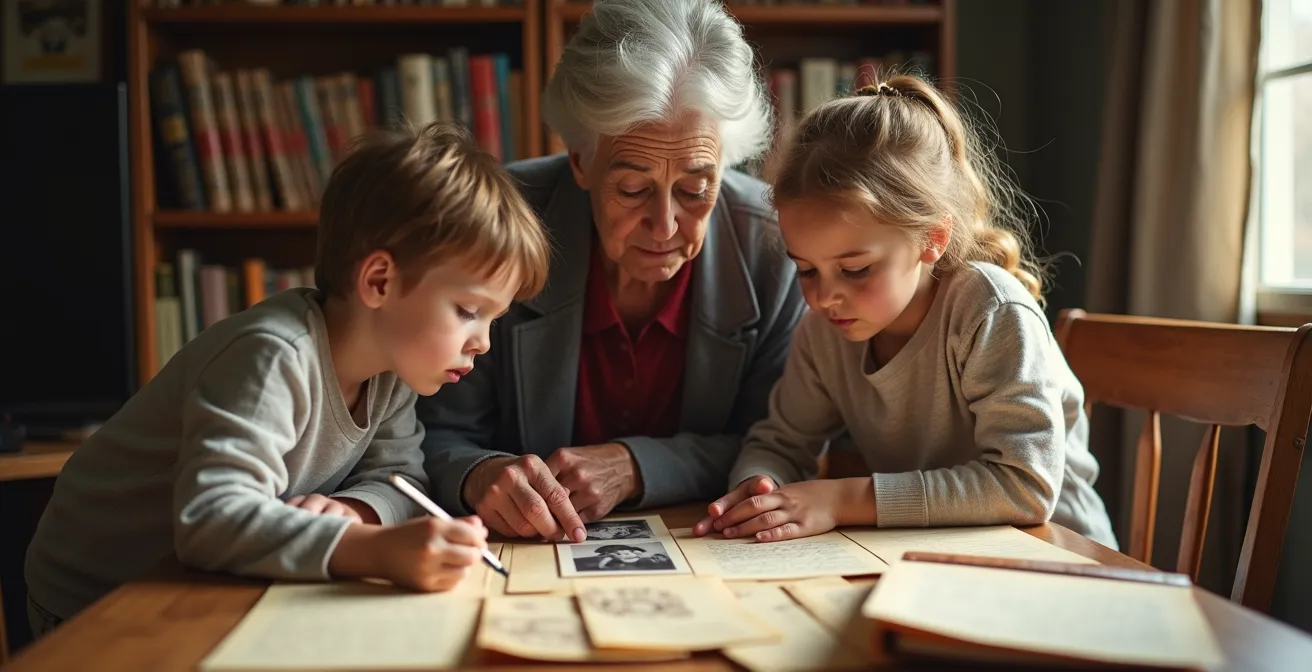
Contrary to popular belief, a DNA test isn’t the end of your ancestry journey—it’s the beginning of a deeper investigation. True heritage isn’t found in genetic percentages, but in the rich, complex, and often contradictory stories that define your family. This guide reframes genealogy as an emotional exploration, teaching you how to move beyond data collection to uncover the narratives that forge identity and build resilience.
The email arrives, and your heart beats a little faster. The results of your online DNA test are in. You click the link and a vibrant map appears, splashed with percentages: 35% Irish, 22% Scandinavian, 15% Italian… It’s a fascinating snapshot, a scientific anchor for your identity. For many, this is the destination. You might build a basic family tree on a genealogy website, matching names to census records, and feel the search is complete. This process is logical, structured, and satisfyingly neat.
But a quiet question often lingers. What about the stories you grew up with? The tale of a great-grandmother who wasn’t who she seemed? The family legend of a mysterious journey across an ocean? These narratives, filled with emotion and inconsistency, rarely fit into the clean boxes of official records. The common advice is to treat them as folklore, interesting but unreliable. We’re told to trust the documents, the hard data, and the genetic markers.
But what if the key to a profound connection with your past isn’t in dismissing these stories, but in investigating them? What if the contradictions themselves are the clues? This guide is built on that premise. We will move beyond the role of a data collector to become an emotional archaeologist. You will learn not just to find names and dates, but to uncover the meaning, motivation, and context behind your ancestors’ lives. We will explore how to reconcile family lore with historical facts, transform static photos into living archives, and ultimately understand that biology is not the same as belonging.
This article will guide you through the essential techniques and mindset shifts needed to transform your search for roots from a simple hobby into a profound journey of connection. Prepare to explore the heart of your family’s story, one discovery at a time.
Summary: Beyond the Percentages: Charting Your True Ancestral Journey
- Why Do Family Stories Often Contradict Official Records?
- How to Interview a Grandparent to Preserve Their Memories Forever?
- Biology vs Culture: Why Does DNA Not Determine Your Cultural Belonging?
- The Psychology of Roots: Why Does Knowing Your History Boost Resilience?
- Why Must You Digitize Family Photos Before They Fade?
- How to Adapt a Global Brand Story for a Local Market Without Losing Meaning?
- How to Transfer Data to a New Phone Without Losing App Settings?
- Tourist vs Traveler: How to Transition from Sightseeing to Connecting?
Why Do Family Stories Often Contradict Official Records?
The first step in any deep genealogical investigation is to accept a fundamental truth: memory is not a filing cabinet. It’s a storyteller. While an official document is a cold snapshot of a single moment—a birth, a marriage, a census entry—a family story is a living narrative, shaped by emotion, perspective, and the passage of time. This is why the tale of your great-uncle’s heroic war deeds might not perfectly align with his military records, or why a family’s immigration story might omit periods of hardship. These aren’t necessarily lies; they are edited realities, curated to preserve dignity, teach a lesson, or simplify a complex past. The discrepancy itself is a clue, pointing to something the family felt was important to either emphasize or forget.
This duality between personal narrative and documented history is the fertile ground where real discovery happens. Instead of viewing contradictions as errors, the skilled family historian sees them as questions. Why was this part of the story changed? What does the omission tell us? The process of narrative reconciliation—placing family lore and official documents side-by-side—allows you to build a three-dimensional picture of your ancestors. You move beyond what happened to explore how they *felt* about what happened. This is where a person’s character truly emerges from the historical record.
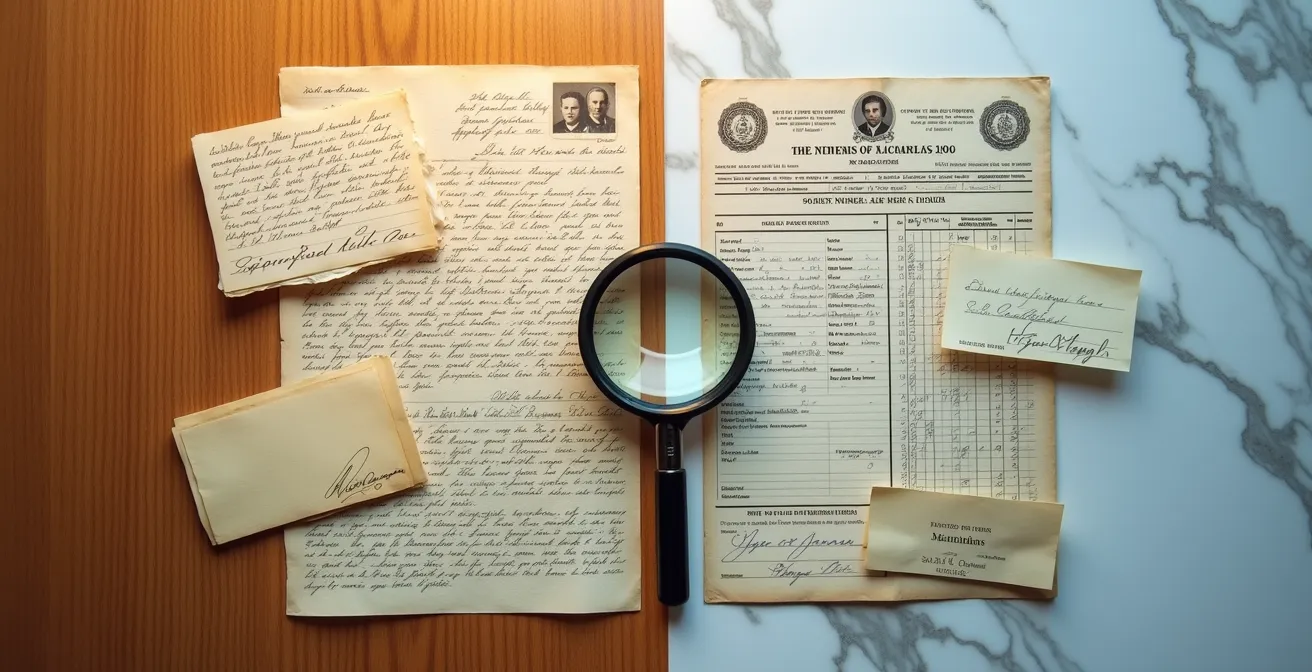
To begin reconciling these two worlds, you must become a detective. The following steps provide a framework for navigating the rich, and sometimes murky, waters of your family’s past:
- Interview First, Document Later: Start with the living memory. Interview older generations before diving into archives, as the stories they hold are often unwritten and carry emotional context that documents lack.
- Document Every Detail: During interviews, record every name, street, or seemingly minor anecdote. These details are the threads you’ll later use to search for corroborating evidence in census reports, military records, or old newspapers.
- Consult Primary Family Documents: Before heading to public archives, look for records held by the family. Check old Bibles where births and deaths were often recorded, and review original birth, death, and marriage certificates, which can reveal crucial names and dates.
- Cross-Reference with Official Archives: Use the clues you’ve gathered to verify or understand discrepancies. Libraries and archives with genealogical collections often hold unpublished materials like photo collections and surname files that can bridge the gap between story and fact.
How to Interview a Grandparent to Preserve Their Memories Forever?
Interviewing a grandparent or elderly relative is not a simple Q&A session; it is an act of emotional archaeology. Your goal is to unearth not just facts, but feelings, atmospheres, and the sensory details of a life lived. A birthdate can be found in a record, but the memory of the smell of a grandmother’s kitchen or the sound of music at a wedding exists only in memory. Preserving these details is what gives a family tree its soul. Approaching the interview with this mindset changes everything, transforming it from an interrogation into a shared experience of remembrance.
The key to a successful interview is creating an environment of comfort and trust, where memory can flow freely. It’s about asking the right kind of questions—ones that open doors rather than demand simple answers. Instead of “Where did you go to school?” try “What do you remember most about walking to school?” This shift from factual to sensory questions can unlock a flood of vivid details. The aim is to capture the personality and voice of your loved one, preserving their essence for generations who will never have the chance to meet them.
A structured yet flexible approach yields the best results. Preparing themes can guide the conversation without making it rigid. Here is a practical process for conducting an interview that captures the heart of your family’s story:
- Prepare Thematic Sessions: Don’t try to cover an entire life in one sitting. Plan shorter sessions focused on themes like ‘Childhood & School,’ ‘First Job,’ or ‘Love & Marriage.’ This creates a more coherent narrative and is less tiring for your relative.
- Use Sensory Triggers: Memory is deeply tied to the senses. Bring old photographs, play music from their youth, or even prepare a family recipe. These triggers can bypass the conscious mind and unlock deeper, long-forgotten memories.
- Ask Emotion-Focused Questions: Go beyond the “who, what, where, when.” Ask questions like, “How did that make you feel?” or “What were you hoping for at that moment?” This is how you preserve personality alongside facts.
- Videotape the Session: If your relative is comfortable, videotaping the interview is invaluable. It captures their expressions, their tone of voice, and the twinkle in their eye as they tell a story—details a transcript can never convey.
- Document Clues for Later Research: As they speak, gently take notes on any mention of a name, place, or specific event. These are the starting points for your future archival research, allowing you to add factual layers to their emotional narrative.
Biology vs Culture: Why Does DNA Not Determine Your Cultural Belonging?
A DNA test can tell you that a percentage of your genetic code originated in a certain part of the world. It cannot, however, tell you who you are. The modern obsession with genetic percentages often confuses biological ancestry with cultural belonging, two profoundly different concepts. Your biology is the genetic material passed down to you. Your culture is the language, traditions, food, stories, and social norms you inherit through lived experience. A person may have 50% Italian DNA but have no connection to the Italian language, its customs, or its way of life. Conversely, someone adopted into a vibrant Greek family may have no Greek DNA but be culturally, and in every meaningful sense, Greek.
The allure of a DNA test is its simplicity. It provides a neat, scientific-sounding answer to the complex question, “Where do I come from?” But this answer is incomplete. Your ancestors were not percentages; they were people who lived within specific communities, spoke specific languages, and navigated specific cultural landscapes. Reducing their existence to a genetic marker strips away the very context that gave their lives meaning. The real journey of ancestral discovery begins when you use DNA results not as a final answer, but as a signpost—a clue that points you toward a culture, a region, or a historical moment to investigate further.
The sheer scale of historical data available puts this in perspective. For example, a single platform like MyHeritage provides access to nearly 37 billion historical records for genealogy research. Your DNA is one record among billions. It is a powerful starting point, but the story is written in the census data, immigration papers, newspaper articles, and parish records. It’s in understanding the food your ancestors ate, the songs they sang, and the hardships they faced as a community. True connection comes from engaging with the culture they inhabited, not just identifying the genes they passed on.
The Psychology of Roots: Why Does Knowing Your History Boost Resilience?
Why do we feel this deep pull to know where we come from? The search for our roots goes far beyond a simple hobby; it’s a fundamental human need for connection and context. Psychologists have found that individuals with a strong sense of their family history exhibit higher levels of resilience, self-esteem, and a greater sense of control over their lives. This phenomenon, known as intergenerational resilience, comes from understanding that you are part of a much larger story—a long line of people who survived, adapted, and overcame their own challenges.
When you discover the story of an ancestor who weathered a famine, crossed an ocean with nothing, or rebuilt their life after a war, their strength becomes a part of your own narrative. Their struggles and triumphs provide a new perspective on your own challenges, making them feel more manageable. You are no longer just an individual facing a problem; you are the descendant of survivors. This knowledge creates a powerful psychological anchor, grounding you in a history of perseverance. As one organization dedicated to family history, Genealogy TV, puts it, this journey is about far more than data.
Genealogy isn’t just about names and dates—it’s about bringing to life the experiences, struggles, and triumphs of those who shaped who you are today. As you explore, you’re embarking on an adventure into the lives of your ancestors, piecing together stories that might have otherwise been forgotten
– Genealogy TV, Genealogy TV Educational Platform
This process is not about romanticizing the past. It’s about building an honest, nuanced understanding of it. Learning about your ancestors’ flaws and failures is just as important as celebrating their successes. It humanizes them and, in turn, allows you to be more compassionate with yourself. By moving beyond simple fact collection to understanding the community and context that shaped your ancestors’ lives, you build a robust and authentic sense of self. Your story didn’t start with your birth; you are one chapter in an epic saga, and knowing the previous chapters gives your own life deeper meaning and purpose.
Why Must You Digitize Family Photos Before They Fade?
A box of old family photographs is a treasure chest of silent stories. Each image is a portal to a specific moment in time—a wedding, a holiday, a simple afternoon in the yard. But these portals are closing. Photographs, especially older prints, are fragile artifacts. They are susceptible to fading from light exposure, discoloration from chemical instability, and damage from humidity and handling. Every day that passes, a little more detail is lost forever. Digitizing these photos is not just an act of technological housekeeping; it is an urgent mission of historical preservation.
However, simply scanning a photo is only half the battle. A digital image without context is just as silent as a faded print. The true magic happens when you transform a collection of scanned images into a living archive. This means embedding the stories behind the photos directly into the digital files themselves. Who is in the picture? Where and when was it taken? What was the occasion? What was happening just outside the frame? Answering these questions and recording them as metadata ensures that the story survives along with the image. Without this context, future generations will be left with a collection of anonymous faces.

Creating a living archive is a powerful way to collaborate with family members, combining multiple perspectives to build a richer narrative. It turns a solitary task into a collective act of remembrance. The process requires a methodical approach to ensure that the quality and the stories of these precious images are preserved for the future.
Your Action Plan: Creating a Living Photo Archive
- Scan for Quality: Scan all photographs at a minimum resolution of 300 DPI (dots per inch), or 600 DPI for very small images. This ensures the files are high enough quality for printing and archival purposes.
- Embed the Story: Use software to embed IPTC/XMP metadata directly into the image files. Record names, dates, locations, and the story behind the photo. This data travels with the image file forever.
- Build a Collaborative Hub: Create a shared digital archive using a cloud service (like Google Photos, Dropbox, or a specialized genealogy platform). Invite relatives to add their own memories and identify unknown faces.
- Restore and Reveal: Use digital restoration tools, many of which are now user-friendly, to repair minor damage and correct fading. This can often reveal hidden details in faces or backgrounds that were previously invisible.
- Analyze for Clues: Use the photos as historical documents. Analyze clothing, hairstyles, automobiles, and architecture in the background to help date and locate photos where the context has been lost.
How to Adapt a Global Brand Story for a Local Market Without Losing Meaning?
In genealogy, your “global brand story” is your broad heritage—”we are Scottish,” “our family is from Italy.” It’s a valid and important starting point, but it lacks specificity and personal connection. To truly connect with your roots, you must adapt this general story to a “local market”—the specific village, town, or parish your ancestors called home. The difference between saying “I’m Irish” and “My family comes from a small fishing village in County Clare, where the church records date back to 1820” is the difference between a vague identity and a tangible connection.
This process of localization involves moving beyond national stereotypes and engaging with the specific history and culture of a place. Every town has its own unique story, its own prominent families, its own economic history, and its own traditions. By researching your family’s specific point of origin, you can begin to understand the actual world they inhabited. Did they live in a farming community, a bustling port city, or a mining town? This context explains their choices, their opportunities, and their challenges in a way that a broad national identity never could.
Localizing your family’s story transforms your research from an abstract exercise into a potential travel itinerary. It gives you real places to visit, local archives to explore, and specific traditions to learn about. The following steps can help you drill down from a broad heritage to a specific, meaningful local identity:
- Identify the Town of Origin: This is the single most important step. Use immigration records, census data, and vital records (birth, marriage, death) to pinpoint the exact village or parish. As research platforms like Findmypast highlight, censuses tell you what households looked like and where people lived at specific points in time.
- Research Your Surname’s Local Etymology: Investigate the specific origin and meaning of your family name within that region. A surname may have a very different history and social standing in one valley compared to another.
- Follow Relatives Through Time with Maps: Use historical maps to see where your ancestors grew up, lived, and worked. Visualizing their physical environment creates a powerful sense of connection to their daily lives.
- Adopt Specific Local Traditions: Instead of general national customs, research the specific traditions, festivals, and recipes of your ancestral village. Cooking a dish that your great-great-grandmother might have made is a profound sensory link to the past.
- Curate Local Newspaper Clippings: Search local newspaper archives for mentions of your family name. These can provide incredibly rich, visual stories about your ancestors’ lives and their role in the community.
How to Transfer Data to a New Phone Without Losing App Settings?
In the world of genealogy, your family tree data is your most precious asset. The “new phone” is any new platform, software, or website you might want to use, and “app settings” represent the years of meticulous research—sources, notes, photos, and stories—you’ve attached to each individual. One of the biggest fears for any family historian is “platform lock-in”: the worry that all your hard work is trapped on a single website. Being able to migrate your data is essential for long-term preservation and research flexibility.
The key to data portability in genealogy is a standard file format called GEDCOM (Genealogical Data Communication). A GEDCOM file is a plain-text file that contains your family tree—names, dates, relationships, and places. Nearly all genealogy software and websites can export and import GEDCOM files. This allows you to move the basic architecture of your tree from one platform to another, for instance, from Ancestry to a personal software program, or from MyHeritage to FamilySearch.
However, it’s crucial to understand that a basic GEDCOM transfer is not always perfect. While it excels at moving the core “who, what, where, when,” it can be less reliable at transferring photos, attached documents, and detailed source citations. Each platform handles this “rich media” differently, which can lead to broken links or lost information during a transfer. Therefore, choosing a platform should involve considering its data portability and export features just as much as its research tools.
This table compares the data migration capabilities of several major platforms to help you understand the landscape of genealogical data transfer.
| Platform | Export Format | Data Portability | Source Preservation |
|---|---|---|---|
| Ancestry | GEDCOM | Full tree export | Manual re-linking required |
| FamilySearch | GEDCOM | Free access | Sources maintained |
| MyHeritage | GEDCOM | Cross-platform sync | Partial source transfer |
| Findmypast | GEDCOM | Standard export | Limited source export |
Key Takeaways
- Family stories and official records are both valid sources; their contradictions are clues, not errors, that reveal deeper truths.
- Your cultural belonging is shaped by lived experience and community, not just the genetic percentages revealed in a DNA test.
- Preserving family history is an act of emotional archaeology; it involves capturing the stories and feelings behind the facts to build intergenerational resilience.
Tourist vs Traveler: How to Transition from Sightseeing to Connecting?
In the end, your approach to genealogy comes down to a choice. You can be a “genealogical tourist” or a “genealogical traveler.” The tourist collects facts like souvenirs. They check off names on a list, gather birth and death dates, and pin locations on a map. Their goal is completion—to fill in all the boxes on the family tree. The work is satisfying, but it remains on the surface. They see the sights of their family’s past but never truly immerse themselves in it.
The genealogical traveler, on the other hand, seeks connection, not completion. They understand that a family tree is not a project to be finished, but a journey to be experienced. They linger. They ask “why.” They embrace the messy, contradictory, and emotional reality of their ancestors’ lives. For the traveler, finding a great-grandmother’s immigration record is not the end of the search; it is the beginning of a dozen new questions. Why did she leave? What was she hoping to find? Who did she leave behind? This approach is about engaging with the story and the humanity behind the data.
This shift in mindset is the final and most important step in going beyond a DNA test. It’s the commitment to move from being a spectator of your history to becoming an active participant in its preservation and interpretation. It is a journey that, by its very nature, will never be complete, but will offer a lifetime of discovery and a profound, unshakable sense of belonging. As the National Genealogical Society beautifully describes it:
Your decision to start a family tree will take you on an interesting journey back through time. As a time traveler, your journey will begin with your life… be sure to record your findings carefully in a permanent place for everyone to enjoy long after you too have become history
– National Genealogical Society, NGS Free Genealogy Resources
Making this transition is the essence of a meaningful ancestral quest. It’s about choosing depth over breadth, and story over simple data. It’s about honoring your ancestors not just as names on a chart, but as the complex, resilient people whose lives made yours possible.
Your family’s true story is waiting to be discovered, far beyond the simple percentages of a DNA report. It’s time to move beyond the data and begin the real investigation. Start today by asking one question, examining one old photograph, and listening for the rich, complex stories that begin to emerge.