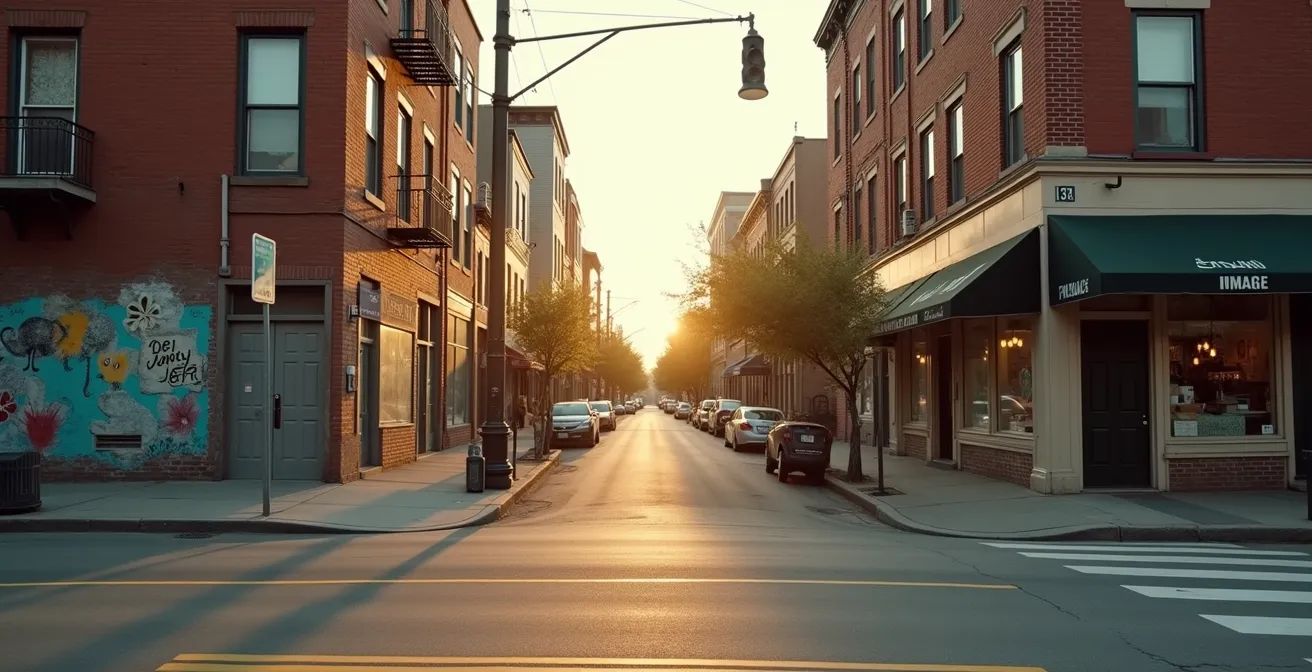
The influx of art into a neighborhood isn’t just a cultural shift; it’s a primary economic indicator that predicts and accelerates gentrification.
- Street art acts as a market signal for investors, correlating strongly with rent hikes and the eventual displacement of original residents.
- True revitalization depends on creating a “local economic multiplier,” a cycle often broken by corporate-owned “creative hubs” that extract value from the community.
Recommendation: To foster genuine community value, consciously shift support towards artist-run spaces and community-led initiatives that ensure capital circulates locally.
A vibrant mural appears on a long-neglected wall. A quirky coffee shop opens, followed by a small, independent gallery. For residents and urban planners alike, these are often hailed as the first signs of a neighborhood’s rebirth—a creative revitalization. The common belief is that art breathes life and economic activity into forgotten urban corners. But this perspective often overlooks the other side of the coin: rising rents, the shuttering of long-standing local businesses, and the cultural alienation of the original community.
The debate is frequently framed as a simple binary: is gentrification good or bad? This question, however, misses the crucial underlying point. The transformation of a neighborhood by art is rarely a cultural accident; it is a predictable economic process. The true challenge is not to stop change, but to understand the financial mechanics that drive it. The appearance of “art” often functions as a powerful leading indicator for real estate investors, signaling that a neighborhood is becoming “safe” for capital investment, which in turn triggers a cascade of economic shifts.
But what if the key wasn’t to fight the arrival of art, but to consciously steer its economic impact? This analysis moves beyond the surface-level debate to decode the economic engine of so-called art districts. We will dissect how street art can correlate with rent increases, what happens to original residents when a new demographic moves in, and how to differentiate a genuine creative hub from a corporatized mall in disguise. By understanding these mechanisms, it becomes possible to advocate for and build strategies that prioritize genuine community revitalization over extractive gentrification.
This article provides a detailed analysis of the economic forces at play when art and commerce intersect in our neighborhoods. Explore the key dynamics that determine whether a creative district will lead to inclusive growth or demographic displacement.
Summary: Gentrification vs. Revitalization: Decoding the Economic Engine of Art Districts
- Why Does Street Art Correlate with Rising Rent Prices?
- How to Identify “Made Locally” vs “Assembled Locally” Products?
- The Displacement Effect: What Happens to Original Residents When Hipsters Move In?
- Creative Hub or Mall: Which Generates More Long-Term Community Value?
- How Long Does It Take for a “Creative City” Strategy to Pay Off?
- Trespassing vs Public Access: How to Explore Without Getting Arrested?
- Why Does staying at All-Inclusive Resorts Benefit Foreign Corporations?
- How to Ensure Your Tourist Dollars Actually Reach the Local Community?
Why Does Street Art Correlate with Rising Rent Prices?
Street art is often perceived as a spontaneous, anti-establishment expression of local culture. However, in the urban economic landscape, it functions as a powerful, and often unintentional, leading indicator for real estate investment. The presence of high-quality murals and public art signals to developers and prospective, wealthier residents that a neighborhood is on an upward trajectory—that it possesses “character” and is shedding its “gritty” image. This perception of authenticity and creativity makes the area more desirable, initiating a cycle of increased demand.
This is not mere conjecture. Research demonstrates a strong 0.78 correlation coefficient between mural density and subsequent increases in commercial rent. The art acts as free marketing for the neighborhood, raising its profile and perceived value. As legendary graffiti artist Meres Ones noted in the Brooklyn News Service, the real estate industry has caught on: “In real estate now they’re realizing that you can hire artists to paint, and then those walls that were available to us are now taken away for ads.” The very artists who made a neighborhood cool are often priced out by the economic forces they inadvertently set in motion.
Case Study: The Transformation of 5 Pointz
Perhaps no example is more poignant than 5 Pointz in Long Island City, Queens. Once a world-renowned “graffiti mecca” where artists from across the globe legally painted, it was a vibrant symbol of street art culture. In 2013, the buildings were whitewashed overnight and later demolished to make way for high-rise luxury apartments. This transformation, detailed by the Brooklyn News Service, perfectly exemplifies the pipeline from authentic cultural hub to high-end real estate commodity, where the original art and its community were completely erased.
This dynamic illustrates that the correlation between street art and rent is not coincidental but causal. The art enhances the “place-brand” of a neighborhood, which in turn attracts capital that inflates property values and, ultimately, displaces the very culture it was drawn to. Understanding this mechanism is the first step in differentiating aesthetic improvement from the onset of gentrification.
How to Identify “Made Locally” vs “Assembled Locally” Products?
As a neighborhood gains a reputation for being a “creative” hub, a wave of businesses arrives to capitalize on this image. Many will use branding like “local,” “artisanal,” or “community-focused.” However, from an economic standpoint, a critical distinction must be made between products that are truly “made locally” and those that are merely “assembled locally.” This difference is fundamental to understanding whether consumer spending will strengthen the community or be extracted by outside entities.
“Made locally” implies that the entire value chain—from design and material sourcing to creation and sales—is rooted in the community. The owner is local, the employees are local, and the profits are reinvested locally. “Assembled locally,” in contrast, often refers to chain stores or externally owned businesses that simply sell products in the neighborhood. While they may provide some local jobs, the bulk of their revenue—the profits—are siphoned out of the community and sent to a corporate headquarters elsewhere. This is the core of economic leakage.
The impact of this distinction is staggering. Economic research demonstrates that for every $100 spent at an independent local business, roughly $50 is recirculated back into the local economy. In contrast, only about $15 from that same $100 spent at a chain store stays local. This phenomenon, known as the local economic multiplier effect, is the engine of genuine community wealth-building. A dollar spent at a local artist’s studio might be used to buy lunch from the local cafe, which then uses it to pay for accounting services from a local firm. The money circulates, strengthening the entire ecosystem. The money spent at a multinational coffee chain largely vanishes from the neighborhood’s economy after paying for minimal labor costs.
Identifying the difference requires conscious consumerism. Ask questions: Who owns this shop? Where is this art, clothing, or food actually produced? Is this a franchise or a one-of-a-kind business? Prioritizing businesses that are deeply embedded in the community’s economic fabric is a direct way to support revitalization over extractive gentrification.
The Displacement Effect: What Happens to Original Residents When Hipsters Move In?
While rising rents are the most visible symptom of gentrification, its most profound human consequence is displacement. This isn’t just about people being forced to move; it’s the unraveling of social fabrics, support networks, and cultural identity that have been built over generations. When a new, typically wealthier and often whiter, demographic moves into a historically low-income neighborhood of color, the change is not just economic but deeply social.
The mechanism is straightforward: as a neighborhood becomes more “desirable,” landlords see an opportunity to increase profits. They may raise rents beyond what long-term tenants can afford, convert rental units into high-end condos, or decline to renew leases to attract higher-paying newcomers. The scale of this issue is significant; federal data reveals that between 2000 and 2013, gentrification in major cities led to the displacement of an estimated 110,000 Black and 24,000 Hispanic residents. These are not just statistics; they are families, elderly residents, and community leaders forced out of their homes.
Beyond this direct physical displacement, there is a more subtle but equally damaging form: cultural displacement. This occurs when the character of a neighborhood changes so drastically that original residents no longer feel they belong. The corner stores they relied on are replaced by boutique wine shops; the community centers become yoga studios; the very sounds and smells of the street are altered. The new businesses and amenities cater exclusively to the tastes and price points of the new residents, leaving the original community feeling like strangers in their own home.

This image of weathered, historical material meeting new, stark construction visually represents the friction of this process. The neighborhood’s identity is overwritten, not enhanced. For an urban planner or a long-term resident, the key question becomes: who is this revitalization for? If the answer is not “for the people who already live here,” then the process is not revitalization; it is replacement.
Creative Hub or Mall: Which Generates More Long-Term Community Value?
When policymakers aim to foster a “creative district,” they face a fundamental choice in their model: should they encourage a decentralized, organic ecosystem of small-scale creators (a “creative hub”), or should they court a large, centralized developer to build a polished, cohesive district (a “creative mall”)? While the latter might offer quicker, more visible results, the former generates far more significant and sustainable long-term community value.
The core difference lies in their economic structure and social impact. A true creative hub is a network of independent, often artist-run, spaces, galleries, workshops, and businesses. It fosters social connection, preserves cultural skills, and, most importantly, keeps economic returns within the community. A creative mall, on the other hand, often consists of chain retailers, corporately-owned galleries, and restaurants under a single management entity, designed for transactional efficiency rather than community building.
This comparative analysis from the University of Chicago highlights the stark contrasts. A decentralized hub has a high local economic multiplier, while a mall’s is low. It builds strong social capital through workshops and events, whereas a mall fosters weak, transactional relationships. Most critically, a hub allows for community ownership models, while a mall is almost always corporately owned, extracting wealth from the area.
| Metric | Creative Hub | Traditional Mall |
|---|---|---|
| Local Economic Multiplier | High – diverse small businesses | Low – chain stores dominate |
| Social Capital Creation | Strong – community events, workshops | Weak – transactional relationships |
| Cultural Skill Preservation | Active – artisan knowledge transfer | Minimal – standardized retail |
| Economic Resilience | High – diverse revenue sources | Fragile – anchor tenant dependent |
| Community Ownership | Possible – cooperative models | Corporate – external ownership |
Case Study: Philadelphia’s Decentralized Arts Strategy
Philadelphia’s “Culture Builds Community” initiative provides a powerful example of the hub model. Instead of concentrating resources in one downtown district, the city supported 38 arts organizations in neighborhoods citywide. The result was not only economic activity but also profound social connection, with 80% of event attendees traveling outside their own neighborhoods to participate. This demonstrates that a network of smaller, community-embedded creative hubs can create more resilient and integrated value than a single, monolithic “art mall.”
For urban planners, the lesson is clear. The path to sustainable community value lies not in creating a polished facsimile of creativity, but in nurturing the messy, organic, and economically circular ecosystem of a true creative hub.
How Long Does It Take for a “Creative City” Strategy to Pay Off?
For city planners and investors, the “creative city” strategy is often seen as a long-term investment in urban renewal. The promise is that by fostering an arts scene, a city can attract talent, tourism, and investment, eventually leading to economic prosperity. But the critical question is: a payoff for whom, and on what timeline? The data suggests that while the economic benefits for property owners can be significant, they often materialize on a timeline that coincides with the displacement of the original community.
The process is a slow burn, not an overnight transformation. It involves stages: the initial arrival of artists seeking affordable space, the organic growth of a creative scene, the “discovery” of the neighborhood by outsiders, and finally, the influx of large-scale investment. A case study of Northeast Minneapolis’s Arts District is telling. Designated in 2003, the area saw a slow but steady increase in property values and artist studios. However, it wasn’t until around 2019 that significant displacement pressures became acute. This timeline shows it can take roughly 16 years for a district’s designation to fully mature into a gentrified market where original residents and even the initial artists are priced out.

This extended timeline creates a complex policy challenge. As a Philadelphia Federal Reserve study by Brummet and Reed notes, the “concern that gentrification displaces or otherwise harms original neighborhood residents has featured prominently in the rise of urban NIMBYism and the return of rent control as a major policy option.” The gradual nature of the change can make it difficult to implement protective policies like rent control or inclusionary zoning until it’s too late.
Concern that gentrification displaces or otherwise harms original neighborhood residents has featured prominently in the rise of urban NIMBYism and the return of rent control as a major policy option.
– Brummet and Reed, Philadelphia Federal Reserve Study
The “payoff” of a creative city strategy, therefore, is a double-edged sword. For property owners and the city’s tax base, the payoff can be substantial over a decade or two. For low-income renters and the original cultural community, this same timeline represents a slow-moving crisis of affordability and displacement. A successful strategy must therefore measure its “payoff” not just in property values, but in the stability and prosperity of its long-term residents.
Trespassing vs Public Access: How to Explore Without Getting Arrested?
As art districts evolve, the lines between public and private space can become blurred, creating confusion for residents and visitors alike. What appears to be a public mural might be on private property, and a welcoming courtyard could technically be off-limits. Navigating this new landscape requires an understanding of the difference between invited public access and trespassing, and recognizing the design cues that either encourage or deter exploration.
A key concept in urban design is “neighborhood permeability.” This refers to the ease with which people can move through a neighborhood. High permeability is created by open pathways, accessible public art, benches, and a lack of barriers. It invites discovery. Conversely, low permeability, or “defensive architecture,” uses gates, high fences, surveillance cameras, and hostile design (like spiked ledges) to control access and keep the public out. As a neighborhood gentrifies, there is often a shift from high to low permeability as new developments prioritize security and exclusivity over community openness.
For those wishing to explore an art district responsibly, sanctioned events are the best starting point. Many districts host Open Studio Weekends, where private artist workspaces are officially opened to the public. These events bridge the gap between creative production and community curiosity, respecting property boundaries while fostering connection. They provide a legitimate way to see “behind the scenes” without trespassing. It’s also vital to distinguish between public art installations, which are accessible 24/7 in parks or on streets, and private galleries, which have set hours and may charge admission.
Audit Checklist: Exploring a Neighborhood’s Art Scene Responsibly
- Points of contact: Before you go, map out the different types of art spaces. List the public murals and outdoor sculptures, then note the addresses and hours of private galleries and artist-run studios.
- Collecte: As you explore, inventory the types of art you encounter. Is it community-led (e.g., a collaborative mural), commercially commissioned (e.g., a corporate logo stylized as art), or unsanctioned graffiti?
- Cohérence: Confront the art with the neighborhood’s identity. Does it reflect the area’s history and cultural roots, or does it feel like an externally imposed aesthetic designed for a new audience?
- Mémorabilité/émotion: Pay attention to your reaction. Identify the pieces that spark dialogue, tell a story, or connect with the community’s spirit versus those that feel like generic, decorative “plop art.”
- Plan d’intégration: Use your observations to create a conscious path. Plan a return visit that prioritizes supporting the artist-run spaces, community projects, and local businesses that you identified as authentic.
Ultimately, respectful exploration comes down to observation and intent. By understanding the physical and social cues of the space, one can appreciate the creativity of a district without infringing on private property or contributing to the sense of being an outsider in one’s own community.
Why Does staying at All-Inclusive Resorts Benefit Foreign Corporations?
The economic model of an all-inclusive tourist resort offers a powerful and direct analogy for understanding how some “creative districts” function. In a resort, a tourist’s spending is captured within a closed system. The hotel, restaurants, shops, and tour operators are often owned by a single foreign corporation. While the resort provides local jobs, the vast majority of the profits are extracted from the local economy and funneled back to corporate headquarters abroad. This is a classic example of a closed economic loop with massive economic leakage.
This same model of vertical integration is now being applied to urban neighborhoods. A single large development corporation can buy up residential buildings, develop retail spaces on the ground floor, and even operate the marquee art gallery in the same complex. A new resident can live, shop, eat, and consume culture, all while their money circulates within the portfolio of one parent company. The neighborhood functions less like an organic community and more like a branded, open-air resort.
Baltimore’s Station North Arts & Entertainment District provides a case study of this dynamic. Research on the area has shown how a few major developers came to own a significant portion of the residential, commercial, and cultural real estate. As detailed in a study on the district’s development, this concentration of ownership creates a closed loop where profits are maximized for the developer rather than circulated to benefit a diverse range of local entrepreneurs. The “local” coffee shop and gallery are, in fact, part of the same corporate balance sheet as the apartments above them.
The alternative, a thriving ecosystem of genuinely local businesses, creates the opposite effect. According to Civic Economics research, independent local restaurants recirculate a much larger share of their revenue back into the local community. This vital economic activity supports other local businesses, creates a resilient and diverse economy, and builds community wealth—the true foundation of sustainable revitalization.
Key Takeaways
- Street art is a powerful economic signal, not just decoration, often preceding and accelerating gentrification by signaling a neighborhood is “safe” for investment.
- The key difference between revitalization and gentrification lies in the ‘economic multiplier’: does money spent in the neighborhood stay to enrich the local community, or does it ‘leak’ out to external corporations?
- Conscious support for artist-run spaces, community-led projects, and genuinely local businesses is the most effective way to steer development towards inclusive growth.
How to Ensure Your Tourist Dollars Actually Reach the Local Community?
For the conscientious resident, urban planner, or visitor, the ultimate goal is to support the vibrant culture of a neighborhood without contributing to the economic forces of displacement. The key lies in being intentional about where your money flows. Ensuring your dollars support the local creative ecosystem requires a deliberate shift away from passive consumption towards active, informed patronage. It’s about moving from being a mere spectator to becoming a supportive participant in the local economy.
The first principle is to shorten the distance between yourself and the creator. Instead of buying a “local-themed” print from a large retailer, seek out an artist’s open studio event and buy directly from them. This ensures the majority of the revenue goes to the person who did the work, not to a series of intermediaries. This applies not just to art, but to all forms of spending. Choosing an independent coffee shop over a global chain, or a family-owned restaurant over a franchise, directly contributes to the local economic multiplier.
To put this into practice, you can adopt a framework for conscious engagement with creative neighborhoods. The goal is to consistently prioritize authenticity and direct support over convenience and corporate polish. This means doing a little more research, but the payoff is the knowledge that you are helping to sustain the very culture you came to appreciate. Here is a practical framework for action:
- Prioritize artist-run spaces and cooperatives over commercial galleries when visiting art districts.
- Take workshops or classes directly from local creators rather than through third-party tour companies.
- Seek out community-led art tours that employ and fairly compensate local residents as guides.
- Purchase art, crafts, and other goods directly from artists at their studios or at local markets.
- Support fundraising events where local artists and community organizations retain the majority of the revenue, as opposed to large-scale international art fairs.
By adopting these practices, your economic activity becomes a force for genuine revitalization. You help build a resilient community where creativity can thrive without being co-opted, and where the financial benefits of that creativity are shared by those who call the neighborhood home.
To put these principles into action, the next step is to actively analyze the businesses and art spaces in your own neighborhood. Start by identifying which are truly local and begin shifting your patronage to support them directly.
Frequently Asked Questions about Gentrification vs Revitalization: How Art Districts Change Neighborhood Economics?
What are Open Studio Weekends?
Open Studio Weekends are sanctioned events where private creative spaces, such as artist studios and workshops, open their doors to the public. They provide a legitimate and respectful way to bridge the gap between artist workspaces and community curiosity, allowing people to see art being made and connect with creators while respecting property boundaries.
How can urban design encourage safe exploration?
Urban design can foster safe exploration through the principle of ‘Neighborhood Permeability.’ This involves making intentional design choices like installing public art, adding benches, creating clear and open pathways, and avoiding ‘defensive architecture’ like gates, fences, and surveillance. These elements create a welcoming environment that invites discovery and community interaction.
What’s the difference between public and private art spaces?
Public art spaces include outdoor installations, street murals, and sculptures in parks that are typically accessible to everyone at any time without a fee. Private art spaces, such as commercial galleries or artist studios, have specific operating hours, are located on private property, and may require permission, an appointment, or an admission fee to enter.