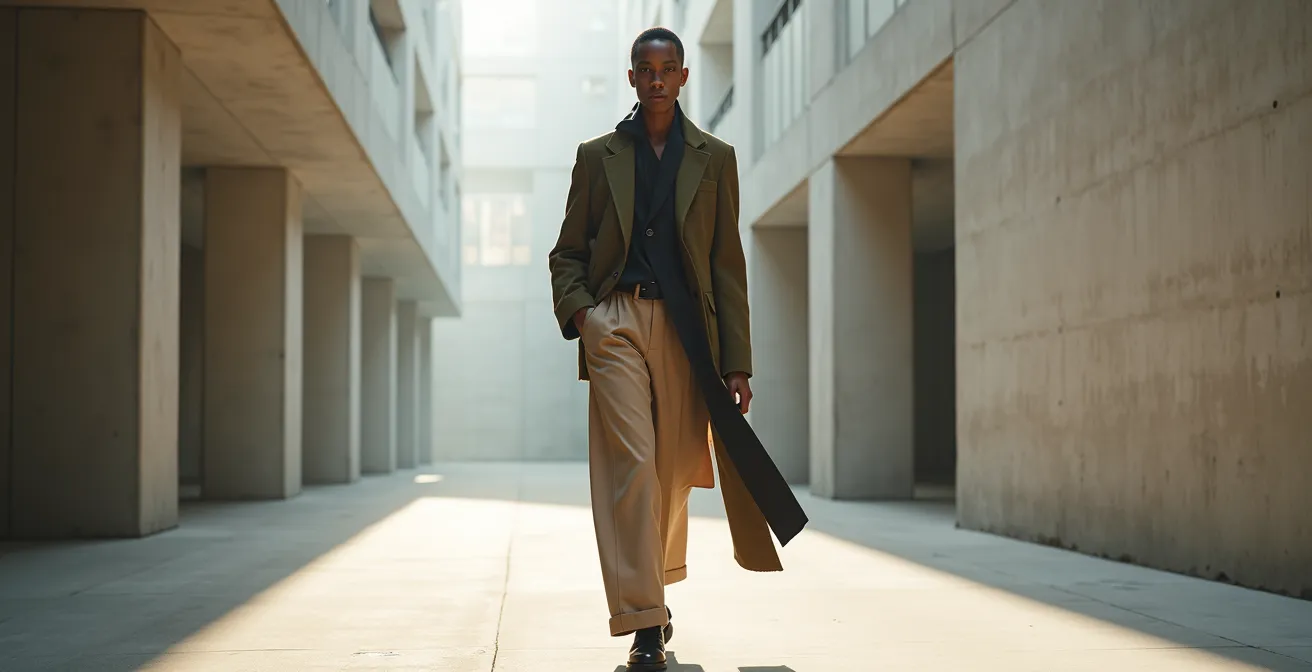
Wearing deconstructed fashion isn’t about looking messy; it’s about speaking a sophisticated visual language of intentional imperfection.
- It transforms clothing from a simple covering into a piece of wearable art that challenges convention.
- Mastery comes from understanding the philosophy behind the style, not from following simple rules.
Recommendation: Start by treating your wardrobe as a gallery, and a single deconstructed piece as your featured artwork, allowing it to tell its story in a curated context.
The allure of deconstructed fashion is undeniable. It’s the raw edge on a jacket, the reversed seam on a dress, the asymmetric cut that defies expectation. It whispers of rebellion, intellect, and an appreciation for the process. Yet, for the fashion-forward individual, the question looms: how does one translate this potent runway concept into a daily wardrobe without appearing to be wearing a costume? The common advice—to “start small” or “balance it out”—barely scratches the surface of this profound aesthetic movement.
These tips are not wrong, but they are incomplete. They treat deconstructed fashion as a mere trend to be diluted for public consumption. They miss the soul of the movement, which finds its roots in Japanese aesthetics of imperfection and philosophical challenges to the very definition of beauty. To truly incorporate this style is to move beyond simple styling hacks and into the realm of personal curation and intellectual expression. This is not about adding a quirky item to your outfit; it’s about learning a new visual grammar.
But if the true key isn’t in following rules, but in understanding a philosophy? The real art lies in embracing the concept of intentional imperfection, seeing garments not as finished products, but as ongoing narratives. This guide will explore that philosophy. We will delve into the power of asymmetry, the dialogue of textures, and the visual language that separates a thoughtless tear from a deliberate, narrative-driven design. It’s time to stop just wearing clothes and start communicating with them.
To navigate this artistic approach, this article breaks down the core tenets of deconstruction, from its philosophical origins to its practical application in any setting. Explore the sections below to master this visual language.
Summary: Deconstructed Fashion: A Guide to Wearing Intellectual Rebellion
- Why Do We Still Visit Museums When We Can See High-Res Images Online?
- Why Does Asymmetry Create Visual Interest in an Outfit?
- Leather and Silk: How to Mix Contrasting Textures Like a Pro?
- Hollywood vs Anime: How Visual Grammar Alters Emotional Impact?
- The Context Error: How to Wear Avant-Garde to the Office?
- Runway vs Real Way: How to Interpret Couture for the Street?
- When to Wear a Statement Piece: Balancing Impact and Occasion
- Capsule Wardrobe vs Eclectic Style: Which Strategy Saves More Money?
Why Do We Still Visit Museums When We Can See High-Res Images Online?
This question, seemingly about art, holds the very key to understanding deconstructed fashion. A high-resolution image online is a perfect, flat, sterile representation of an idea. A museum visit, however, is a physical, sensory experience. You see the texture of the paint, the crackle of age, the sheer scale of the work—the human, imperfect process. Deconstructed fashion champions this same principle. It argues that a garment’s soul is not in its flawless finish, but in the visible story of its creation. It is the fashion equivalent of visiting the museum.
Initially, this style was a radical act of defiance. Curators from the ASU FIDM Museum note that it was intended to challenge “perceptions that garments must be flawlessly finished and enhance accepted definitions of beauty.” Designers like Martin Margiela became historical cornerstones of this movement in the late 1980s. By taking apart existing garments and reassembling them in radical new ways—turning men’s tailoring into floor-length dresses, for example—he revealed the inner architecture of clothing. He showed the seams, the linings, the raw materials. This wasn’t about being unfinished; it was about being honest.
Choosing to wear a deconstructed piece is choosing this honesty. You are selecting a garment that admits it was made, that has a history and a structure. It is a rejection of the illusion of effortless perfection and an embrace of the beauty in the process, the construction, and the inevitable decay. It’s an intellectual and a sensory choice, valuing the authentic “museum” experience over the flawless “online image.”
This philosophy turns your wardrobe into a collection of stories, where each piece offers a unique, tangible narrative.
Why Does Asymmetry Create Visual Interest in an Outfit?
The human eye is trained to seek patterns and symmetry. When it encounters asymmetry, it’s momentarily disrupted. This break in expectation forces the viewer to pause, to look closer, and to engage with the object on a deeper level. In fashion, an asymmetric hemline or an off-center neckline isn’t a mistake; it’s a deliberate invitation to look again. It creates a dynamic tension and a sense of movement, transforming a static garment into something that feels alive and unpredictable.
This appreciation for the imperfect has deep cultural roots. As Dr. Anne Walther, an expert on Japanese aesthetics, explains, asymmetry is a core tenet of wabi-sabi, the worldview centered on the acceptance of transience and imperfection. She notes, “Asymmetry taps into concepts like wabi-sabi, celebrating the imperfect and transient, which resonates with an audience looking for authenticity over sterile perfection.” This philosophy is gaining traction, as research into these principles shows that fashion emphasizing the beauty of aged or unique garments is finding significant appeal. It’s a move away from factory-made uniformity towards individual character.
Pioneering designers like Rei Kawakubo of Comme des Garçons built an empire on this very principle. Her work uses asymmetry and deconstruction not just for visual effect, but as a political tool. As noted in an analysis of her work, Kawakubo’s deconstruction is a feminist act that invites us “to be more conscious of the ways in which notions of femininity are constructed.” An asymmetric design can reject or distort the traditional hourglass silhouette, offering a new, more powerful form. It is a structural narrative of defiance.
By choosing asymmetry, you are not just choosing an interesting shape; you are aligning yourself with a philosophy of authenticity and thoughtful rebellion.
Leather and Silk: How to Mix Contrasting Textures Like a Pro?
Mixing textures is a foundational element of advanced styling, but in deconstructed fashion, it transcends aesthetics to become a form of dialogue. Pairing a rough, protective material like leather with something fluid and vulnerable like silk isn’t just a tactile contrast; it’s a conceptual one. It speaks to the dualities of strength and softness, structure and chaos, armor and intimacy. The “pro” move is to think of yourself as a curator, selecting textures that tell a story together.
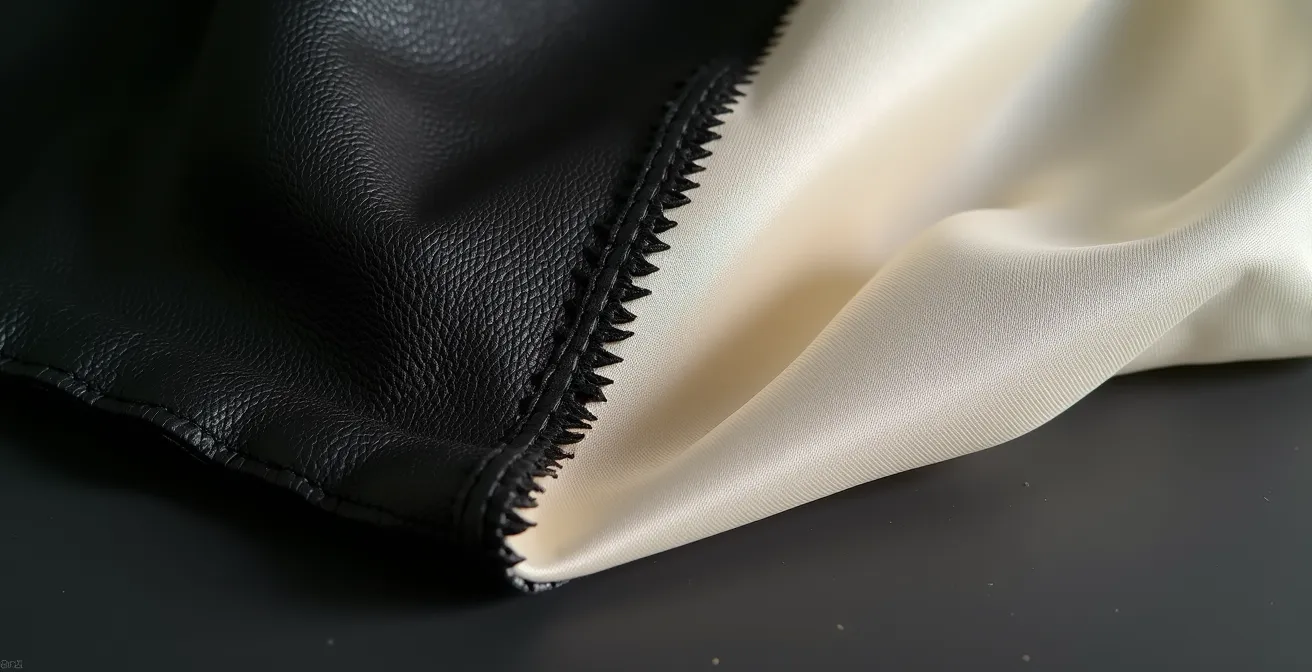
As the image above illustrates, the magic happens at the intersection. Notice how the raw, unfinished edge where the materials meet becomes the focal point. This is the visual grammar of deconstruction at work. It’s not about a smooth, invisible transition but a celebrated, visible seam. To do this like a pro, focus on one of two approaches:
- Harmonious Contrast: Pair textures within a single color family (e.g., a black leather jacket over a black silk camisole, with a black raw-hem denim). The monochrome palette unifies the disparate textures, making the statement subtle and sophisticated.
- Disruptive Contrast: Use texture to amplify a color difference (e.g., a heavy, cream-colored wool knit with a sharp, vinyl black trouser). Here, the textural difference heightens the visual clash, creating a bolder, more avant-garde statement.
The goal is to embrace what fashion philosopher Catherine Valentin calls the interplay of “simplicity and complexity, deconstruction and construction.” The key is intentionality. Ask yourself what you want the textures to say. Is the leather protecting the silk? Is the silk softening the leather? This narrative approach elevates a simple outfit into a piece of wearable art.
Ultimately, the most successful combinations are those that feel both surprising and inevitable, creating a rich sensory experience for both the wearer and the viewer.
Hollywood vs Anime: How Visual Grammar Alters Emotional Impact?
To understand the emotional power of deconstructed fashion, it’s useful to draw an analogy from visual media: the “visual grammar” of Hollywood versus that of Anime. Hollywood filmmaking often relies on a direct, universally understood language of glamour, power, and confidence. It’s a classic three-piece suit or a perfectly tailored gown. The message is clear, immediate, and authoritative. Deconstructed fashion, much like the complex visual symbolism in many anime, uses a different grammar. It communicates more nuanced, and sometimes contradictory, emotions: vulnerable rebellion, fragile strength, intellectual melancholy.
This is because deconstruction is inherently an intellectual pursuit. A fashion theory study highlights this, stating, “Under the influence of deconstruction, a new strategy was formed in fashion – an understanding of fashion as an intellectual phenomenon.” A reversed seam or an exposed lining requires a certain “fashion literacy” to be fully appreciated. It’s a coded message, understood by those who speak the same subcultural language. It doesn’t scream for attention; it invites closer inspection and interpretation.
This table breaks down the differing visual grammars, using the “Hollywood vs. Anime” framework to contrast classic and deconstructed approaches:
| Aspect | Classic Fashion (Hollywood) | Deconstruction (Anime) |
|---|---|---|
| Communication Style | Direct, widely understood | Symbolic, requires fashion literacy |
| Emotional Range | Simple authority, confidence | Complex emotions: vulnerable rebellion |
| Visual Impact | Immediate recognition | Gradual appreciation |
| Cultural Context | Universal business codes | Subcultural identity markers |
Choosing deconstruction is choosing the “Anime” column. It’s a deliberate move away from the obvious and toward the symbolic. It prioritizes personal expression and subcultural connection over universal approval. The emotional impact is quieter but often far more profound and lasting for those who can read the signs.
It’s a powerful shift from wanting to be simply seen to wanting to be truly understood.
The Context Error: How to Wear Avant-Garde to the Office?
The biggest mistake in wearing avant-garde fashion to a conservative environment like an office is thinking you have to abandon it entirely. This is the context error. The key is not abandonment, but translation. The corporate world operates on a specific visual grammar of stability and professionalism. Your task is to inject the deconstructed dialect into this language without making it unintelligible. As designer Mari Goround wisely put it, “Limitations tend to spark creativity.” The office dress code is not a barrier; it’s a creative brief.
The solution is modularity. Treat your deconstructed pieces not as a single look, but as a collection of adaptable elements. An intricately deconstructed blazer might be too much for a board meeting, but its detachable, structural collar, worn on a simple cashmere sweater, becomes an intriguing—and acceptable—intellectual detail. A jacket with reversed seams is a quiet nod to the aesthetic, while a full harness overlay is reserved for after hours. You are deconstructing the deconstructed look itself.
This table, based on principles of modular styling, offers a practical guide for navigating the office/after-hours divide, showing how to scale the intensity of the look. An analysis of adaptable avant-garde fashion provides a clear framework:
| Element | Office Hours | After Hours |
|---|---|---|
| Base Layer | Classic white shirt, tailored trousers | Asymmetric tank, raw-hem denim |
| Deconstructed Accent | Detachable structural collar or subtle reversed seam blazer | Full harness overlay or exposed-seam jacket |
| Texture Mix | One contrasting element maximum | Multiple layered textures |
| Asymmetry Level | Minimal – slight hem variation | Dramatic – full uneven silhouette |
The strategy is to anchor the avant-garde piece with conventionality. A blazer with an unusual cut is grounded by classic tailored trousers. An asymmetric silk blouse is balanced by a structured pencil skirt. You are using the familiar language of office wear as the foundation, allowing your single deconstructed “word” to be heard clearly without shouting.
This shows a level of sartorial intelligence that is far more impressive than simply conforming or rebelling outright.
Runway vs Real Way: How to Interpret Couture for the Street?
The gap between a runway spectacle and a wearable outfit can seem vast, but the process of translation is the very essence of deconstruction. The trick is to deconstruct the *idea*, not just the garment. Don’t ask, “How can I wear that giant duvet coat?” Instead, ask, “What is the core concept here?” For Martin Margiela’s iconic duvet coat, the concept was about challenging the boundary between bedding and clothing, public and private, comfort and couture. You don’t need the literal coat to channel that idea. You can evoke it with an oversized, pillowy scarf, a voluminous quilted jacket, or by playing with exaggerated, soft proportions in your own way.
This approach is central to the evolution of luxury fashion. As a fashion trend analysis by WWD reports, the focus is shifting towards “the work of the hand, the artisanal touch and individuality.” The trend sees silhouettes being “repurposed, spliced, turned into something new.” Your job is to become that artisan for your own wardrobe. Take the runway concept as your raw material and splice it into your personal style. Think of it as distillation: boiling down a complex runway look to its most potent, wearable essence.
An effective way to do this is to focus on a single element. If a runway look features exposed seams, dramatic asymmetry, and distressed textiles, choose just one of those elements for your daily outfit. Wear a simple dress that has one asymmetric drape. Pair a classic blazer with jeans that have a raw, frayed hem. You are referencing the runway conversation, not shouting it verbatim. This allows you to participate in the high-fashion narrative in a way that is authentic and personal.
Action Plan: Auditing Your Runway Interpretation
- Concept Core: Identify the single core idea of the runway piece (e.g., “exposed structure,” “protective volume,” “fluid movement”).
- Element Inventory: List all the deconstructed elements in your existing wardrobe (e.g., asymmetric top, raw-hem jeans, jacket with visible stitching).
- Coherent Pairing: Match one wardrobe element to the runway concept. Does your asymmetric top evoke the same feeling of imbalance?
- Context Check: Is this pairing appropriate for your day? Can a single element be isolated for a more formal setting?
- Integration Plan: Create an outfit that lets this single, distilled concept be the focus, supported by simpler, classic pieces.
By doing so, you transform yourself from a passive consumer of trends into an active interpreter of design.
When to Wear a Statement Piece: Balancing Impact and Occasion
In the world of deconstruction, the definition of a “statement piece” is itself deconstructed. It is not necessarily the loudest, biggest, or brightest item in the room. As one fashion design expert from the ASU FIDM Museum puts it, “In deconstruction, the statement can be a quiet, intellectual detail—a reversed seam, a misplaced button—that speaks volumes to those who understand the language.” The impact of your statement is therefore not about volume, but about context and audience. A subtly ‘wrong’ detail on a classic garment can be a more powerful statement at a conservative event than a wildly avant-garde piece that is simply dismissed as ‘costume’.
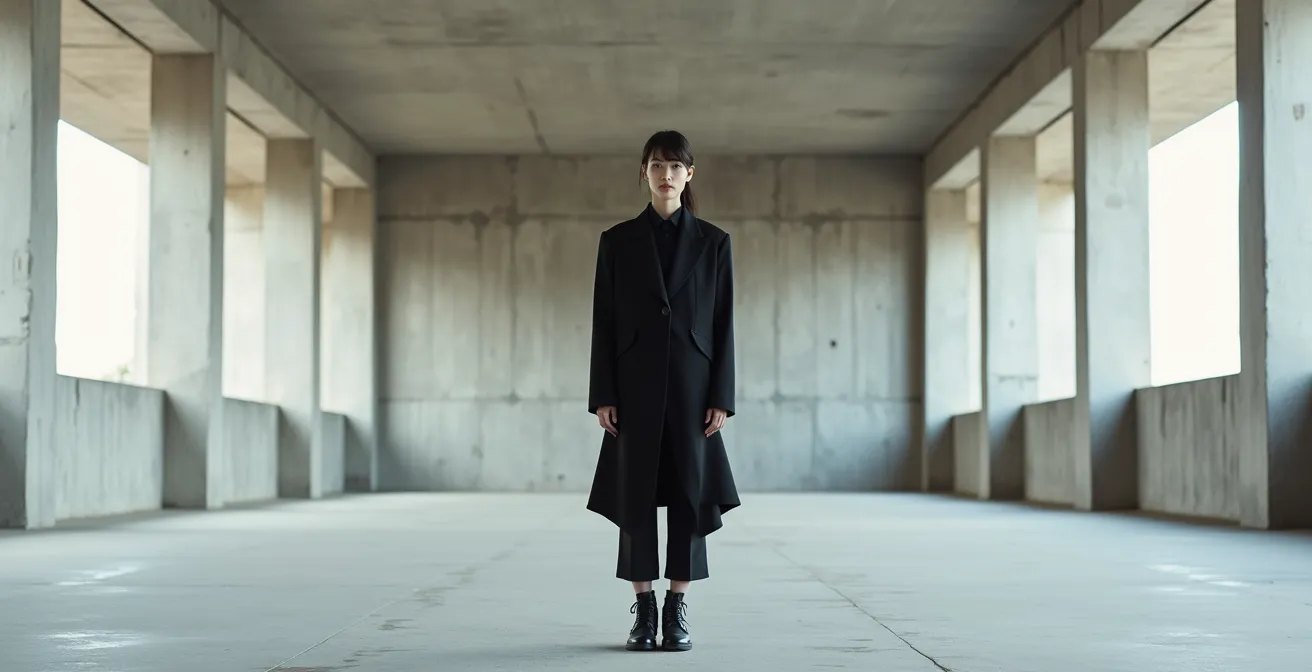
The key to balancing impact and occasion is to treat your statement piece as the anchor of your entire look, as seen in the minimalist space above. The environment is clean, the rest of the outfit is simple, allowing the one deconstructed element to have maximum impact without overwhelming the senses. The goal is curation. You are creating an exhibition, and your statement piece is the main installation. The rest of your outfit and your environment are the gallery walls—they are there to support and highlight the art, not compete with it.
Knowing *when* to deploy these pieces is as important as knowing *how*. The ideal occasion is one where the “visual literacy” of the audience is likely to be high. The goal is to find a space where your sartorial choices will be read as intentional and artistic. Prime opportunities include:
- Gallery openings and art events, where experimental fashion is appreciated as wearable art.
- Creative industry meetings, demonstrating innovative thinking through clothing choices.
- Fashion week events and industry gatherings, for connecting with like-minded individuals.
- Weekend outings in artistic or bohemian neighborhoods, where casual settings welcome fashion expression.
- Evening cultural events like theatre or concerts, where bold choices can enhance the creative atmosphere.
By choosing your moments strategically, you ensure your statement is not just seen, but understood and appreciated.
Key Takeaways
- Deconstructed fashion is a philosophical choice, not just a trend; it’s about embracing intentional imperfection.
- Mastering the style means learning its “visual grammar,” using asymmetry, texture, and visible construction to tell a story.
- The key to daily wear is translation and curation: distill runway concepts to their essence and let one piece make a quiet, intellectual statement.
Capsule Wardrobe vs Eclectic Style: Which Strategy Saves More Money?
The debate between a minimalist capsule wardrobe and a sprawling eclectic style often centers on economics. A capsule wardrobe promises savings through versatility and limited purchasing. However, this model often relies on replacing items to stay current with trends. Deconstructed fashion, the pinnacle of an eclectic, artistic style, proposes a different economic model: investment over consumption. It argues that a piece of wearable art, a garment chosen for its unique design and intellectual weight, does not become obsolete.
Think of a Comme des Garçons jacket from the 90s. It is as relevant and powerful today as it was then, perhaps even more so, because its value is in its design integrity, not its trendiness. These are not disposable clothes; they are collection pieces. They are assets. While the initial outlay for a designer deconstructed piece can be high, its longevity and timeless rebellion against trends can result in a lower cost-per-wear over a decade than a dozen fast-fashion items purchased and discarded over two seasons.
This is especially true as the broader market continues to expand. The global fashion market is not just growing; it’s valuing unique and quality pieces more than ever. According to market analysis from Statista, revenue is projected to see an annual growth rate (CAGR 2025-2030) of 4.73%. In this expanding market, a well-chosen, iconic deconstructed piece can even appreciate in value, turning your wardrobe from a line-item expense into a potential asset portfolio. The eclectic strategy, when executed with an investor’s eye for timeless design, can be the more financially astute choice in the long run.
Start building a collection, not just a wardrobe. Invest in pieces that challenge, inspire, and endure, and you will find your personal style and financial strategy beautifully intertwined.