
Saving money on clothes isn’t about having a minimalist capsule or an eclectic wardrobe; it’s about mastering the financial metric of ‘Cost Per Wear’ (CPW).
- Fast fashion’s low initial price hides a disastrously high CPW due to being worn only a handful of times before disposal.
- A strategic wardrobe, whether capsule or curated eclectic, focuses on versatile, high-quality pieces to maximize Return on Investment (ROI) and build a strong personal brand.
Recommendation: Audit your closet not by item count, but by calculating the CPW of your most-worn and least-worn items to reveal your true spending habits.
The debate between a capsule wardrobe and an eclectic style often centers on aesthetics and minimalism. One promises a life of streamlined simplicity, the other a vibrant expression of personality. But when it comes to your finances, the discussion is framed incorrectly. We’re often told that buying fewer, neutral items is the only path to savings. This advice, however, overlooks the most critical financial metric in fashion: Cost Per Wear (CPW). The true cost of an item isn’t its price tag; it’s the price tag divided by the number of times you wear it.
The real question isn’t whether a small, cohesive wardrobe is cheaper than a large, varied one. The question is: which strategy delivers the highest Return on Investment (ROI) for your personal brand? Chasing micro-trends and accumulating cheap, disposable garments leads to high financial dilution, where each new, low-quality purchase diminishes the value and utility of your entire closet. An eclectic style can be just as financially sound as a capsule wardrobe if it’s built on a foundation of strategic, high-utility pieces rather than impulse buys.
This article reframes the entire debate. Instead of picking a side, we will build a financial framework for your personal style. We’ll analyze how to calculate and minimize your CPW, transform your wardrobe into a high-ROI asset, and make strategic purchasing decisions that strengthen both your look and your bank account, regardless of whether you prefer a uniform of neutrals or a kaleidoscope of colors.
To navigate this financial approach to personal style, this article provides a structured analysis. Explore the sections below to understand the core principles of building a cost-effective wardrobe that truly reflects you.
Summary: A Financial Breakdown of Personal Style Strategies
- Why Do You Gravitate Toward Neutrals or Brights Automatically?
- How to Translate a Pinterest Board into a Real-Life Wardrobe?
- The Micro-Trend Trap: Why Fast Fashion Dilutes Your Personal Brand?
- How to Create a “Daily Uniform” Without Looking Boring?
- When to Swap Your Wardrobe: The Temperature Guide for Layering
- The Branding Mistake That Alienates Loyal Customers During a Hype Cycle
- How to Prep 5 Lunches in Under 90 Minutes on a Sunday?
- Why Does a Trench Coat Never Go Out of Style After 100 Years?
Why Do You Gravitate Toward Neutrals or Brights Automatically?
Your natural inclination towards a specific color palette—be it calming neutrals or vibrant brights—is the foundational data point for building a cost-effective wardrobe. This preference isn’t just aesthetic; it’s a subconscious selection of your personal brand’s core identity. Honoring this instinct is the first step in avoiding expensive purchasing mistakes. Trying to force a minimalist, all-beige wardrobe when your personality craves color will lead to unworn items and wasted money. Conversely, buying a statement piece in a bold hue you’re not comfortable with ensures it will languish in your closet, driving its Cost Per Wear to astronomical heights.
The market is clearly responding to a collective desire for durability and versatility. The global capsule wardrobe market is projected to reach $8.58 billion by 2032, signaling a massive consumer shift toward strategic dressing. This isn’t just about minimalism; it’s about building a reliable base. According to Stitch Fix’s 2024 Style Forecast, a staggering 88% of clients cited “wardrobe builders” like knits and basic tops as the trend they’re most likely to embrace. This data proves that consumers are prioritizing pieces that lower the average CPW of their entire closet.
Whether your base is black, navy, and cream, or a more personal palette of deep green, burgundy, and mustard, the principle is the same. These core colors will host your most-worn items—the workhorses of your wardrobe. Identifying them allows you to invest more confidently in higher-quality versions, knowing their high utility will guarantee a low CPW and a strong wardrobe ROI. Every other piece should be evaluated on its ability to integrate with this core palette.
How to Translate a Pinterest Board into a Real-Life Wardrobe?
A Pinterest board is a data-gathering tool, not a shopping list. It’s a visual representation of your aspirations, but without a strategic filter, it can lead to a closet full of beautiful but incompatible “orphan” items. The key to translating this digital inspiration into a financially sound, real-life wardrobe is to move from aesthetics to analytics. Instead of just pinning what you like, start identifying the patterns: the silhouettes you pin repeatedly, the specific items that appear in multiple outfits, and the color combinations that define your ideal look. These are the building blocks of your personal uniform.
This process of analysis turns a chaotic mood board into a structured blueprint. You are not just looking for clothes; you are identifying the versatile assets that will form the backbone of your wardrobe system. An item that appears in ten of your favorite pins has a much higher potential for low Cost Per Wear than a one-off statement piece you admire in isolation. The goal is to distill your digital vision into a concise, actionable plan that prioritizes function and integration over fleeting visual appeal.
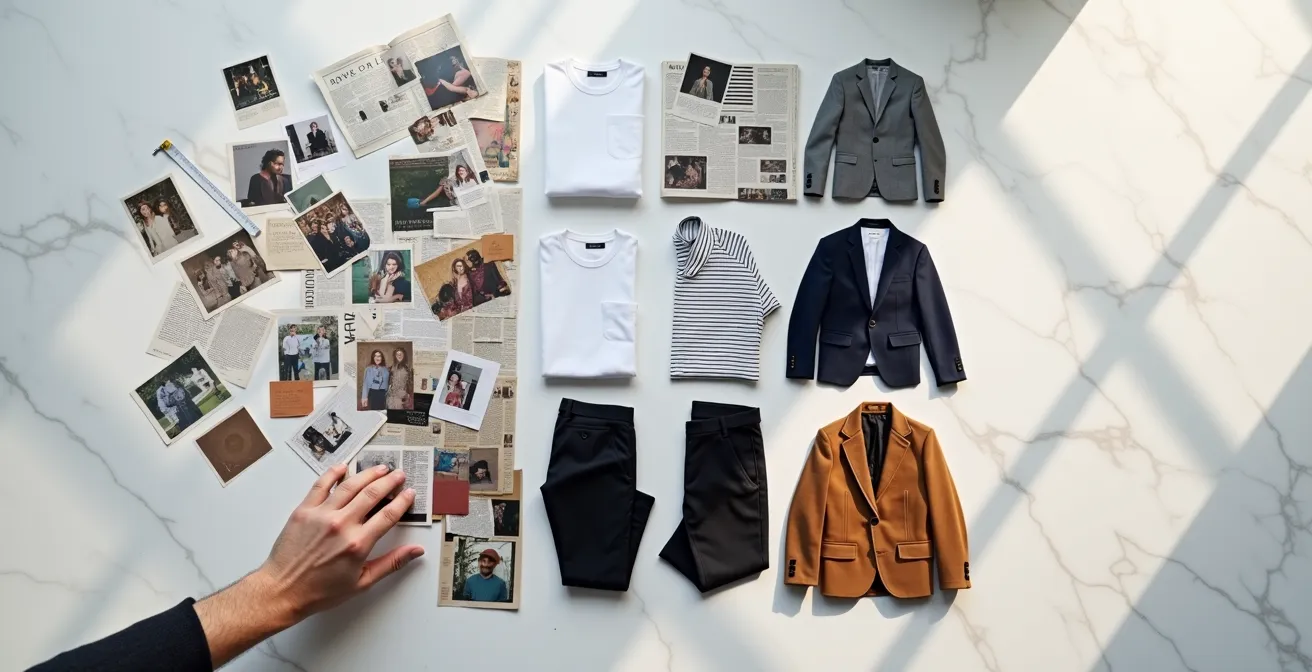
As the image above illustrates, the transition from inspiration to reality requires a methodical approach. It’s about taking the creative chaos of ideas and imposing a logical structure to create a functional, high-ROI system. The following checklist provides a concrete framework for this transformation, ensuring every purchase serves a strategic purpose.
Action Plan: Build a Wardrobe from Your Existing Closet
- Audit Existing Assets: Pull out everything from your current wardrobe that is classic in style and aligns with your ideal colors and body shape. These are your foundational pieces.
- Define Style Foundation: Analyze your audit. Do you lean minimalist, eclectic, or a hybrid? This determines your ratio of core basics to statement pieces.
- Create a Color Algorithm: Choose 2-3 base neutrals (e.g., black, navy, cream) and 2-3 accent colors (e.g., olive, rust) that work together seamlessly. This is your brand palette.
- Stress-Test Combinations: Before buying anything, actively mix and match your existing pieces. Your goal is to see how many new outfits you can create, identifying the true utility of each item.
- Draft a Strategic Acquisition List: Only create a shopping list for items that fill genuine functional gaps and work with at least three existing pieces in your wardrobe.
The Micro-Trend Trap: Why Fast Fashion Dilutes Your Personal Brand?
The greatest threat to both your personal brand and your financial well-being is the micro-trend trap, fueled by the fast fashion industry. These trends offer an illusion of affordability with their low initial price tags, but they inflict severe “financial dilution” on your wardrobe. Each trendy, low-quality item you purchase is a poor asset with an extremely high Cost Per Wear. Research confirms that on average, a garment is worn only 7 times before being discarded. A $20 top worn 7 times has a CPW of nearly $3. In contrast, a $140 high-quality shirt worn weekly for two years has a CPW of just $1.35, making it the far superior investment.
Chasing trends forces you into a constant cycle of purchasing, leading to a closet full of disconnected items that don’t build a cohesive personal brand. Your style becomes a reflection of an algorithm, not your identity. This is a critical branding mistake. A strong personal brand is built on consistency and authenticity, two things that are fundamentally at odds with the disposable nature of fast fashion.
A capsule wardrobe isn’t about minimizing your closet; it’s about maximizing the cost per wear.
– Alicia Lloyd, Stitch Fix stylist
This insight from an industry expert perfectly encapsulates the strategic mindset required. The goal isn’t deprivation; it’s optimization. The following table starkly illustrates the long-term financial reality of these two opposing strategies.
| Metric | Fast Fashion | Capsule Wardrobe |
|---|---|---|
| Average items purchased annually | 70 items | 5-10 quality pieces |
| Average cost per wear | $5-10 | $0.50-2 |
| Garment lifespan | Worn 7 times | Worn 30+ times |
| Annual clothing budget impact | $1,500-2,500 | $500-1,000 |
The data from this comparative analysis of fashion consumption is unequivocal. The fast fashion model is a financial drain disguised as a bargain. A strategic, quality-focused approach, whether capsule or eclectic, offers substantial long-term savings by focusing on maximizing the utility and lifespan of every single garment.
How to Create a “Daily Uniform” Without Looking Boring?
The concept of a “daily uniform” is often met with the fear of monotony. However, from a strategic and financial perspective, a uniform is not about wearing the exact same clothes every day. It is about creating a reliable, repeatable outfit formula that eliminates decision fatigue, streamlines your mornings, and prevents costly impulse buys. Think of it as a personal brand template: a consistent base that can be customized with variable accents. The key to keeping it interesting lies in the strategic use of textures, accessories, and subtle variations.
A successful uniform is built on the “Uniform Matrix” principle: a combination of 1-2 core formulas that you know work for your body and lifestyle. For example, a formula could be: high-quality dark denim + a silk blouse + a blazer. Or, it could be: tailored trousers + a fine-gauge knit + leather sneakers. Once you have your core formulas, you can create variety by swapping out components. You might have one pair of jeans but five different blouses, or one style of trousers in three different colors. This approach maintains brand consistency while offering flexibility.
Accessories become your primary tool for differentiation. A simple black dress can be professional with a structured tote and pointed flats, edgy with a leather jacket and boots, or casual with a denim jacket and white sneakers. Each accessory is a low-cost, high-impact way to alter the entire mood of your base uniform, ensuring you never look boring. This system allows you to invest heavily in the foundational pieces that get constant use (lowering their CPW) while spending modestly on the accents that provide variety. One case study showed a complete, year-long capsule wardrobe was built for just under $1,000 by focusing on quality basics and minimizing redundant purchases.
When to Swap Your Wardrobe: The Temperature Guide for Layering
An effective wardrobe strategy isn’t static; it must adapt to changing conditions, primarily temperature. The seasonal swap is a critical moment of financial management that, if done correctly, maximizes the utility of your garments and lowers their aggregate Cost Per Wear. The goal is not to have four separate wardrobes, but to have a core collection of all-season items supplemented by a smaller, dedicated set of seasonal pieces. This is where layering becomes a financial strategy, not just a practical one.
A temperature-based approach to your closet is far more effective than a calendar-based one. Instead of packing away all “winter” clothes on March 1st, think in terms of fabric weight and function. A merino wool sweater, for instance, is a winter staple but also serves as an outer layer on a cool spring evening or in an overly air-conditioned office in summer. A high-quality cotton t-shirt is a base layer in winter and a primary piece in summer. By viewing items through the lens of their layering potential, you dramatically increase their number of potential “wear days” throughout the year, which directly reduces their CPW.
Your strategic wardrobe should operate on a 75/25 principle. Approximately 75% of your closet should consist of “year-round” or “three-season” pieces like jeans, t-shirts, blazers, and transitional jackets. The remaining 25% is reserved for the true weather-specific items: heavy parkas, linen shorts, thermal base layers. The seasonal swap, then, is not a complete overhaul. It’s a minor logistical shift:
- Store True Extremes: Off-season, truly single-season items (like heavy wool coats or sundresses) should be stored properly to protect your investment.
- Promote Transitional Layers: Bring versatile pieces like cardigans, lightweight jackets, and vests to the forefront of your closet.
- Maintain Core Neutrals: Your neutral base layers (tees, camisoles, button-downs) should remain accessible year-round as they are the foundation for layering in any season.
- Introduce Seasonal Accents: This is the time to rotate in 2-3 accent pieces, like a scarf in a seasonal color or a different style of shoe, to refresh your look without a major financial outlay.
This system prevents the costly mistake of buying an entirely new wardrobe each season and instead focuses on maximizing the ROI of every piece you own.
The Branding Mistake That Alienates Loyal Customers During a Hype Cycle
On a macro level, fashion brands often make a critical error during a “hype cycle” that individuals should learn from: they abandon their core identity to chase a fleeting trend. A brand known for timeless quality that suddenly produces a cheap, trendy item alienates its loyal customer base. The same principle applies to your personal brand. When you have cultivated a specific style—be it classic, bohemian, or minimalist—jumping on a contradictory micro-trend sends a confusing message. It dilutes your brand identity.
This brand dilution has direct financial consequences. The pressure to participate in hype cycles is a primary driver of overconsumption. The average consumer now buys 60% more clothing than they did 15 years ago, yet keeps it for half as long. This cycle of rapid acquisition and disposal is a financial trap. You spend money on items that don’t integrate with your existing wardrobe, have a short lifespan, and ultimately contribute nothing to your long-term style equity. They are financial liabilities, not assets.
A strategic approach to style—whether capsule or eclectic—requires you to act as the CEO of your own brand. This means having a clear brand mission (your core style) and evaluating every potential acquisition against that mission. Does this item reinforce my brand identity? Does it integrate with my existing assets? Will it deliver a positive ROI in terms of Cost Per Wear? If the answer to any of these questions is no, it’s a poor investment, no matter how “on-trend” or inexpensive it seems. Resisting the hype cycle is not just an act of style discipline; it is an act of fiscal responsibility and brand protection.
How to Prep 5 Lunches in Under 90 Minutes on a Sunday?
Let’s reframe this question through the lens of personal branding: how do you prep five outfits in under 20 minutes on a Sunday? Think of your weekly wardrobe planning like meal prep. The goal is the same: invest a small amount of time upfront to save significant time, money, and decision-making energy later. This systematic approach is the engine of a low-cost, high-functioning wardrobe. Instead of facing your closet with a sense of dread each morning, you execute a pre-determined plan, freeing up mental bandwidth for more important tasks.
This “outfit prep” system directly combats the two biggest enemies of a clothing budget: decision fatigue and impulse dressing. When you’re rushed or uninspired, you’re more likely to grab the newest or easiest thing, not the most strategic one. This often leads to repeating the same few outfits while the rest of your wardrobe—your assets—go underutilized, driving up their average CPW. A few minutes of planning allows you to “shop your closet” effectively, creating fresh combinations from existing pieces and identifying what you truly need versus what you impulsively want.
Case Study: The Systematic Approach to Saving Thousands
One individual who implemented a systematic wardrobe strategy found the financial impact to be dramatic. By adopting a 75/25 rule (75% core pieces, 25% unique items) and pre-planning outfits, she eliminated impulse spending. As she noted in an interview with Money Magazine, “I was spending a LOT of money on clothes I didn’t need. I wouldn’t think it through, I would just spend because it looked good. Without this excessive expenditure on clothing, I ended up having more discretionary income to spend on other things, such as travel.” This demonstrates that the time invested in a system yields a direct financial return by curbing wasteful expenditure.
This process is simple. On Sunday, check the weather for the week ahead. Then, build five complete outfits—from clothing to shoes and accessories—and hang them together in one section of your closet. This small ritual transforms your wardrobe from a source of stress into a tool for efficiency, reinforcing the value of every piece you own by ensuring it gets used.
Key Takeaways
- Financial style success is measured by ‘Cost Per Wear’ (CPW), not the number of items you own.
- Fast fashion’s low prices hide a high CPW, making it a poor long-term investment that dilutes your personal brand.
- A “daily uniform” is a repeatable outfit formula, not a boring outfit, that saves time and money by reducing decision fatigue.
Why Does a Trench Coat Never Go Out of Style After 100 Years?
The trench coat is the ultimate case study in low Cost Per Wear and high wardrobe ROI. Its century-long reign is not an accident; it is a masterclass in strategic design and function. The trench coat embodies the three pillars of a financially sound wardrobe asset: versatility, durability, and a timeless silhouette. It’s a piece that defies the hype cycle, proving that true style is an investment, not a disposable commodity. Analyzing why it works provides the final, essential blueprint for any cost-effective style strategy.
First, its versatility is unmatched. It can be worn over a suit for a business meeting, a dress for an evening out, or jeans and a t-shirt for a casual weekend. It functions across at least three seasons and a wide spectrum of formalities. This incredible range of use cases means its potential for a low CPW is built into its DNA. Second, it is designed for durability. Originally created for military use, its construction from materials like gabardine was intended to withstand harsh conditions. A well-made trench coat is not an item you expect to replace in a year; it’s an asset you can own for a decade or more.
Finally, its silhouette is timeless. It is classic without being dated, structured without being rigid. It transcends fleeting trends. This means your investment doesn’t depreciate with the changing seasons of fashion. A trench coat bought five years ago is just as relevant today as it will be in five more years. It is the perfect example of separating style from fashion. When you evaluate potential purchases against the “Trench Coat Standard”—asking “Is it versatile? Is it durable? Is its design timeless?”—you create a powerful financial filter that protects you from the costly trap of trends and ensures every dollar spent is a true investment in your personal brand.
By shifting your focus from the price tag to the Cost Per Wear, you transform your relationship with your clothes. Your closet ceases to be a collection of expenses and becomes a portfolio of assets working to build your personal brand. Whether you choose a minimalist capsule or a curated eclectic style, this financial framework is the definitive strategy for saving money while looking your best.
Frequently Asked Questions on Capsule Wardrobes
Can capsule wardrobes really save money?
Yes, by focusing on versatile, high-quality pieces that can be mixed and matched, you’ll likely buy fewer clothes overall. This approach reduces impulse buys and the cost of replacing lower-quality items frequently.
How much does a capsule wardrobe cost to build?
A basic capsule wardrobe can range from a few hundred to a couple of thousand dollars. Investing in high-quality pieces might cost more upfront but can save money in the long run due to their durability and lower Cost Per Wear.
What’s the ideal number of items for a capsule wardrobe?
While there’s no hard rule, aim for around 30-42 pieces including shoes and outerwear. The goal is enough variety to create different outfits while keeping your wardrobe manageable and ensuring each piece is used frequently.